
Logo
 
 
Updated Sept. 26, 2003, 12:38 p.m. ET

Injury analyst: Theory that novelist's wife died from fall 'doesn't add up'
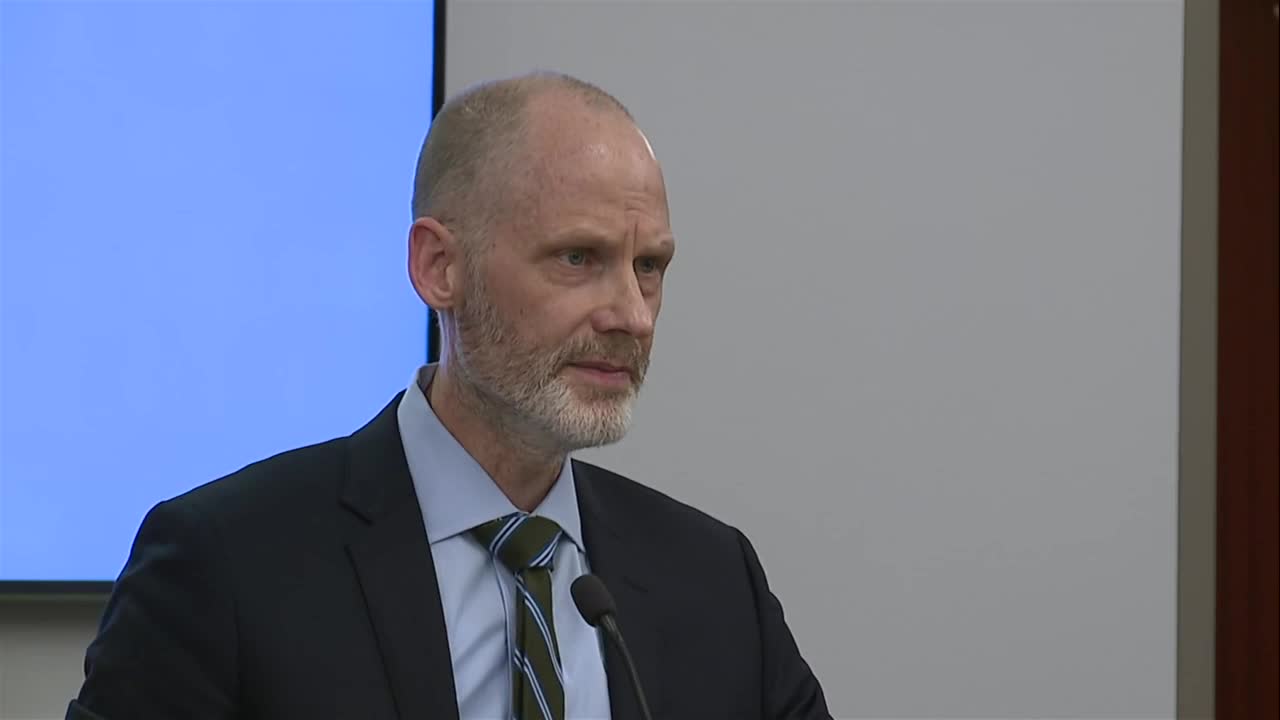
Witness Saami Shaibani testifies Thursday about tests he did on staircase falls.

DURHAM, N.C. — Data from five women who volunteered to fall backward down a mock stairwell dispel the theory that Kathleen Peterson fell to her death, an expert testified Thursday.

"It doesn't add up," said Saami Shaibani, an injury mechanism analyst.  "The human body doesn't behave this way."

Shaibani, brought in for the state's rebuttal case against novelist Michael Peterson, rounded up women similar in height and weight to Peterson's wife, who was about 62 inches tall and 120 pounds when she died.

"I wanted to compare apples with apples.  I wanted the same height, give or take a few inches, and the same weight, give or take a few pounds," said the expert.

Though Shaibani came under attack from Michael Peterson's defense team over his academic credentials (and will likely face additional scrutiny on Friday) his testimony refutes the defense contention that Peterson died from a fall. The prosecution's theory is that Michael Peterson bludgeoned his wife of five years to death on Dec. 9, 2001, possibly with a fireplace "blow poke" or similar instrument.

Peterson, 59, who could spend life in prison if convicted, says he was out by the pool when his wife fell to her death.

Shaibani's first test was to determine whether it was possible for the victim to have hit the a strip of ridged molding on the doorway leading to the stairwell, as the defense has suggested in a computer animation created by its injury expert.

Shaibani asked each of his volunteers to fall backward from different levels in the stairway and measured the height at which they would have contacted the doorjamb (They weren't actually allowed to hit it.)

According to his test results, no matter which stair they started to fall back from, the point on the doorjam they would have struck was higher than the blood markings the defense has singled out as the site of the victim's first impact. 

"She could not have contacted it at that point or any point below," said Shaibani, referring to the impact site Peterson's defense has suggested.  "It would have had to have been substantially higher," he said.

Shaibani argued that his tests with real people were more accurate than the computer simulation presented by the defense.

Shaibani also examined whether it would have been possible for Peterson to have ended up in the contorted position in which she was found.

"As we did these tests, something just didn't add up," said the expert, pointing to a photograph of one of his volunteers in the bottom of the mock stairwell.

"This was an unnatural position. The body could not end up here under any normal or reasonable circumstances."

At times, the British native's attempts at levity left jurors — who laughed heartily last week at forensic scientist Henry Lee's numerous asides — stone-faced.

Explaining the physics of a 35 mph rear-end accident, for example, Shaibani grinned and drily added, "Don't try that at home, by the way." No one laughed.

The expert did draw some snickers, perhaps unintentionally, when he explained that the problem with using a cadaver in an injury experiment is that "it's a dead person."

Throughout Shaibani's testimony, Peterson's defense lawyer, David Rudolf, sat reclined in his chair, staring at the jury with raised eyebrows, nonplussed.

Earlier Thursday, the lawyer said he had a good faith basis to argue that Shaibani had fabricated at least some of his academic credentials, but reserved the brunt of his questioning until Friday.

Still, when Rudolf asked Shaibani to demonstrate how the blow poke might have been used in an assault, the tension was palpable when the expert became playfully aggressive.

Saami Shaibani, left, demonstrates a blow poke on defense attorney David Rudolf.


"You want to be a volunteer, sir?" Shaibani said to Rudolf, brandishing the blow poke. "I can whack you and then finish you off on the stairs."

During his redirect testimony Thursday morning, Duke University injury biomechanics expert James McElhaney maintained that Peterson's injuries were inconsistent with a stairway fall.

"Two of those lacerations in that scenario [a fall] would be different than the ones that she suffered ... because the impact positions would be different," he said.  "In my opinion, the point of contact doesn't coincide with the three or four lacerations near the top of her head."

McElhaney, who is working for the prosecution for free, analyzed 15 impact sites and 33 places of bruises or abrasions or lacerations on Kathleen Peterson's body to reach his conclusion.

On Friday, jurors will pose for photographs in the courtroom, and will snap pictures of Judge Orlando Hudson Jr. and both legal teams as well.  As one juror noted Thursday morning, "we've all spent a considerable amount of time on this case."

Peterson's trial, which is being broadcast live by Court TV, will resume Friday at 9:30 a.m.


Full coverage


advertisement


Contact us
©2007 Turner Entertainment Digital Network, Inc. A Time Warner Company. All Rights Reserved.
CourtTV.com is a part of the Turner Entertainment New Media Network.
Terms & Privacy Guidelines