

By Emanuella Grinberg Court TV
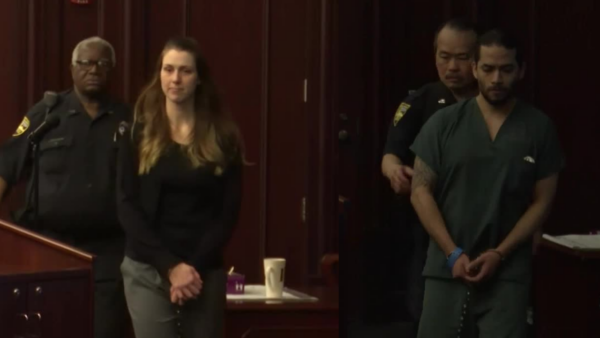
The Michigan Attorney General's office closed its case for first-degree murder against a confessed serial killer by calling three women who narrowly escaped death at his hands 22 years ago. Coral Eugene Watts faces a mandatory life sentence without the possibility of parole in the murder of Helen Dutcher in 1979. The three Houston women were subpoenaed to recount the gruesome details of their harrowing experiences with Watts in 1982. Between sobs, Julia Hernandez recalled Watts' laughter as he left for her dead after slashing her neck open on the side of a freeway.
Melinda Aguilar, who was 18 when Watts broke into her apartment, recalled how he prattled with glee at the prospect of executing both her and her roommate, Lori Lister. In 1982, Watts was captured outside the young women's apartment complex as he tried to flee the scene. Soon after that, he admitted to the attacks and 12 other murders in a plea deal with Texas authorities, who didn't have enough evidence to charge him for the crimes. Since then, he has been in prison on lesser charges. He has been facing release in 2006 after receiving credit for good behavior. With his impending release, authorities sought to link him to other crimes for which he had not received immunity. Watts was implicated in Dutcher's slaying by a single eyewitness who watched the incident from his back porch about 80 feet away. Joseph Foy testified earlier in the trial that in January 2004 he saw Watts' mug shot on MSNBC's "The Abrams Report" and immediately recognized him as "that man who stabbed that woman behind my home." Foy's testimony and Watts' prior confessions make up the state's case against Watts, who, at the time of the plea deal, indicated he was responsible for at least 40 more murders, but would not provide details when police refused to grant him immunity for them. Circuit Judge Richard Kuhn allowed details from Watts' prior acts into evidence to establish a motive and common plan for how Watts targeted his victims. "You must not use the evidence to decide the defendant is a bad person," Kuhn warned the jury before they heard the testimony. Methods of a killer Hernandez, a NASA employee, testified she was changing a tire on a Houston freeway on Jan. 17, 1982, when Watts came up behind her and thrust a knife into the left side of her throat, slicing her neck open. "I could hear his breath right on my ears when he cut me," Hernandez said as she demonstrated the slicing motion on Assistant State Attorney Tom Cameron. She escaped his grasp for a second, she testified, until he grabbed her again and smashed her face against the car. "I could feel him pushing my nose all the way inside my face," she testified, sobbing heavily. He went on to slash her once more in the groin area, she testified, and in the back, although the cuts were absorbed by the multiple layers of clothes she was wearing. At the defense table, Watts appeared disengaged from her testimony, barely looking up from what he was reading. The attack Hernandez described bore certain similarities to the assault 36-year-old Helen Dutcher died from on Dec. 1, 1979. Dutcher was stabbed at least 12 times in the face, neck and chest in a deserted lot near 8-Mile Road, a strip made famous by rapper Eminem. Testimony from former roommates Lori Lister and Melinda Aguilar provided further insight into Watts' methods. Lister testified with nervous laughter that she was coming home from a late night out when Watts ambushed her from behind at her front door, choking her unconscious before dragging her to her second-floor apartment. Aguilar, her roommate, was getting ready for church when Watts unlocked the door to her apartment with her roommate's keys. As he choked her to the ground, she pretended to faint and he dragged her to her bedroom. As he presumably prepared to drown the roommates by filling up their bathtub with scalding water and binding them with wire hangers, Aguilar said she heard Watts jump up and down and clap gleefully. "He made a little remark that this was going to be fun, this was exciting, and I knew at that point he was enjoying what he was doing," she testified. At that point, Aguilar crept outside to the balcony and jumped two stories headfirst. She survived and alerted authorities. Watts' lawyer, Ronald Kaplovitz, had little to say to the witnesses except to ask their occupations and to commend Aguilar for her bravery. A litany of deaths Assistant Attorney General Donna Pendergast also called the three detectives who took Watts' confessions in 1982 and accompanied him to the locations of his murders. Pendergast led the detectives through a litany of each victim's manner of death. From the deaths of Elizabeth Montgomery and Susan Wolf, which occurred within two hours of each other on Sept 13, 1981, in Houston, to that of Jeanne Clyne, whom Watts claimed to stab with a screwdriver in the chest one month before Dutcher's murder, common factors emerged. He would cruise around in his Pontiac 1978 Grand Prix and scope out lone victims to follow to their homes, targeting young, petite, white women. He would come upon them from behind and deliver multiple stab wounds primarily to the left sides of their bodies. He killed Michelle Midday and placed her in her bathtub "to keep her spirit from getting away," retired Houston Police Detective Thomas Ladd testified. Watts buried his lone black victim after fatally stabbing her. "She fought him so hard ... he said he buried her deep to prevent her spirit from getting out," Ladd testified. Phyllis Tam, who was a little larger than the rest of his victims, was found on Jan. 4, 1982, hanging by her tube top from the branch of a bush. She died from strangulation. "Did he know any of them?" Pendergast asked Ladd. "Were there any signs of sexual assault?" "No," Ladd responded to both questions. "He said he could see evil in their eyes and that was how he picked his victims." The defense will open its case Tuesday. The trial is being aired live on Court TV.
|