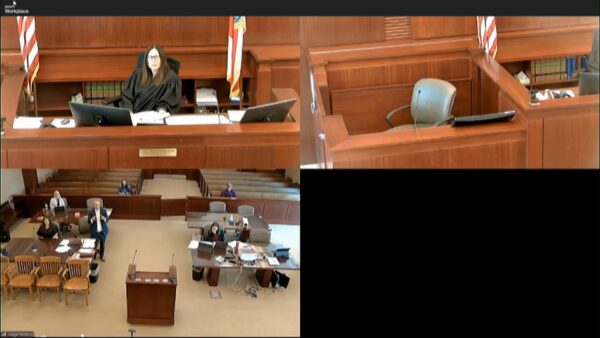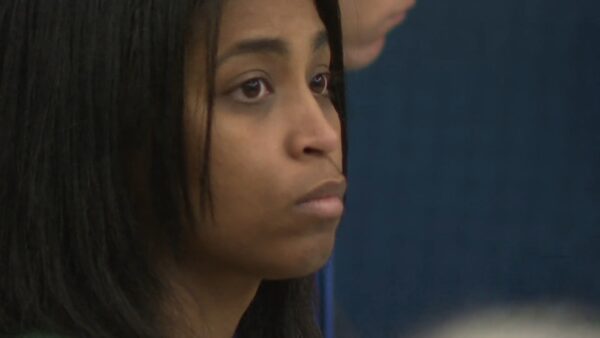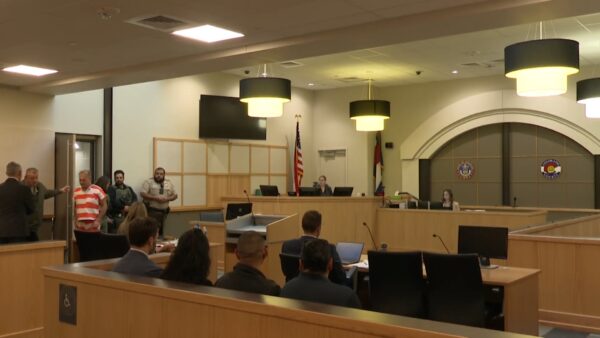

TALLAHASSEE, Fla. (Court TV) — A Florida appeals court has overturned a babysitter’s murder conviction, ruling the trial judge gave the jury faulty instructions.
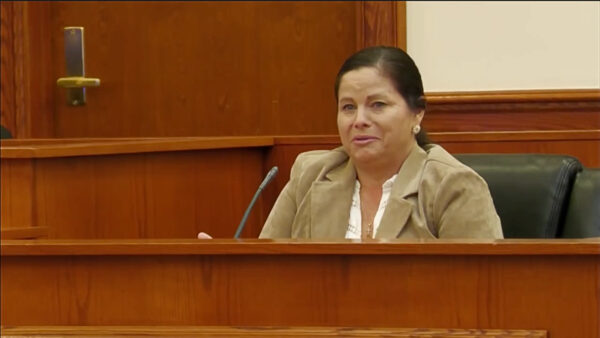
Rhonda Jewell testified at her 2024 trial. (Law&Crime)
Rhonda Jewell, 49, stood trial on charges of manslaughter, felony murder and leaving a child unattended in a motor vehicle. At her 2024 trial, the jury acquitted her of manslaughter but convicted her of felony murder and leaving a child unattended; she was sentenced to 17 years in prison.
Jewell admitted her role in the death of the 10-month-old girl she was hired to watch, but said that she never intended to hurt the child. She cried as she testified at her trial — livestreamed by Law&Crime — describing the moment she found the lifeless infant.
On July 19, 2023, Jewell agreed to watch the 10-month-old, identified in court as “A.P.,” and three children from another family. Jewell picked A.P. up from the infant’s mother, then drove to the other family’s home, where she planned to care for all four children together. But when she arrived at the home, she got out of the car with only her phone, a cup and a snack, leaving A.P. in her car seat in the backseat.
Five hours later, when A.P.’s mother arrived to pick her up, Jewell became upset and ran to her vehicle, where the 10-month-old was found lifeless and hyperthermic. In a police interview, Jewell said she “assumed [the baby] was asleep” when she arrived at the home and “I forgot she was there.”
Prosecutors charged Jewell with leaving a child unattended in a vehicle — a crime that was a noncriminal traffic offense until 2007, when the Legislature raised the penalty to a misdemeanor or felony. A subsection of the law makes the crime a felony when the victim suffers injury. In his opinion overturning the conviction, Judge L. Clayton Roberts of Florida’s First District Court of Appeal agreed with Jewell’s attorneys, who argued the change in law required a mens rea element, meaning the state had to prove the defendant “consciously or knowingly left the child.” Roberts wrote that “this reading is problematic, because it allows for a conviction without any conscious action.”
At trial, Jewell’s attorney requested an instruction for the jury telling them they needed to find that the defendant “knowingly, willfully and consciously left the child.” After the trial judge denied that request, jurors needed to find only that the victim was under 6, was in the defendant’s care, was left alone in the car for more than 15 minutes and suffered great bodily harm.
The felony murder count was predicated on the charge of leaving a child unattended, so overturning that conviction also toppled the felony murder conviction. “To be clear, it was a fallacy to charge [Jewell] with third-degree felony murder based on what the State believed was an underlying felony that did not require it to prove any intent,” Roberts wrote. “Third-degree felony murder cannot be based on an unenumerated predicate felony that does not require any proof of intent.”
The nonprofit organization Kids and Car Safety filed an amicus brief on the defendant’s behalf, arguing that “strict criminal punishment for unintentional car deaths is an ineffective deterrent.”
Roberts remanded the case to the lower court, instructing it to retry Jewell on the charge of leaving A.P. in a vehicle unattended “before a jury properly instructed on the statute.”