Updated February 24, 1999, 3:35 p.m. ET
Behind the badge with your hand on the trigger: Our reporters try out the NYPD's crisis simulator.
 |
Can a regular citizen ever really know what it's like to be a police officer equipped with deadly force in a crisis? (AP Photo) |
By Andrew Brooks and Harriet Ryan
Court TV
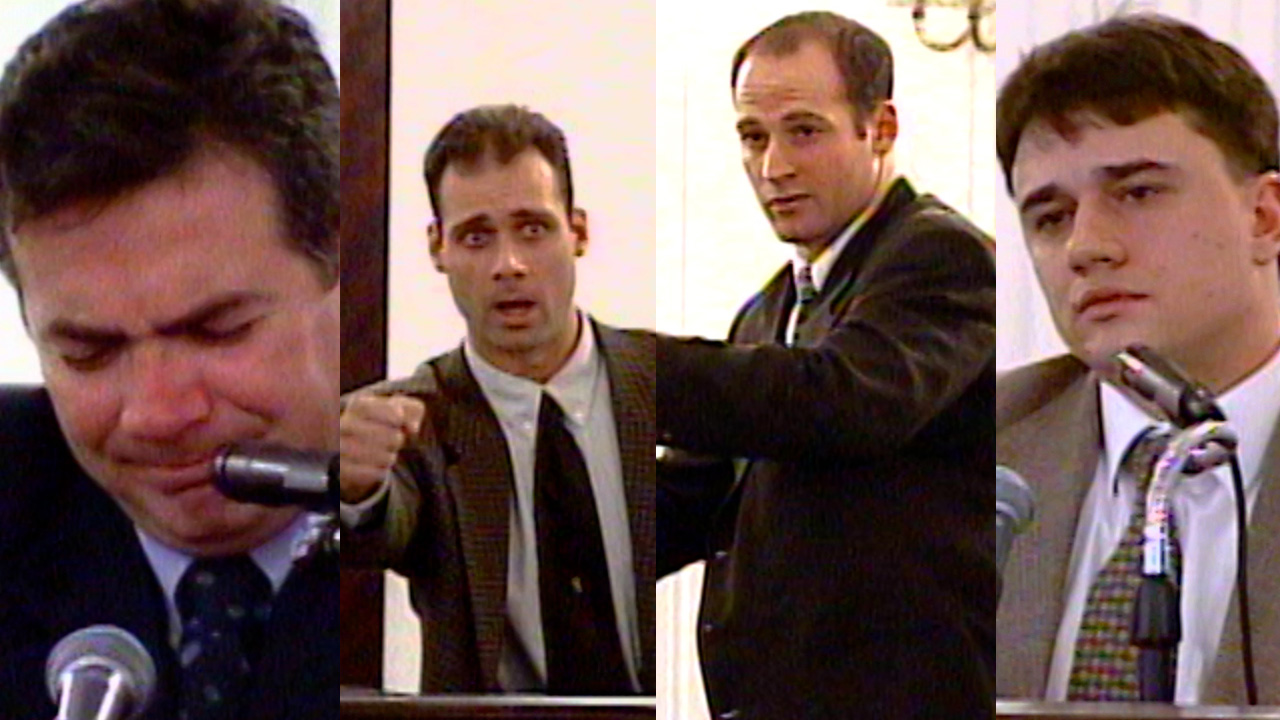
Late night. Tough neighborhood. Uncooperative citizen. We know what the four officers did. What would you have done? It's the fundamental question in the Diallo case. What's it like to be on the other side of the badge, holding a gun? We can only guess.
But now, thanks to a marvel of modern technology known as the firearms simulator, there is a way to do more than guess. These computerized programs, part of weapons training for many police departments, use technology to simulate potentially dangerous situations. Trainees, armed with interactive guns, must make a split-second decision whether or not to fire their weapons.
In New York, where cops train on the simulator twice a year, one of the machines is open to the public. Last week, when the Diallo trial was in recess, two courttv.com reporters went to the New York City Police Museum, a nonprofit organization staffed by the NYPD, to try out a simulator. We wanted to find out what it's like to be cop with a gun in a crisis.
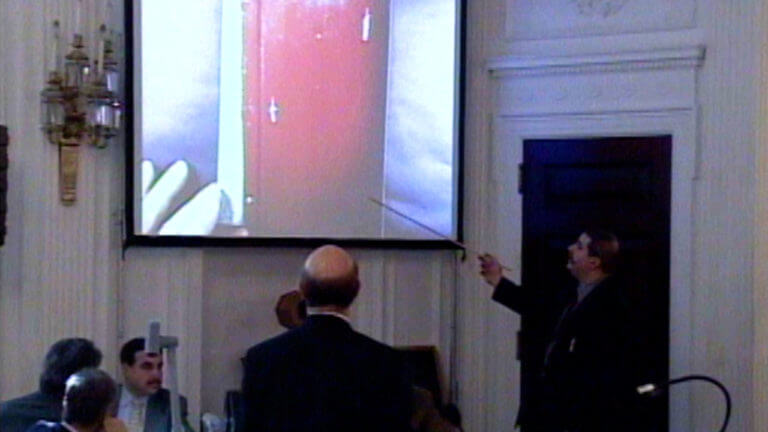
The FATS, or firearms training simulator, stands in the rear of the museum behind a heavy curtain. The simulator area is a dark, rectangular room about the size of a small classroom. A projection screen about 10 feet wide stretches the height of the far wall. Two Glock semiautomatic handguns lie on two small tables in front of the screen. Wires run from the base of the guns to a large computer along the right wall operated by a uniformed officer.
On the morning we visit, the museum on lower Broadway is nearly empty save for a pair of tourists who turn out to be a small-town Kansas cop and his wife. They are also eager to try out the simulator, and the four of us step behind the curtain. About a half dozen NYPD officers who work at the museum gather at the back of the simulator to watch us.
The Kansas cop volunteers to go first. He steps forward, and picks up the Glock. The officer behind the simulator punches a few buttons and the screen jumps to life. The first scenario is beginning.
Scenario 1:
The camera bounds up a set of stairs and a hand knocks on a door. The door opens and we move into the apartment. Two hysterical teens are cowering in a living room. They scream something at us and point to the bedroom. It's hard to understand just what they are saying, but we make out "he's killing her" or "he'll kill her."
A female officer comes into view and begins talking to us. Apparently, she's our partner. She leads us down a hall in the direction the teens pointed. The door opens into a bedroom.
On a large bed, a man is wrestling with a woman. He shouts at her in a belligerent tone. She screams for help. They tussle for a second before he notices us standing in the door. Our partner moves forward brandishing pepper spray and telling the man to let go of the woman.
The man grabs at our partner, and they scuffle. Suddenly, the Kansas cop aims the Glock at the man and fires repeatedly. The man on the screen looks up, reaches into his waistband and pulls out a handgun. He begins firing at us.
The action on the screen freezes. The scenario is over.
"Why did you shoot at first?" one of the officers asks the Kansan.
"He was going for her gun," he answers. They murmur approvingly. On the screen, the final seconds of the scenario are replaying frame by frame. Red circles pop up on the screen to show the time and location of each shot the Kansan fired. The officer behind the computer says that his first shots were not fatal and allowed the perpetrator to get off several shots at us and the woman.
The NYPD cops and the Kansan were veterans of the simulator, but for us civilians, using FATS for the first time, the experience was unnerving. All the action a beating and at least one shooting death occurred in a few seconds. In daily civilian life, even the smallest decision gets more thought.
Things happened so fast, in fact, that neither of us realized what the Kansan had seen clearly: The perpetrator was reaching for our partner's gun. On the replay, it was obvious, but during the scenario, we were distracted by the many moving parts of the crisis. The teenagers were crying, the man was attacking a woman, our partner was shouting. The Kansan wasn't distracted. He knew to focus on the gun.
As we were recovering, the officer cued the second scenario.
Scenario 2:
We are told that neighbors report a drugged man carrying a baby. He has dropped the baby several times.
The scene opens in a wide alley. A drunken-looking man carrying an infant stumbles about, muttering to himself.
"Stop! Police!" courttv.com reporter Andy Brooks yells at the screen.
The man begins wobbling towards us, still carrying the baby and shouting. At about 10 feet away, he pulls a long brown object from behind the baby. Andy picks up the Glock and aims it at the man who shields his body with the baby. He continues lumbering toward us, waving the long brown object. By the time we have recognized it as a machete, he is on top of us. The scenario is over, and as the officers in the rear point out, "you're dead."
There was no need to watch a replay. We hadn't fired a single shot. The simulator room was silent for a moment.
"Why didn't you shoot?" one of the officers asked finally.
We hesitated.
"I didn't want to hit the baby by mistake," Andy told them.
"What do you think he's going to do now?" an officer said, gesturing to the screen. "He killed you and now he's going to kill the baby."

|
New York Police Department cops train on the simulator twice a year.
|
We stood there shocked. The man had a knife. Were we to kill him with a gun? Wasn't there any middle ground? What about our night stick or pepper spray? The simulator didn't give us those alternatives. It was use a gun or die.
We cornered one of the cops after the scenario and pressed him further on the machete scene. Possibly we could have avoided shooting the drunk by running away and getting a better position, we suggested to him. The cop smiled.
"You're missing the point of our job. When everyone else is running away from trouble, we're running toward it," he said.
Scenario 3:
This is a traffic stop, the officer at the simulator tells us. Andy and the Kansan each pick up a gun. A bright, sunny day pops up on the screen. We are looking through the front window of a police cruiser at a minivan which we have apparently stopped for a traffic infraction.
Our partner exits the cruiser and approaches the van. He tells the driver to stay in the car. As he is doing so, the van begins to reverse and strikes our partner, throwing him to the ground. As we climb out of the cruiser, a man jumps out of the van, shouting "I'm sorry, I'm sorry" in an agitated voice. The Kansas cop fires a single shot at him, but the scenario continues. The driver hurries toward us holding his hands aloft and apologizing.
Suddenly, he reaches behind his back with one hand. As soon as he does, the Kansan begins unloading his weapon. A split second later, we can see that the driver is pulling a handgun from behind his back. He fires at us.
Andy points the Glock at the driver and squeezes off four shots. The scenario ends.
Scenario 4:
"Take a look at this one," the officer behind the simulator tells us. "You don't have to shoot. Just watch."
She keys up the machine and it begins playing the traffic stop scenario again. The van stops, reverses, hits our partner, and the driver jumps out apologizing. Once again, the man reaches behind him. This time, however, what he pulls out is not a gun but a wallet.
No one in the room mentioned the Diallo shooting, but the parallels were clear and the tension was high. According to the simulator, it was possible, but extremely difficult to tell the difference between a killer and a regular citizen.
The scenario asked the question: when is it appropriate to shoot, and there were numerous answers in the room. The Kansan, for example, killed the driver as soon as he exited the car and before he reached for a gun or wallet or even lowered his hands from a surrender position. Watching the replay, he acknowledged that he had fired too soon. But one of the bystanding officers reminded him that the man had reversed his vehicle into the partner. Another officer, however, countered that nervous motorists, in a rush to be cooperative, often put their cars in reverse instead of park.
All the cops agreed that when the man put his hand behind his back, it was time to shoot. He had already hit our partner, jumped out of the van, and rushed toward us. The speed at which he reached behind indicated a gun, not a wallet, and if an officer waited until he saw the actual weapon, he might be shot, they argued.
What if he was reaching for a wallet? Well, in the cops' minds, he wasn't supposed to do that. He was told to stay in the car and to put his hands in the air. When he violated those orders, he lost his right to be innocent.
What we discovered was that while technology might let us step into the shoes of cops in life-and-death situations, the computer isn't advanced enough to allow us into their minds. Cops are different from the rest of us. Maybe it's the training, maybe it's the reality of police work, but they definitely live in a world apart.
Time after time our reaction to a computer situation was entirely at odds with the men and women in blue who gathered in the simulator room to watch us. We stammered to explain why we had hesitated to shoot or why we had squeezed off a few rounds, and time after time, the officers shook their heads. They were polite, but it was clear that in their opinion, we just didn't get it.
Their mind set, "copland" as one officer called it, is both a logical
and scary place. In it, we are all potential killers and they are all potential
victims. Protect your life, protect your partner and you go home safe. Think
too much, waiver at all, and you die.
Editor's Note: On Feb. 16, Court TV Online requested permission from the New York Police Department to interview museum staff and to film the simulator in use. Despite a dozen follow-up telephone calls, the department's public information office has yet to respond. We have also been told that several other news organizations have made similar requests to the NYPD, and have had similar results.
|