
PLYMOUTH, Mass. (Court TV) — Doctors who treated Lindsay Clancy and her three young children testified in court on Monday as the emotionally fraught case entered its second week.

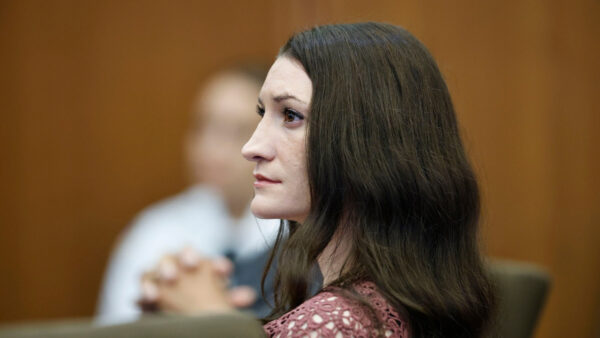
Lindsay Clancy sits in court on Aug. 3, 2026. (Court TV)
Clancy, 35, has pleaded not guilty to charges she murdered her three young children — Cora, 5, Dawson, 3, and Callan, 8 months. Clancy does not deny that she killed the victims, but has argued through her attorney that she was suffering from postpartum psychosis and is not legally responsible for her actions.
Prosecutors opened the second week of trial by focusing on the injuries the children suffered. Dr. Michael Snyder, who treated Cora, said the young girl was blue, with bruising to her neck, petechiae around her eyes and blood coming from her nose. After trying to revive her for 30 minutes, emergency room doctors pronounced Cora dead.
Medics flew Callan to Boston Children’s Hospital’s emergency room after doctors were initially able to get his heart beating again. “He was cold on arrival, and he was quite limp, was not making any purposeful movements on his own,” Dr. Andrew Capraro said on Monday. “His pupils were fixed and dilated and he had ligature marks around his neck with some swelling of the neck.”
Capraro said Callan’s brain had swelled to the point that it had “overwhelmed the capacity of the skull” and was herniating through its base. While the infant’s heart began to beat on its own, Callan was never able to recover. Doctors determined he was brain-dead and removed him from life support on Jan. 27, three days after he was first admitted.
Doctors and nurses who treated Clancy said that she was unresponsive when she arrived at the hospital. Though she was breathing on her own, doctors intubated her to protect her airway. Clancy was ultimately transferred from South Shore Hospital to Brigham and Women’s Hospital, where she was admitted to the intensive care unit. While there, nurse Rachelle Amede said the defendant nearly died after going into cardiac arrest. Doctors performed CPR and started a “massive blood transfusion protocol,” which saved her life.
By Jan. 28, Clancy was awake and alert, but unable to speak because of a breathing tube. She communicated with a whiteboard, telling Amede that she was confused and couldn’t feel her legs. Amede described Clancy as cooperative but with a flat affect. On Feb. 2, Amede noted in the defendant’s chart that she had asked to speak with her attorney. “That was the first time she referred to anything going on with the case,” Amede said.
Psychiatrist Sejal Shah treated Clancy while she was at Brigham and Women’s. By Jan. 29, Clancy had asked to change her healthcare proxy. “She was saying that her parents are quite supportive to her and that she was thinking that she would have to change her healthcare proxy from her husband to somebody else,” Shah said. “We didn’t necessarily go into the reasons as to, you know, why she would have to change it.”
By the end of February, Clancy was getting ready to be discharged to a rehabilitation hospital. In her notes from the time, Shah wrote, “The patient reported feeling down about her current situation, her paralysis, and the events leading up to her hospitalization,” but said, “Her thoughts about what she had done were not constant throughout the day.”
Prosecutors have told the jury that Clancy was sane when she killed her children and suggested in opening statements that the defendant hadn’t truly intended to take her own life when she cut her neck and wrists and jumped from a second-story window of the family’s home. Clancy’s attorney, Kevin Reddington, has countered that Clancy suffered severe and permanent damage from her suicide attempt.