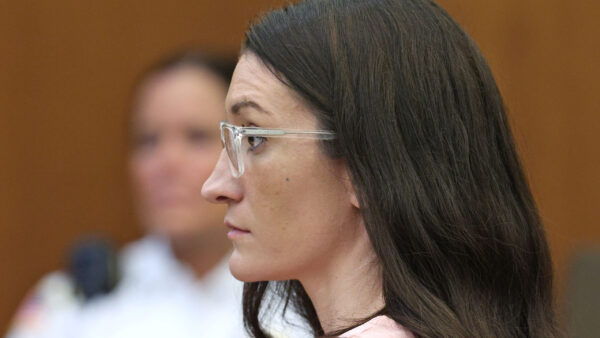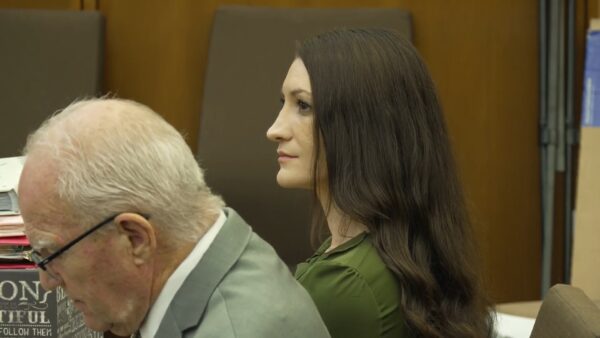

PLYMOUTH, Mass. (Court TV) — Tensions rose on Wednesday in a Massachusetts courtroom as Lindsay Clancy‘s defense attorney pressed the state’s final expert during cross-examination.

Lindsay Clancy appears in court on Aug. 26, 2026. (Court TV)
Clancy, 36, has admitted that she strangled her three young children — Cora, 5, Dawson, 3, and Callan, 8 months — with exercise bands in the family’s Duxbury home; she has pleaded not guilty to charges she murdered the children, arguing that she was not criminally responsible because she was suffering from postpartum psychosis.
Psychiatrist Gregory Saathoff was the final witness to testify in Clancy’s murder trial; Saathoff, who is affiliated with the FBI’s Behavioral Analysis Unit, was hired as an expert by prosecutors who have argued that Clancy was legally competent when she killed her children.
“I believe Lindsay Clancy was suffering from a mental disease or defect,” Saathoff testified, but clarified, “my opinion is that she did have the capacity to appreciate right from wrong.” He said his reasoning was partly based on the fact that the “voices” Clancy reported hearing were addressed by lorazepam, which led Saathoff to conclude the phenomenon was not a hallucination but an internal thought.
Saathoff cited Clancy’s alleged planning as evidence of her sanity, pointing to the internet searches the defendant did before sending her husband to pick up food and run an errand on Jan. 24, 2023. While he was out of the house, she killed her children.
“Timing was really, really significant in this,” Saathoff said. “There was a window of time that Ms. Clancy was aware of in which she would need to kill her three children as well as to kill herself, which she expected would happen. She was conscious of time and told me that she had mapped out the distance, et cetera, because she didn’t want her husband to be gone too long. But in this case, I think the issue of time and her husband returning, rather than being a solution for her, was a problem. To accomplish all of this in the course of that amount of time that Mr. Clancy was gone was significant; it really showed an awareness of time.”
Especially important for Saathoff was a phone call that Clancy placed. Her husband called her at 5:33 p.m.; when she missed it, she called him back at 5:34 p.m. “When she received the phone call from her husband, she did not report to him that she was in distress, that she was having hallucinations, that she needed help,” Saathoff said. “With that phone, by calling her husband back, and reassuring him by the fact that, yes she knew the medication, wherever, that helped guarantee that he would continue on the errands. Had she not called him back, it would likely — it certainly was possible that he would be concerned enough that he would return home. So I think the phone figures in just in terms of her awareness and confirming her behavior, such that the strangling of her children could be concealed.”
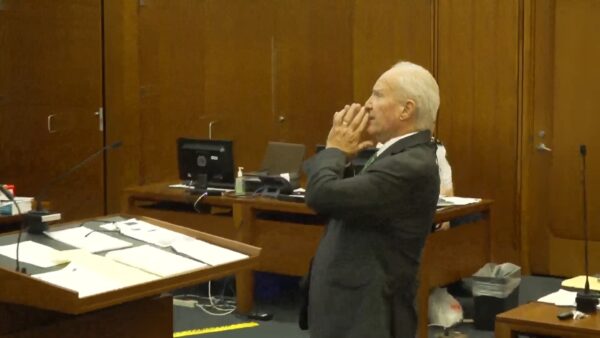
Kevin Reddington grows frustrated in court on Aug. 26, 2026. (Court TV)
“Have you ever treated a woman suffering from postpartum psychosis?” Clancy’s attorney, Kevin Reddington, asked during cross-examination. “In the late 1980s and also during the 1990s when I ran a unit in a state hospital,” Saathoff said, agreeing that postpartum depression can escalate to postpartum psychosis rapidly.
Reddington questioned Saathoff’s conclusions, specifically his claim that Clancy had misled her family. Saathoff defended his findings, saying, “In text messages, for example, in the days prior to the event … the communications she was providing did not give a sense of her state of mind regarding suicidality.” “Are you kidding me?” a frustrated Reddington shot back.
Reddington also pressed Saathoff about why the doctor had never interviewed Clancy’s mother as part of his investigation.
Saathoff: “I contacted the district attorney, and I—”
Reddington: “Which one? Which one of the two?”
Saathoff: “Ms. Sprague.”
Reddington: “OK, you spoke to Jen Sprague, and what did you say to her?”
Jennifer Sprague: “Attorney Sprague.”
Reddington: “What is it?”
Sprague: “Attorney Sprague.”
Reddington (turning back to witness): “You spoke to Jen Sprague —”
Judge William Sullivan: “Attorney Sprague.”
Law&Crime’s Sierra Gillespie was inside the courtroom when the testy exchange happened. She noticed that moments later, when Saathoff referenced “Ms. Sprague,” and Reddington corrected him, “Attorney Sprague,” the jurors were visibly stifling laughter.
Saathoff was the final witness in Clancy’s murder trial; the jury was dismissed after he left the stand.
The jury will return to hear closing arguments on Thursday morning.