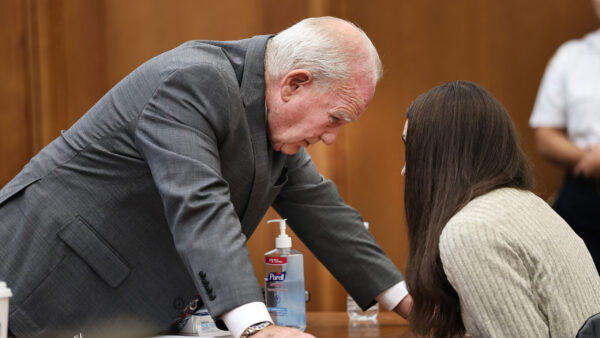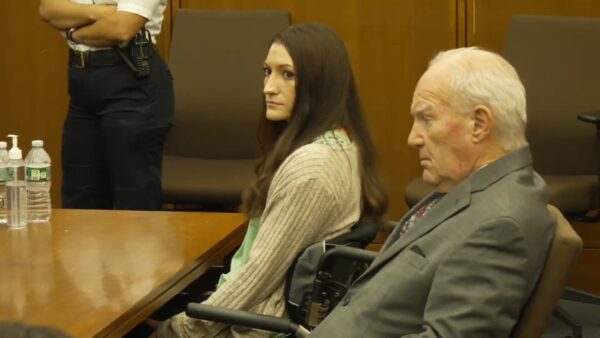

PLYMOUTH, Mass. (Court TV) — Lindsay Clancy‘s attorney grew frustrated with the judge presiding over her case on Friday morning when he refused to conduct an inquiry into a juror who is accused of refusing to deliberate properly.
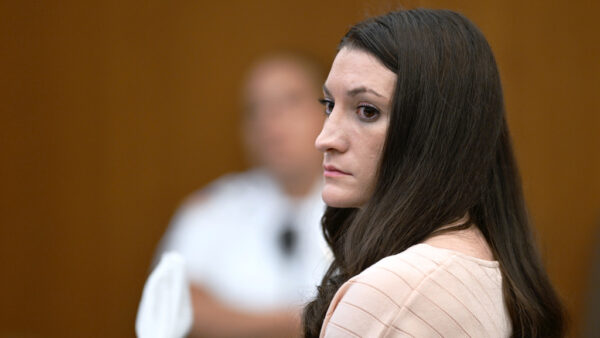
Lindsay Clancy sits in court on Aug. 13, 2026. (Josh Reynolds/AP/Pool)
Clancy, 36, has pleaded not guilty to three counts of murder in the deaths of her young children. She has admitted strangling Cora, 5, Dawson, 3, and Callan, 8 months, in the basement of their family’s home, but has said that she was suffering from postpartum psychosis at the time and not legally responsible for her behavior.
The jury has sent several notes to Judge William Sullivan saying that it is deadlocked; each time, Sullivan has sent them back to continue working. The third note, sent Thursday afternoon, was the most specific — it said the panel was voting 11-1 and that the single holdout juror had acknowledged doubt in the case but refused to apply it to the verdict.
On Thursday afternoon, Sullivan called each juror individually to sidebar and asked them whether they could follow the law as it was given to them. Satisfied with the responses, he read the instructions on reasonable doubt and sent them back for 20 more minutes of deliberation before dismissing them for the day.
On Friday morning, before the panel resumed deliberations, Clancy’s attorney, Kevin Reddington, asked for further inquiry into the holdout juror. Reddington told Sullivan the juror “looked you in the eye and lied,” referencing the juror’s claim that he would follow the law. “I have never seen a situation like this where a foreperson on the jury is so courageous as to speak on behalf of 11 jurors,” Reddington said. “You have not one, but two notes that clearly indicate that this individual has acknowledged doubt but refuses to apply it to the verdict.”
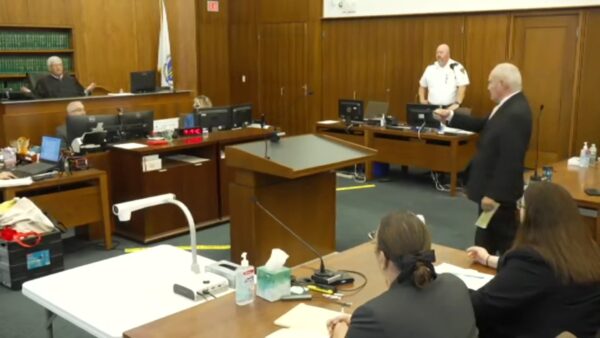
Kevin Reddington addresses Judge William Sullivan outside the presence of the jury on Sept. 4, 2026. (Court TV)
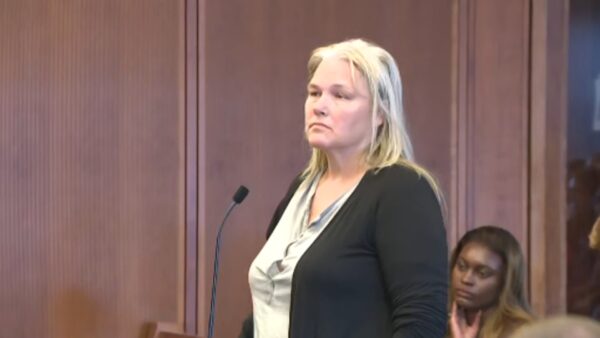
Prosecutor Jennifer Sprague argued there was no need for further inquiry. “The note does not indicate that this juror lied to Your Honor when responding,” she said. “The note indicates that the parties disagree on what is reasonable doubt or what doubt is and how it should be applied, and we are in no position to judge if the 11 are right or if the one is right, but there’s no indication that the juror is intentionally trying to mislead the court or lie to the court.”
Sullivan sided with prosecutors, saying he saw “no showing for an inquiry of this particular juror.”
Reddington objected and asked the judge to change how he gave the jury instructions that morning to address the issue.
Reddington: “I would ask that you not give them, as I described it yesterday, a soft inquiry. … I would ask that you specifically direct their attention to proof beyond a reasonable doubt and reinstruct them on that forcefully.”
Sullivan: “I think I did that yesterday, didn’t I?”
Reddington: “Yes, you did it yesterday. You did it soft. You didn’t do it forcefully.”
Sullivan: “What do you want me to do? Get a brass band? I read the instruction as written by the [Massachusetts Supreme Judicial Court]! The fact that perhaps I didn’t give it my full inflection, I’m sorry about that. I’m not an actor.”
Reddington pressed the matter, accusing Sullivan of “glossing over” the issue. Sullivan said, “I am specifically not glossing over this issue,” and pledged to “try and give [the instruction] with more pizzazz.”
The jury returned to deliberate after Sullivan gave the instruction.