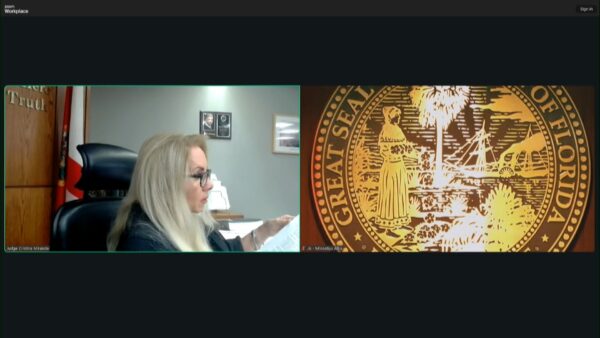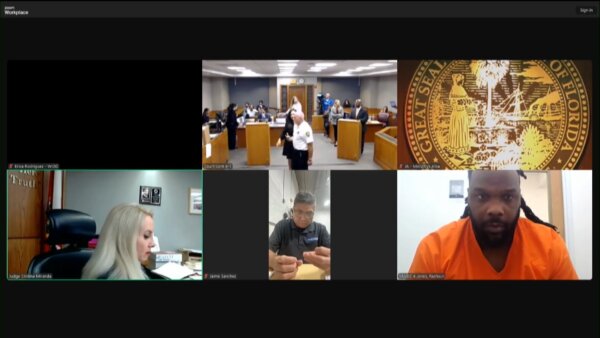

MIAMI (Court TV) — The murder trial for a former University of Miami football player will move forward with the same judge after she refused to recuse herself from the case at the defendant’s request.
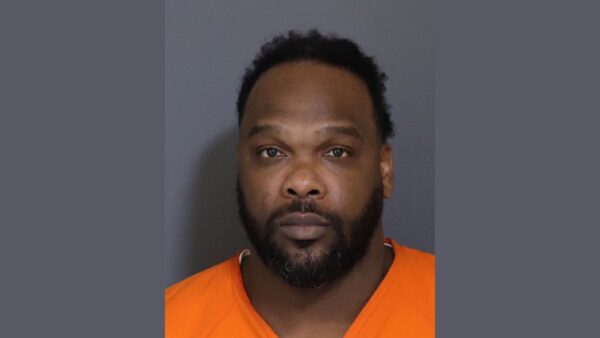
Rashaun Jones (Miami-Dade Department of Corrections and Rehabilitation)
Rashaun Jones, 41, has pleaded not guilty to a charge of first-degree murder in the death of Bryan Pata, 22, who was his teammate. Pata was fatally shot outside his Miami apartment on Nov. 7, 2006. Jones was arrested 15 years later and stood trial for the first time earlier this year; that trial ended in a mistrial when the jury deadlocked.
Jones’ retrial was scheduled to begin Sept. 14, but was delayed over defense objections. After a series of hearings that saw one of Jones’ attorneys thrown out of court and increasing tension between the defense and Judge Cristina Miranda, Jones filed a motion asking Miranda to recuse herself from the case.
“Mr. Jones fears that the Court’s expressed distrust of counsel will continue to prevent impartial consideration of his defense,” Jones’ attorney, Sara Alvarez, wrote in the motion.
Alvarez said the motion rested on three hearings held on Aug. 28, Sept. 3 and Sept. 8. At the Aug. 28 hearing, prosecutors raised concerns about an interview the defense team’s private investigator conducted with one of the witnesses in the case, suggesting the questioning interfered with their investigation. Alvarez testified in court that she knew the witness’s attorney was present during the interview, but declined to be sworn in to answer further questions about it. At that point, the court went into recess so that Alvarez could consult with counsel.
After that hearing, Alvarez and Jones’ other two defense attorneys hired a separate attorney, Jude Faccidomo, to represent them personally on the witness interview issue. Miranda said the attorneys’ decision to bring in their own counsel gave her “pause and concern,” and she added that it “would only happen in a situation where there might be some inappropriateness.”
Tensions escalated further on Sept. 3, when the parties returned to court, in part because Faccidomo was not present. Because Jones’ attorneys were represented by counsel, Miranda refused to allow the original attorneys to put anything on the record, even though the team wanted to say they were ready to proceed to trial. When one of his attorneys pressed the issue, the judge ordered her to leave the courtroom. Because of the issue with the defense attorneys, Miranda continued the trial to November and had the record reflect that the delay was by joint stipulation of the parties.
That delay prompted Jones to file a written objection, asking Miranda to take note of his desire to proceed to trial on the original Sept. 14 date.
On Sept. 8, Faccidomo appeared with Jones’ three attorneys and said Alvarez had been present when the witness was initially interviewed. “Mr. Faccidomo advised that the statement was properly obtained, explained that counsel sought his assistance because of the handling of the Aug. 28 inquiry,” Alvarez wrote in the motion. “The Court continued questioning and again stated that seeking personal representation gave it pause concerning possible misconduct.”
Alvarez’s motion said that Miranda characterized Jones’ written objection as “directly contravening its order precluding defense counsel from access to the record,” and asked Faccidomo if he was planning to adopt it, despite Faccidomo never entering a notice of appearance to represent Jones — only his attorneys. Faccidomo declined to adopt the motion and Miranda ordered it stricken from the record.
“The Court’s distrust of counsel has already affected Mr. Jones’ defense,” Alvarez wrote in the motion. “It repeatedly prohibited his attorneys from presenting his position and denied access to the record, attributed agreement and delay to him, and then treated his written objection as disobedience of a court order. Consequently, these actions have instilled a well-founded, firmly rooted, and objectively reasonable fear in Mr. Jones that he cannot receive a fair trial or impartial adjudication of this case before the presiding judge.”
This was Jones’ fourth attempt to have Miranda removed from his case. Jones filed the first motion to disqualify on Aug. 29, 2025, after Miranda warned the defendant during a colloquy that going to trial was a “very big gamble.” Miranda also encouraged Jones to accept a 15-year plea offer at that hearing and, according to the motion, “referred to the trial as a ‘circus’ and noted that all the attorneys were ‘going to get some notoriety on TV about it,’ and — immediately after the State identified the minimum mandatory as 25 years — told Mr. Jones directly: ‘That means I have to sentence you to life and that means life. That means you don’t get out. That means you come out in a pine box, that’s the only way out.'”
Jones filed another motion to disqualify following a May 7, 2026, hearing, after his attorneys said Miranda made “repeated on-the-record attacks on defense counsel’s honesty and characterized legitimate defense litigation as ‘game.'”
Miranda denied the motion to disqualify her without a written order.