
TAMPA, Fla. (Court TV) — A 74-year-old blind man who is facing trial for allegedly stabbing a woman in the jugular, chopping up her body and dumping the remains in a bay said Monday that he wanted to represent himself.
But on Tuesday, not only did Robert Kessler change his mind, he told a judge he preferred not to be in the courtroom at all.
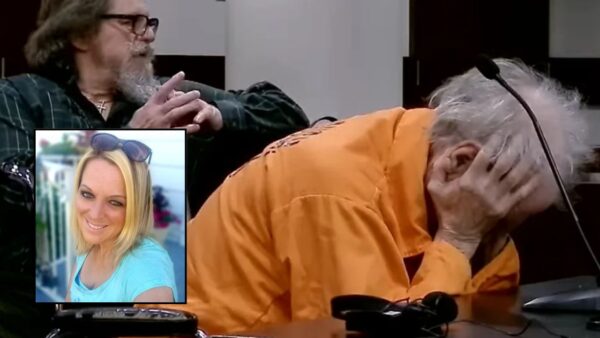
Background: Robert Kessler (Law&Crime). Inset: Stephanie Crone-Overholts (Tampa Police).
Kessler is accused of killing 47-year-old Stephanie Crone-Overholts in Tampa. Crone-Overholts moved into Kessler’s Tampa home in the fall of 2021. In early November of that year, Kessler allegedly stabbed her in the neck four times before he dismembered her body and placed the remains in garbage bags. He tossed the bags in McKay Bay, and fishermen later discovered them, police say.
Kessler on Monday told Circuit Judge Nick Nazaretian that he wanted to represent himself. The defendant also said he would change his plea in exchange for “a Philly cheesesteak, an order of fries and a 20-ounce Coke.” Nazaretian quickly rejected the request, saying it was “wrong in a thousand ways.”
As Tuesday’s proceedings began, Nazaretian asked if the defendant could look at him but Kessler looked and pointed in the wrong direction.
“You know where I’m at. You can hear my voice,” the judge said. “I appreciate you think I’m over there, but you can hear my voice. I’m relatively loud.”
After that was resolved, Kessler confirmed that he no longer wanted to represent himself and tossed the case back to his public defender, Maria Dunker.
Then, Kessler said he did not want to be in the courtroom at all.
Nazaretian told Kessler it was a “bad decision,” although the judge said he would inform jurors that they cannot use the defendant’s absence to determine his guilt or innocence. Nazaretian also warned that if Kessler was not in the courtroom, he would be unable to help his lawyer. The judge offered a hypothetical example of how Kessler’s absence could hurt him.
“Let’s say that a witness said, I’m making this up, ‘the car was blue,'” Nazaretian said. “And then the car actually, let’s say the car was red. And maybe Ms. Dunker didn’t know that. And by you not being here, you couldn’t tell her that, or you can’t give her any other suggestions or inside information that only you would know about because you’re, you’re at the jail or back in the lockup.”
Still, Kessler, who was sitting in a wheelchair, insisted he no longer wanted to be in the courtroom and a deputy rolled him out. The judge will ask Kessler via Zoom twice daily if he still wants to stay at the jail during his trial.
Assistant State Attorney Scott Harmon told jurors during opening statements that Kessler met Crone-Overholts in a McDonald’s parking lot about 10 days before her body was recovered. He saw that she had a Pennsylvania license plate and struck up a conversation with her because he grew up in the Keystone State. Crone-Overholts did not have a place to live, so Kessler offered to let her live with him.
For reasons not stated during openings, Kessler attacked her, according to Harmon.
“He stabbed her. Not once. Not twice. He stabbed her four times,” Harmon said. “He stabbed her in her neck.”
Crone-Overholts “fought for her life” but died, the state said. Then the defendant allegedly “abused and desecrated her body,” chopping her into at least seven pieces. He placed the remains in garbage bags, plastic bins and totes, according to Harmon. The defendant drove to a bridge and hurled the remains in the water below, according to Harmon.
A father and son were fishing in the area on Nov. 11, 2021, when they spotted something in the water. It turned out to be a floating leg. The leg had a distinctive tattoo with three hearts and the names of Sean, Greg and Zach — Crone-Overholts’ sons.
Authorities arrested Kessler after allegedly finding the victim’s blood in his home. Harmon said it’s clear that Kessler killed her.
“An absolute flood of evidence is going to pour into this courtroom, and the only thing that’s going to be floating at the end of this trial is the defendant,” Harmon said at the end of his opening statement. “He’ll be floating in a sea that stinks and reeks, with the evidence of his murderous guilt.”
Dunker, Kessler’s attorney, said in her opening that there was little evidence that showed how and when the victim died and nothing that showed the defendant was the actual killer.