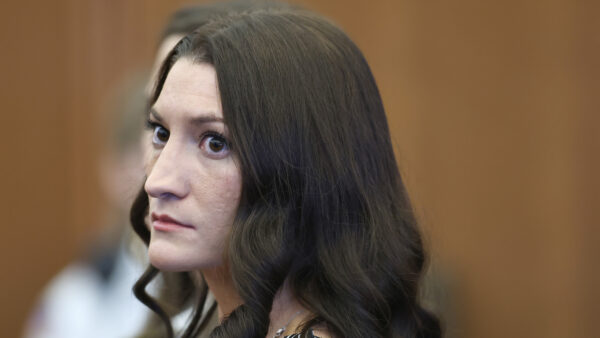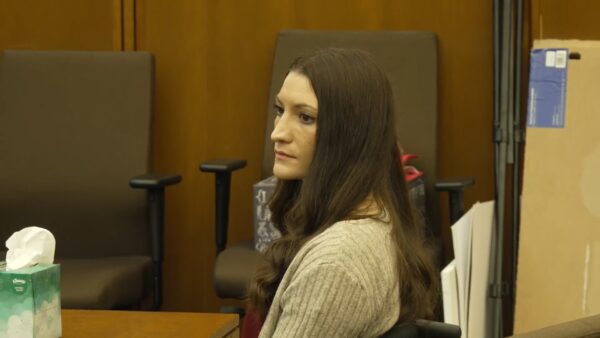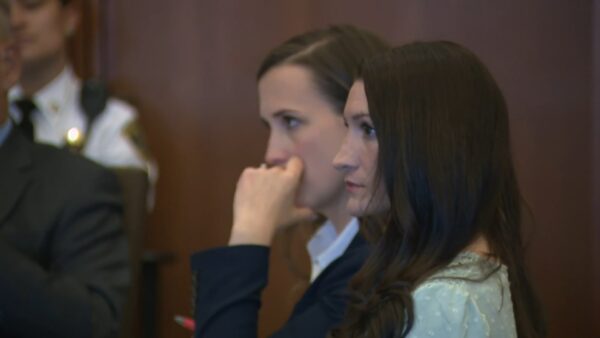

BOSTON (Court TV) — Two juror notes that preceded Lindsay Clancy’s mistrial are now public after her defense included them in its appeal to Massachusetts’ highest court, asking the justices to bar a retrial.
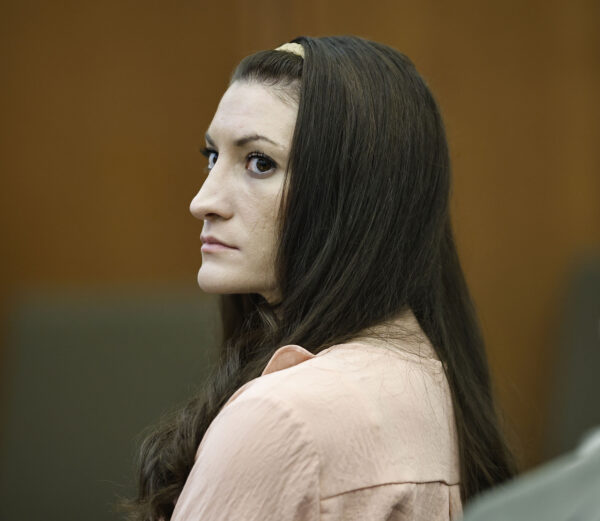
Lindsay Clancy sits in court on Aug. 25, 2026. (Court TV)
Clancy, 36, stood trial in August and September 2026 on three charges of first-degree murder in the deaths of her children. Cora, 5, Dawson, 3, and Callan, 8 months, were strangled to death in their family’s home with exercise bands. At her trial, Clancy’s attorney conceded that his client had killed her children but argued that she was not legally responsible because she was suffering from postpartum psychosis.
After weeks of testimony, the 12-person jury deliberated for days before Judge William Sullivan declared a mistrial. During those deliberations, the foreperson sent notes to the court asking for help and claiming that one of the jurors was refusing to follow the law. The jurors reported they were split 11-1, with the majority of the panel wanting to find Clancy not guilty by reason of insanity.
Clancy’s trial attorney, Kevin Reddington, had sought to prevent a mistrial by having the lone holdout juror removed, arguing that if they could not follow the law, they should not remain on the jury. Sullivan declined to do that after asking all 12 of the jurors whether they could abide by his instructions and each said that they could.
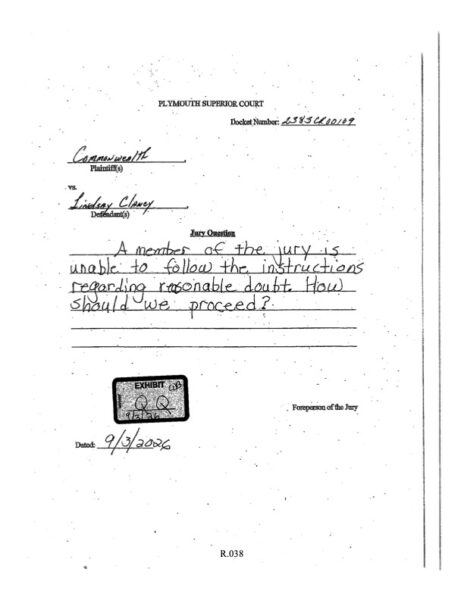
Handwritten juror note (court record)
Reddington challenged Sullivan’s decision, but the judge stood firm, finding that he had no choice but to declare a mistrial.
In an effort to stop Clancy’s retrial, Reddington and Clancy’s appellate attorneys filed another appeal on Nov. 16, 2026, to the Massachusetts Supreme Judicial Court (SJC), asking the justices to intervene and declare a retrial a violation of double jeopardy.
The new filing includes much of the court record as exhibits, including trial transcripts and the juror notes themselves, which had previously not been made part of the public court file.
The two handwritten notes contain no identifying information. The first note read, “A member of the jury is unable to follow the instructions regarding reasonable doubt. How should we proceed?”
The second note required redaction before it was included as part of the exhibit, because it identified the holdout juror by their number. “Juror [redacted] has made statements acknowledging doubt, but refuses to apply it to the verdict as the law states,” the foreperson wrote in the second note. “This is why we can not come to a unanimous decision.”
Prosecutors have opposed any further examination of the holdout juror and said at a hearing on Nov. 16, 2026, that they planned to retry Clancy on the same first-degree murder charges. Because those charges carry a mandatory life sentence without parole, state law bars Clancy from pleading guilty, so she must go to trial.
On Nov. 19, 2026, the SJC announced it would hear Clancy’s appeal with a full panel of justices. Oral arguments are tentatively scheduled for January 2027.
Sullivan scheduled Clancy’s trial to begin on March 29, 2027; at a previous hearing, Reddington promised that his appeal of Sullivan’s decision would not delay any trial scheduling.