|
|
|
|
|
|
|
|
|
GPS data
 |
|
|
Ten days after Laci Peterson vanished, investigators began keeping tabs on her husband's movements with Global Positioning System tracking devices attached to the vehicles he owned, rented and borrowed. |
|
|
|
GPS technology "has not been generally accepted by the scientific community" and "poor antenna placement by the Modesto police" may have led to hours-long gaps in mapping that make the results meaningless.
|
|
|
|
Courts have admitted GPS technology before and routinely use it to monitor parolees and sex offenders. The defense can cross-examine police about the gaps, but the evidence should come in.

 |
|
|
 |
|
|
|
|
|
|
|
|
|
Tracking dogs
 |
|
|
Peterson said his wife planned to take a walk the morning she went missing, but police scent-sniffing dogs indicated she left her home Christmas Eve morning not by foot, but by car. |
|
|
|
This dog evidence is less reliable than in other cases because the trail was not fresh and the animals never actually found the person tracked Laci Peterson.
 |
|
|
|
The bloodhound and retriever used had previously found trails that were much older than Laci Peterson’s, and they tracked her scent to "the body of water where the victims' bodies were recovered."

|
|
|
 |
|
|
|
|
|
|
|
|
|
Hypnotized witness
 |
|
|
Police used hypnosis to probe the memory of a pregnant neighbor of the Petersons named Kristen Dempewolf. Prosecutors reportedly believe citizens who said they saw the missing woman the estimated time of her death actually saw Dempewolf. |
|
|
|
By hiring "an unqualified hypnotist directly involved in ... law enforcement" and improperly preserving Dempewolf's "prehypnotic memory," prosecutors failed to follow the strict law for hypnotizing witnesses.
 |
|
|
|
After the defense objections, prosecutors said they would not call Dempewolf at the prelim, but would call her for the trial. They also warned that defense arguments against Dempewolf are just as valid against another hypnotized witness whose account of a suspicious van may help Peterson's case.
|
|
|
 |
|
|
|
|
|
|
|
|
|
Wiretaps
 |
|
|
Soon after Laci Peterson's
disappearance, investigators asked a judge for permission to put wiretaps on her husband's phone. The taps approved after officers detailed their suspicions showed Peterson called his girlfriend, Amber Frey, dozens of times while his wife was missing.
|
|
|
|
The wiretap applications were rife with errors and omissions. For example, the "cornerstone of the prosecution's theory" is that Peterson used his boat to dump his wife's body, but detectives did not tell a judge that a cadaver dog failed to "alert" them when sniffing Peterson’s boat.

|
|
|
|
The defense has no proof
detectives "intentionally or recklessly misrepresented or omitted material facts" in the applications. And the cadaver dog's behavior around the boat was "inconclusive" and was rightly left out of the materials sent to the wiretap judge.

|
|
|
 |
|
|
|
|
|
|
|
|
|
MtDNA
 |
|
|
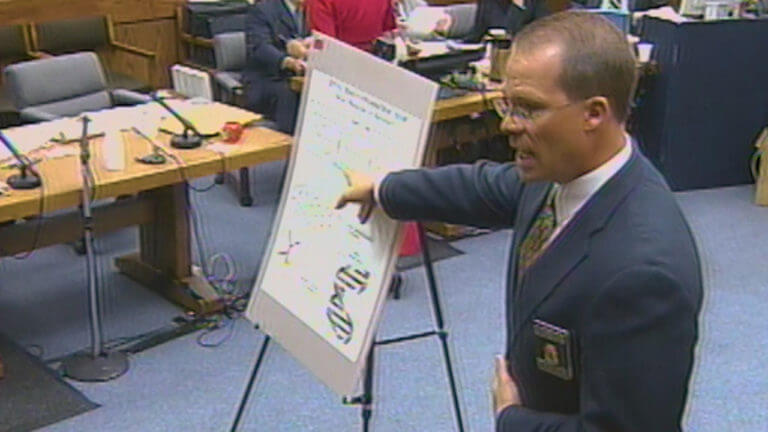
When police searched Peterson's warehouse, they found a black hair on a pair of pliers in his boat. Mitochondrial DNA (mtDNA) tests matched it to Laci Peterson. |
|
|
|
MtDNA "lacks the reliability" of nuclear genetic tests. Also, while in Modesto police custody, the hair "miraculously ... spontaneously multiplied into several hairs," suggesting "negligent handling" and perhaps evidence tampering.

|
|
|
|
MtDNA is "generally accepted in the scientific community" and has been used for two decades. The "magic" hair never multiplied, but simply "broke apart in the package."
 |
|
|
 |