

JACKSON, Miss. (Court TV) — Attorneys representing a matricidal teenage girl sought to have her life sentence overturned by Mississippi’s highest court on Wednesday.
Carly Gregg, 17, was only 14 years old when she shot and killed her mother, Ashley Smylie, 40, and tried to kill her stepfather, Heath Smylie, 39, at their home in Brandon on March 19, 2024.

Carly Gregg sits in court during defense closing arguments. (Court TV)
During her trial, Gregg pleaded not guilty by reason of insanity and argued she suffered from mental illness at the time of the violence — but jurors rejected the defense’s narrative. On Sept. 20, 2024, a Rankin County jury found her guilty of murder in the first degree, attempted murder, and evidence tampering. She was sentenced to life in prison without the possibility of parole.
Now, Gregg’s attorneys say her trial and sentencing were plagued by a series of inadequacies, mistakes, and unfair rulings — up to and including ineffective assistance of counsel from the defendant’s own attorney during some of the proceedings. In some instances, Gregg’s appellate counsel claim, the errors violated her Fifth and Sixth Amendment rights.
Lead appeal attorney James Murphy told the Mississippi Supreme Court the sentence was unconstitutional because the hearing that preceded it did not abide by the strict standards governing juvenile life in prison without parole.
In 2012, the U.S. Supreme Court decided Miller v. Alabama, which held that mandatory life prison sentences for minors are unconstitutional. During oral arguments, Murphy said the trial court did not sentence Gregg in line with the Miller precedent for various reasons.
“The sentencing phase — and I’m gonna use that term loosely — the sentencing phase of this case consisted of the court announcing the verdict of the jury and then transitioning immediately to asking the state whether they wanted to call their first sentencing witness,” Murphy explained.
MORE | Mississippi Supreme Court denies teen killer Carly Gregg’s appeal
In response, both the state and defense declined to call witnesses, saying they would rest on the evidence presented during the trial and allow the sentencing phase to be determined by “argument only.”
“There was no meaningful mitigation development process,” Miller argues “There was no opportunity given to the defense to marshal mitigation witnesses. They were given no opportunity to call witnesses, family members, teachers.”
After discussing with some of the justices whether Gregg was actually sentenced to life in prison without the possibility of parole or simply life in prison — the jury instructions suggested the former; the sentencing order suggested the latter — the defense moved on to the specific content of the sentencing hearing.
The defense angled for the justices to view the prosecution’s rhetoric as an impropriety so bad it infected Gregg’s sentence itself.
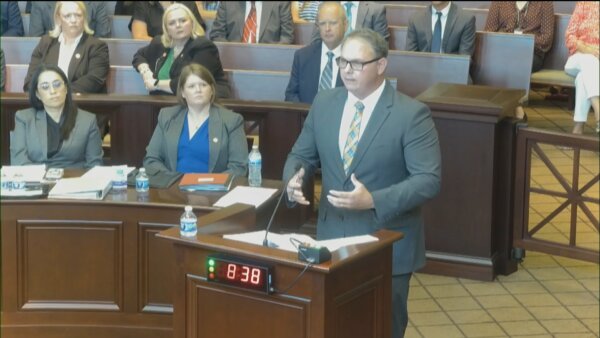
James Murphy argues before the Mississippi Supreme Court on May 27, 2026. (Court TV)
“They were given the option of life or life with the possibility of parole,” Murphy recounted. “The prosecutor stood in front of the jury and told them that if you give her life with the possibility of parole, ‘We don’t know when she’s gonna get out.'”
The defense then elaborated:
“She might be out,” and I’m paraphrasing here. “She may be out in as little as a year,” which I think we all know is outside the realm of possibility for a life sentence. “She may be out in as little as a year.” And again, I’m paraphrasing: “You may see her at the supermarket or you may see her at church, you may run into her at any place outside in public.”
The defense referred to those comments by the state as “improper golden rule rhetoric,” arguing that “appealing to the fears of the community” is improper.
Notably, Gregg’s trial counsel did not object to that line of rhetoric — but her appellate lawyers say the lack of any such objections is part and parcel of their ineffective assistance of counsel claim.
“We can see no strategic reason why a defense, a competent defense counsel, would not object to that type of rhetoric argued in a sentencing phase,” Murphy said.