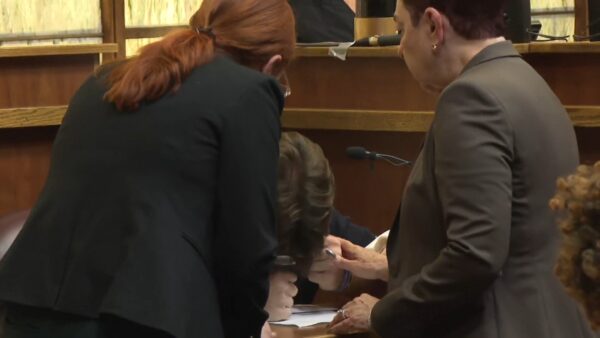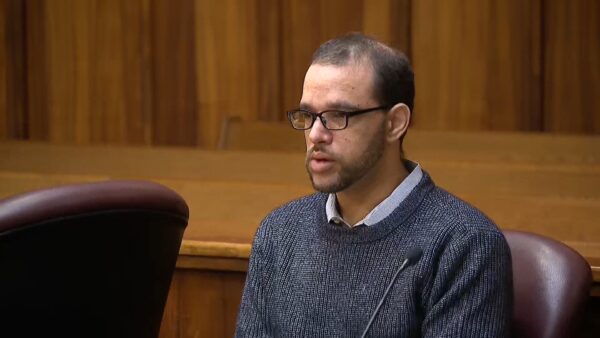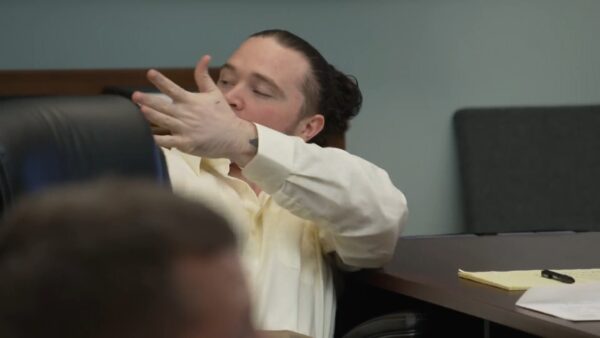

BOSTON (Court TV) — A man accused of attacking women in Boston returned to court as he fights to suppress what prosecutors say is key evidence in his case.
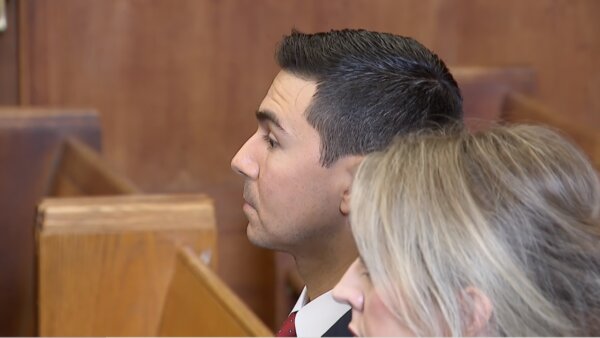
Matthew Nilo appears in court at an evidentiary hearing on June 22, 2026. (Court TV)
Matthew Nilo has pleaded not guilty to multiple charges of aggravated rape, kidnapping, assault with intent to rape and indecent assault and battery after a series of alleged attacks on women in 2007 and 2008.
Prosecutors say that Nilo attacked a total of eight women in Boston and have said in court documents that they were able to link the defendant to the crimes via DNA. But Nilo’s attorneys have challenged how investigators obtained that DNA and have asked a judge to bar prosecutors from introducing it at trial.
After three attacks on Terminal Street in Boston in 2007 and 2008, the Boston Police Department was able to link the DNA collected from the incidents to each other; the DNA collected, however, didn’t match any known suspect in any local or national database. In 2022, the police department renewed its investigation into the assaults and asked for the FBI’s help to analyze the DNA that had been collected.
The FBI used Investigative Genetic Genealogy (IGG), a relatively new tool that uses publicly available data from genealogical databases to help investigators to locate a suspect by tracing them through their family members. The technology was critical for investigators in Idaho, who used IGG to identify Bryan Kohberger as the killer of four University of Idaho students who were found stabbed to death.
In this case, prosecutors said the FBI used FamilyTreeDNA, GEDMatch Pro and MyHeritage.com to narrow down the suspect pool and create a family tree that led them to Nilo. Once they identified him, they began conducting surveillance on him at his home.
On April 6, 2023, FBI agents watching Nilo saw him take a car into New York City and go out to dinner at a restaurant. After hours of watching him eat and drink, the agents approached the restaurant’s waitstaff, who handed over the glassware and utensils Nilo had been using at the table — including a fork, four drinking glasses and a napkin. DNA was taken from the items and was apparently a positive match to the unknown male DNA that had been collected from the rape kits.
The same DNA, when compared to other attacks in the Boston area, yielded more matches, prosecutors say. Nilo was indicted for additional assaults in the city’s North End in 2007 and 2008 — including two attacks on the same alleged victim just 11 days apart.
In his motion to suppress the DNA evidence, Nilo argued that the FBI’s actions amounted to a “warrantless search and seizure of dinnerware.”
“Nilo had a reasonable expectation of privacy in his drinking and dinner utensils at the Oscar Wilde Restaurant that was both objective and subjective,” the motion says.
Nilo’s motion accuses investigators of compelling waitstaff to produce the items, which he claims he did not “abandon or voluntarily relinquish.” That qualification is important — because once something is discarded as trash, it becomes fair game for investigators to collect as evidence. A pizza box thrown away outside Rex Heuermann‘s office was what led investigators to link him to eight murders of women whose bodies were found buried along Gilgo Beach.
Prosecutors noted in their opposition to the defense motion that each of the attacks was committed when the defendant was attending school at the University of Wisconsin, but said: “The dates of these offenses line up perfectly with the academic calendar, and school was not in session at those times.” A Boston native, Nilo was living nearby at the time of the attacks.
Nilo worked as an attorney for an insurance company at the time of his arrest; he is out on bond while awaiting trial. No trial date has been set.