
PLYMOUTH, Mass. (Court TV) — Lindsay Clancy‘s defense attorney slammed quarters down on a table as he delivered his closing argument to the jury on Thursday morning, punctuating different areas of the prosecution’s case he said were flawed and “repulsive.”
“This is a prosecution that has ripped the soul out of this girl,” Clancy’s attorney, Kevin Reddington, told the jury. “This young lady did nothing wrong in her life. She was a nurse, a daughter, a wife and a darn good mother.”

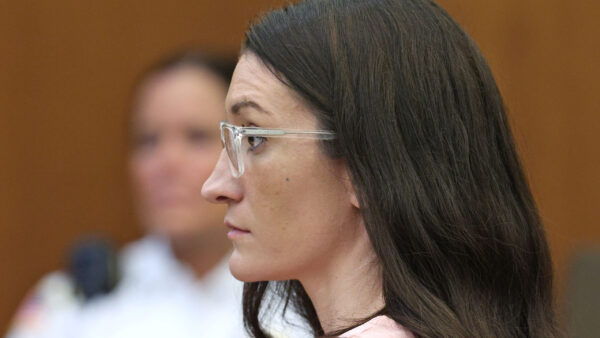
Lindsay Clancy sits in court during closing arguments on Aug. 27, 2026. (Court TV)
Clancy, 36, has admitted to killing her three young children — Cora, 5, Dawson, 3, and Callan, 8 months — by strangling them with exercise bands in the basement of the family’s Duxbury home. She pleaded not guilty to three murder charges in the children’s deaths, arguing through her attorney that she was not responsible for her behavior because she was suffering from postpartum psychosis.
“In my opening statement, I told you, I said, ‘Watch the evidence. Watch the manipulation,'” Reddington said Thursday. “Because that’s what this case was built upon originally and how it developed as the case progressed.”
Reddington put the quarters down as he dismantled the prosecution’s case and criticized how they presented it to the jury. As he slammed the first coin down, he turned to the prosecution’s table and said, “I challenge you to tell this jury why we spent a week showing that she committed —.” Judge William Sullivan cut Reddington off and instructed him to direct his comments only to the jury.
While Clancy was willing to stipulate to the jury that she was the one who killed the children, Reddington highlighted the apparent gaps in the prosecution’s case surrounding how the kids died. “This government, this prosecution, is a mess,” he said. “Lousy investigation. Well, that’s OK because she was guilty and they put her in the hospital and she’s the evil woman who killed the three innocent kids.”
During the trial, Clancy’s defense focused on her mental health, bringing in witnesses who testified that she was psychotic and unable to control her own behavior after hearing a voice that commanded her to kill her children. After taking their lives, Clancy then used a knife to slash her neck and wrists before jumping out of a second-story window.
“There’s no dispute that Lindsay Clancy was suffering from mental illness and that she tried to kill herself. There’s no dispute about that,” Assistant District Attorney Jennifer Sprague said in her closing argument to the jury. “That’s not the issue in this trial. The issue is whether at the time she killed Cora, Dawson and Callan, she knew the difference between right and wrong and whether she could conform her behavior to the requirements of the law.”
While Reddington aimed to paint Clancy as someone who had been overmedicated by doctors who prescribed too many medications at dangerous doses, Sprague argued that Clancy was just impatient and controlling. “She wanted to get better. But she wanted to get better on her own terms, doing things her way, the way she thought she should do them,” Sprague said, pointing to the fact that journal entries detailing the medications Clancy took and their effects stopped abruptly on Jan. 18. “Someone who’s been so meticulous about everything all the way up to January 18 and it just stops. It’s as if she’s decided she’s done trying. She’s decided that it’s too much, and she just doesn’t want to do it anymore and so she just stopped keeping track of the prescriptions.”
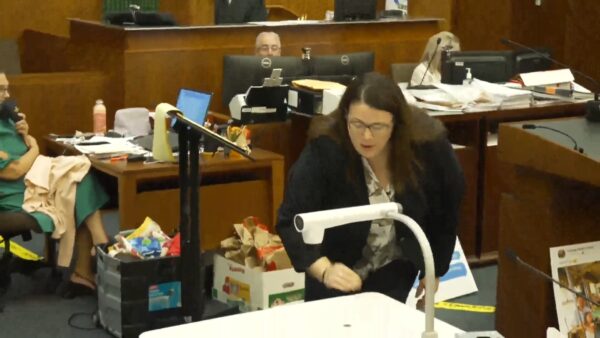
Jennifer Sprague picks up a quarter during her closing argument in Lindsay Clancy’s trial on Aug. 27, 2026. (Court TV)
“The defense would have you believe that a mother who was this good, who loved her kids this much — which we’re not denying — would never harm her kids this way unless she was so mentally ill that she was hearing these command voices and had no choice. But you know that’s not the world we live in,” Sprague said. “Mothers kill their children, and it’s horrible, and it’s awful, but it happens. So why did she specifically do it? She was depressed. She was exhausted. She was done. She didn’t want to try anymore. She felt damaged. But those kids, those kids were her protective factor. Those kids were keeping her from ending her misery, and so she had to remove the protective factor. And I’m not saying she was happy about it; I’m saying it was what she had to do to end her misery.”
Sprague picked up the quarters Reddington left behind on the table as she addressed each of his points. Sprague said Clancy’s actions proved her sanity and that the order in which she killed the children reflected deliberate planning: “Cora and Dawson are older. If she had tried to strangle one in front of the other, they would have known this was bad. And they would have tried to intervene or run and hide, and she had very limited time. She didn’t have time to try to find a child who ran off and hid. So taking Dawson first and moving him to a separate room; having Cora stay with Callan and having Dawson go in another room — that’s rational. That makes sense. That’s ordered thinking.”