
PLYMOUTH, Mass. (Court TV) — Prosecutors trying to convince a Massachusetts jury that a mother murdered her three young children have turned their focus to blood evidence found in the family’s home.
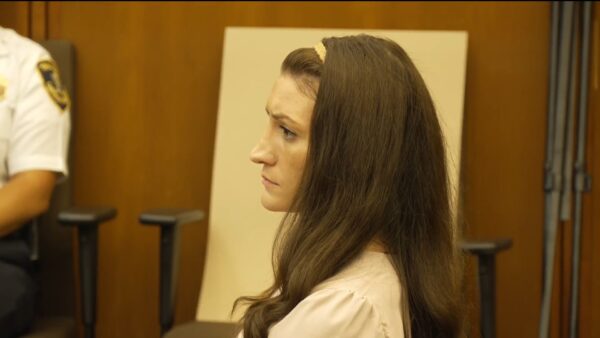
Lindsay Clancy sits in court on Aug. 4, 2026. (Court TV)
Lindsay Clancy, 35, has admitted to killing her three children but pleaded not guilty to murder charges in the case, arguing that she suffered from postpartum psychosis. Clancy’s three young children — Cora, 5, Dawson, 3, and Callan, 8 months — were strangled to death with exercise bands in the basement of the family’s home.
Clancy’s defense attorney, Kevin Reddington, told the jury in his opening statement that after taking her children’s lives, Clancy cut her neck and wrists with a knife and then threw herself from a window on the second floor of the family’s home in an attempt to take her own life. First responders and doctors who treated the defendant at the hospital said that she suffered serious and permanent injuries, including paralysis, and experienced a cardiac arrest that nearly killed her while she was in the hospital.
MORE | Lindsay Clancy murder trial: See the evidence from court
Prosecutors have argued the self-inflicted injuries weren’t as serious as they could have been and that the defendant never truly intended to take her own life. While Clancy’s husband described blood covering the couple’s bedroom after he returned home to find his wife on the lawn and his kids dead in the basement, a blood-spatter expert said there’s no evidence that blood sprayed into the room at any point. Instead, Sherri Crook, who works for the Massachusetts State Police Crime Lab, testified on Tuesday that the drips and puddles of blood found in the Clancy home were more suggestive of someone standing still and letting blood run down onto the floor than someone slashing an artery.
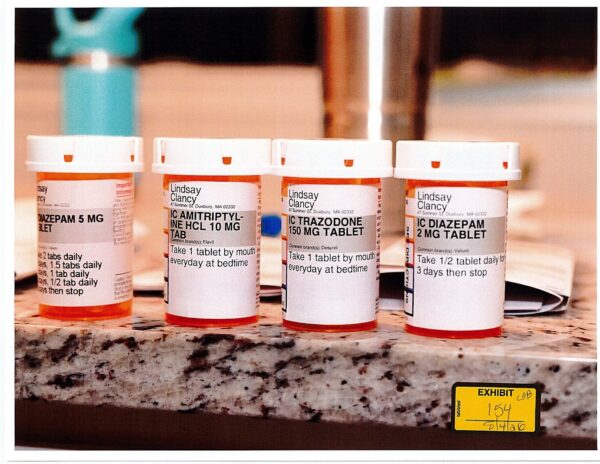
Lindsay Clancy’s medications. (court evidence)
Photos shown to the jury from inside the Clancy home on Tuesday not only detailed blood in the master bedroom but also pills found in the kitchen. Detectives said they found a kitchen cabinet filled with pill bottles, which they seized as evidence. Those bottles included Clancy’s prescriptions for lorazepam, sertraline, buspirone, hydroxyzine and clonazepam, all of which were prescribed in the months before her children’s deaths.
Days after the search warrant was executed, Clancy’s husband brought a CVS bag filled with more pill bottles to investigators.
Reddington has argued that Clancy had tried to get help for her worsening mental health symptoms, but her doctors overmedicated her rather than treating her.
Outside the presence of the jury on Tuesday, the defense stipulated to some evidence to save time. “I would just like, Your Honor, for the record, to again reiterate the fact that we have not been contesting the government’s case-in-chief,” Reddington said. “This stipulation basically relieves the government of having to bring in dozens, if not more, witnesses to prove chain of custody of blood, fluids, the bands, DNA, all of that. Rather than have days of testimony, the stipulation will avoid that.”
Clancy herself spoke briefly on Tuesday, telling Judge William Sullivan that she agreed with her attorney’s decision to stipulate.
The trial is set to continue for several more weeks.