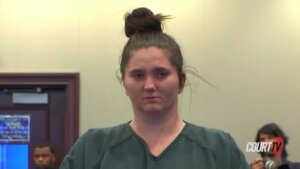
ATLANTA (Court TV) — A Georgia prosecutor has offered a formal apology after she says she used artificial intelligence when she submitted briefs to the court that cited cases that don’t exist.
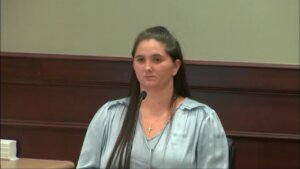
Hannah Payne testified in court on Dec. 11, 2023. (Court TV)
Assistant District Attorney Deborah Leslie filed a supplemental brief with the Georgia Supreme Court after appearing before the Court to deliver oral arguments in the case of Hannah Payne. Payne, who was convicted of murder and other charges in the death of another driver, has appealed her conviction and claimed ineffective assistance of counsel.
But when Leslie appeared before the Court on March 20, the justices questioned several citations that appeared in both her brief and the lower court’s order denying Payne a new trial.
“These errors were not intentional,” Leslie wrote in the newest brief, filed on Friday.
Leslie wrote that she used “traditional and AI research tools” when she prepared both her briefs in Payne’s case and the proposed order that the trial court later signed denying the motion for a new trial. Leslie said she intended to “provide a more detailed explanation of the relevant legal principles,” but conceded that “Case references generated by AI were not independently verified before inclusion.”
Despite the fictitious cases and erroneous citations, Leslie said the meaning behind her briefs remains unchanged. “The undersigned has carefully considered whether, and to what extent, these erroneous citations affected the substance of the State’s arguments or the trial court’s ruling,” Leslie wrote in an affidavit attached to the brief. “To the best of my understanding and belief, the legal positions advanced by the state did not depend solely on the fictitious or misattributed authorities, but were supported by valid precedent and the trial record. I fully acknowledge, however, that the inclusion of any inaccurate citation is a serious matter.”
To prevent a similar slip-up in the future, Leslie said she has implemented several safeguards, including requiring all case citations to be independently verified, a dedicated citation-verification step in the drafting process, and a second-level review of citations by another attorney or qualified staff member.
“I assume full responsibility for the inclusion of the erroneous citations,” Leslie wrote. “I reaffirm my unwavering commitment to the standards of candor, accuracy and diligence that the Court properly expects of officers of the Court.”
Payne is serving a life sentence plus 13 years for her conviction, but maintains that her attorney failed to adequately research the law. The Georgia Supreme Court said it would issue a ruling on her request for a new trial, but offered no time frame as to when it might publish its opinion.