
The two bars that served Karen Read and John O’Keefe are seeking to dismiss the lawsuit the slain police officer’s family filed against them, arguing on Tuesday that Read showed no signs of intoxication on that fateful night.
Read, 46, stood trial twice on charges that she murdered her boyfriend, Boston police Officer O’Keefe. After the first jury deadlocked, causing a mistrial, the second jury cleared Read of murder charges but found her guilty of driving under the influence. Prosecutors accused Read of hitting O’Keefe with her Lexus SUV and driving away, leaving him to die in the snow outside a friend’s home. Read and her defense team, meanwhile, accused investigators of conspiring to frame her and suggested that the people who owned the property where O’Keefe was found had killed him.
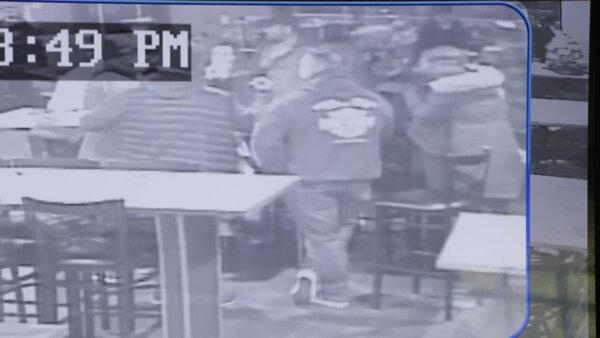
Surveillance video from Waterfall Bar & Grille shows Karen Read and Brian Albert. (Court TV)
Neither Read nor O’Keefe’s family were in the courtroom Tuesday.
O’Keefe’s estate, in a civil lawsuit against Read and the bars, claims that she was overserved.
Lawyers for C.F. McCarthy’s and the Waterfall Bar & Grille, where Read and O’Keefe spent the night before a blizzard with their friends, argued she was not visibly intoxicated. Attorney Lincoln Rose, representing C.F. McCarthy’s, said a high blood alcohol level alone does not constitute visible intoxication. Read testified that was a typical night of drinking for her, he said. There was also purportedly no one who said that Read was drunk, Rose said.
Plaintiffs’ attorney Mark Diller noted that Read told her friend Jen McCabe that she was feeling “buzzed” while at the Waterfall.
“What does buzzed mean?” Judge Mark Gildea interjected.
“What does buzzed mean? It means under the influence of alcohol,” Diller responded.
Gildea pressed Diller on whether Read said anything about feeling intoxicated at McCarthy’s. Diller admitted she did not, but noted she had seven drinks containing two shots of liquor each. Video from the Waterfall also shows she was clearly intoxicated, he told the court.
Diller noted that the city of Canton, where the bars are located, requires establishments to train their employees on spotting intoxicated patrons.
Rose countered that the standard in Massachusetts is “visible intoxication.”
“And as Your Honor alluded to earlier, there’s not a single patron at C.F. McCarthy’s who stated that she was visibly intoxicated. Every patron there … none of them stated that she was visibly intoxicated. And, again, what’s important to note, Your Honor, is that they had the ability to speak with her. They said that she did not slur her speech, she was not, acting inappropriately, or being loud or obnoxious at C.F. McCarthy’s.”
Read started the night at C.F. McCarthy’s before going to the Waterfall.
The attorney for the Waterfall said she showed no signs of intoxication there, either.
The judge did not make any decisions.
After Read’s not guilty verdict, O’Keefe’s family members have turned their attention to the lawsuit they filed against Read, accusing her in a civil lawsuit of being responsible for his death as well as causing them emotional distress.
Read filed a formal response to the civil suit after Judge Daniel O’Shea refused to dismiss the case.
In her response, Read denied all of the allegations laid out by the O’Keefe family, including suggestions that her relationship with O’Keefe had been on the rocks. At her criminal trial, prosecutors had argued that the couple’s relationship had been deteriorating and pointed to Read’s alleged jealousy and anger as a motive for murder. But Read says those allegations are false.
Despite her conviction for operating a vehicle under the influence, Read also denied claims in the lawsuit that she was “showing signs of intoxication” and was unable to operate a motor vehicle safely.
Read also denied that she “feigned comfort” to O’Keefe’s family and used a brief visit with them after his death to “remove the offending weapon, her vehicle, and/or destroy relevant evidence.”
The response indicates that Read plans to present an affirmative defense in the case; among the arguments presented are that the lawsuit “fails to state a claim upon which relief can be granted.” Read’s legal team also suggested that all damages claimed in the suit “were caused by the acts and omissions of third parties for whom Ms. Read is not responsible.”