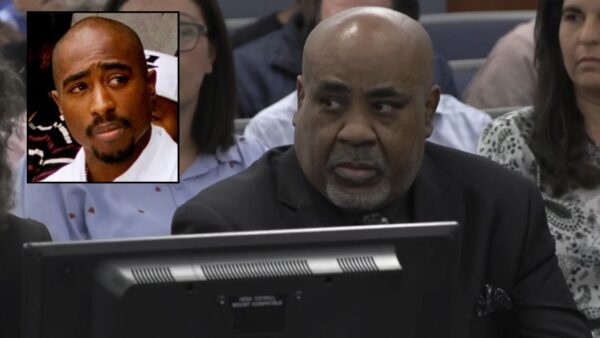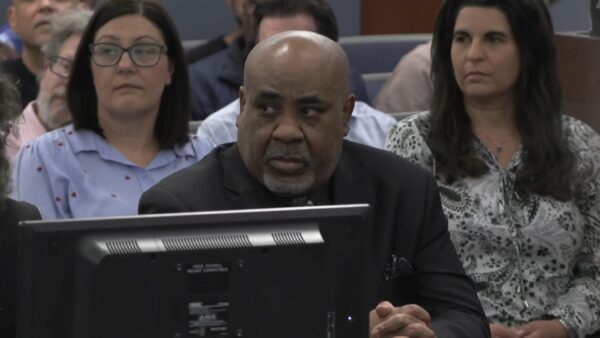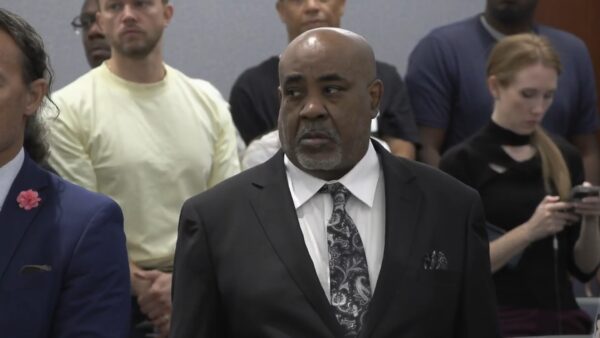

LAS VEGAS (Court TV) — Three decades after rapper Tupac Shakur was gunned down after leaving a fight in Las Vegas, his killer rolled his eyes in court during his sentencing.
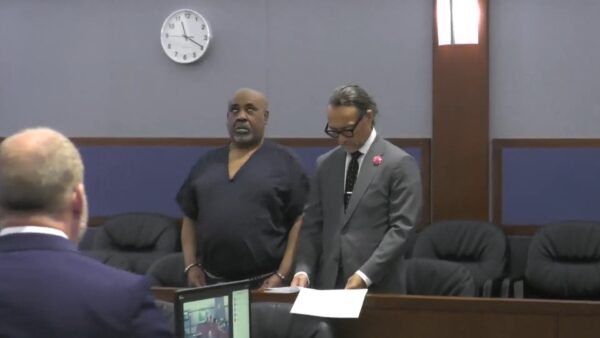
Duane “Keffe D” Davis rolls his eyes while speaking to the judge on Oct. 13, 2026. (Court TV)
Duane “Keffe D” Davis, 63, was convicted of first-degree murder in Shakur’s death. Shakur was 30 when he was shot to death in a drive-by shooting after leaving the MGM Grand on Sept. 7, 1996. Marion “Suge” Knight, who was driving the vehicle in which Shakur was a passenger, was grazed by a bullet.
In 1996, Davis, a five-time convicted felon, was a prominent member of the South Side Compton Crips gang — a rival of the Mob Piru Bloods, which was closely associated with Knight’s record label, Death Row. At trial, prosecutors said that Davis was in the car that opened fire on Shakur, and was the “shot caller,” ordering backseat passengers to shoot the rap star with a gun Davis had passed back.
On Tuesday, as Davis’ sentencing hearing was about to begin, he interrupted proceedings to argue with Judge Carli Kierny about how much time he’d already served in the case.
Davis: I got 1,111 days.
Kierny: A lot of those days, Mr. Davis, did go to the other case that you served time on.
Davis: I was in here for this case. They let that man out to attack me. That’s wrong.
Kierny: I understand that’s your position.
Davis: My position? That’s true!
Kierny: I understand that’s your version.
As the court turned its focus to sentencing, prosecutor Marc DiGiacomo conceded that because of the mandatory sentencing laws, Davis “is guaranteed — assuming he gets no relief anywhere else — to die in the Nevada Department of Corrections.”
DiGiacomo pointed out that had Davis been arrested and charged with Shakur’s murder in 1996, he would have faced sentencing as a five-time convicted felon. Now, 30 years later, Davis is an eight-time convicted felon. “You would expect that you grow up,” DiGiacomo said, “and then you listen to him on those jail calls after being indicted for murder.”
After his arrest and indictment on murder charges, prosecutors said that Davis was recorded talking on jail calls about plans to produce a television show based on his life story.
Kierny offered Davis the chance to address the court at his sentencing.
Davis: I just want my stuff back that they took out of my house. I just want all my stuff back.
Kierny: Anything else you want to say?
Davis: I’m good. I’m gonna appeal this case for sure.
Kierny: You’ve told me.
“My brother was born an icon. He was born a legend,” Shakur’s younger sister told the court. “He was paying all of the bills, all of the rent, all of the food, clothes for at least, I’ve counted them, 17 different families at the age of 25.” She described her brother as generous and known to stand up for those smaller and weaker around him.
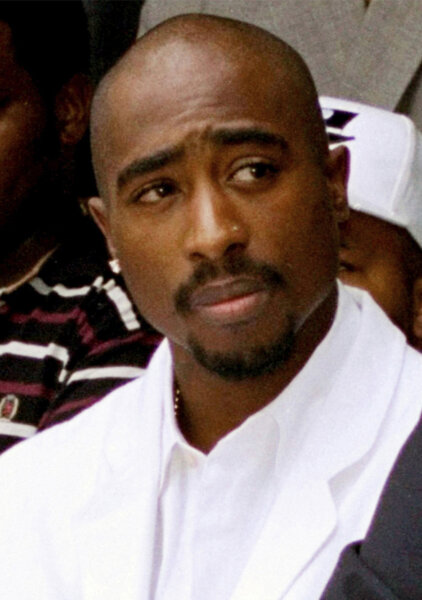
FILE – Rapper Tupac Shakur attends a voter registration event in South Central Los Angeles, Aug. 15, 1996. (AP Photo/Frank Wiese, File)
“The impact from my brother’s murder has been devastating, heartbreaking and sad,” Shakur’s brother, speaking next, said. “For me, for my family, and a nation of pop fans and loved ones. Pac didn’t get a chance to have any kids. Pac didn’t see his nieces and nephews grow up, and Pac didn’t have a trial. All Pac got was a death sentence.”
Kierny referenced the defendant’s many statements to reporters and investigators over the last 30 years as she began to pronounce his sentence. “For three years I’ve heard you say some variation of the same thing to law enforcement, to BET, in your book, and it’s something like, ‘Yeah, I was involved in this, but I’m different, I moved on. I got out of Compton. I’m a grandfather now.’ I’m here to tell you that’s not how this works, OK?” Kierny continued, “You don’t get to take a man from his family. You don’t get to take his very life, his whole future from him, and just walk away from it, especially when that man is Tupac Shakur. The world never forgot about him and his death, and neither did Las Vegas. Took us 30 years, but this time you are going to face justice for what you did on Sept. 7, 1996.”
Kierny sentenced Davis to 20 years to life in prison for murder, to be followed by a consecutive sentence of 20 years to life for the deadly-weapon enhancement made mandatory in 1995.