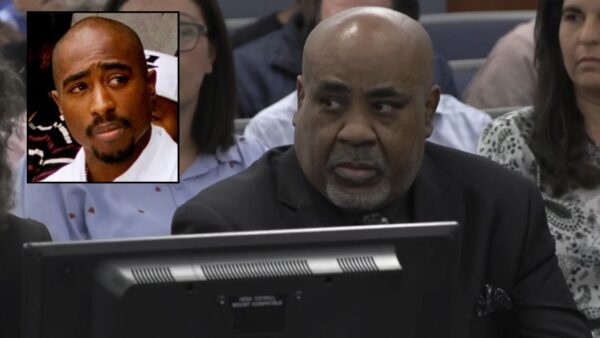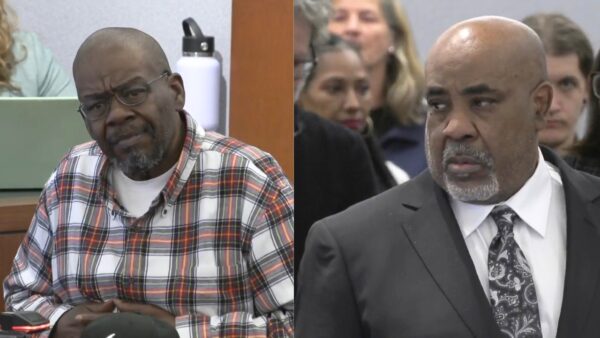

LAS VEGAS (Court TV) — A childhood friend of Tupac Shakur described seeing the drive-by shooting that claimed the rapper’s life as prosecutors continue to present evidence that Duane “Keffe D” Davis was allegedly behind the gangland hit.
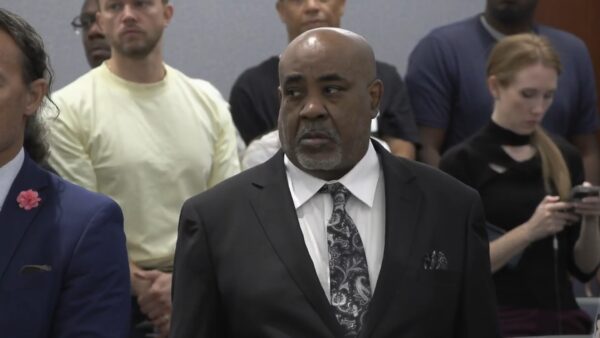
Duane ‘Keffe D’ Davis stands in court on Aug. 25, 2026. (Court TV)
Davis, 63, has pleaded not guilty to charges that he murdered Shakur, who was gunned down in 1996. At the time, Shakur was a rising star on Marion “Suge” Knight’s record label, Death Row, which was closely associated with the Mob Piru Bloods gang. Davis was a known member of the South Side Compton Crips gang, a rival of the Mob Piru Bloods.
Shakur and Knight were in a BMW on Sept. 7, 1996, after leaving a fight at the MGM Grand in Las Vegas. They were en route to Club 662 when a white Cadillac pulled up beside them and fired shots, killing Shakur and injuring Knight.
Malcolm Greenidge, a childhood friend of Shakur’s, was part of a caravan of vehicles driving directly behind Knight’s BMW. He saw their car stop to talk to some women at a red light just before the shots rang out. “When those ladies pulled off, another car pulled up and started shooting at Mr. Shakur and Mr. Knight,” Greenidge said. He described the vehicle as a light-colored four-door Cadillac. “I’m horrified,” he said of his reaction to seeing the shots fired from an arm extended from the vehicle’s back seat. Shakur died in the hospital one week later.
Retired detective and author of “Once Upon a Time in Compton,” Robert Ladd, testified Tuesday that the deadly shooting in Las Vegas sparked a gang war in Compton, California. In the 10 days after Shakur was shot, there were three murders and 10 attempted murders in drive-by shootings in the city. “To me, there was no doubt in my mind that the South Side Crips were responsible, because the Mob Piru had to retaliate and they had 54 other gangs to choose from, but they went right after the South Side Crips,” Ladd said. “There’s no doubt in my mind who’s responsible for shooting Tupac and Suge Knight.”
Davis has long acknowledged that he was in the white Cadillac when Shakur was shot, along with his nephew and fellow gang member, Orlando Anderson. In his memoir, “Compton Street Legend,” published in 2019, Davis said that he was in the front seat of the sedan and that someone in the back seat fired the deadly shots. Ladd testified Tuesday that it didn’t matter where Davis was seated in the vehicle, because no shots would have been fired without his approval.
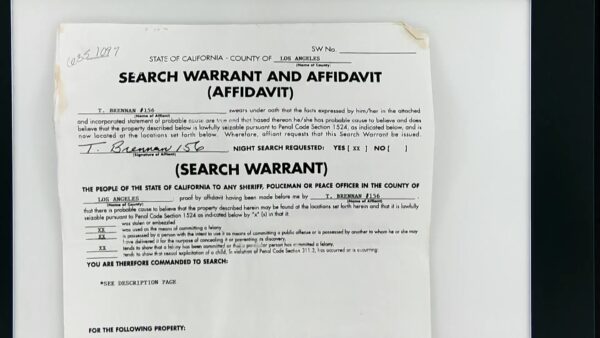
A search warrant from the Compton Police Department, dated May 27, 1997. (Court TV)
Ladd, who worked as a gang detective in Compton, explained that within the structure of the South Side Compton Crips, Davis was considered a high-level gang member and narcotics dealer, known as a “shot caller.” “If he tells them not to do it, say, ‘Let’s handle this back in Compton,’ they wouldn’t have had a shooting. If he sanctioned it, there would be a shooting,” Ladd explained. Prosecutor Binu Paul asked him to clarify: “Could Mr. Anderson shoot that gun with Mr. Davis in the car without Mr. Davis’ permission?” “No,” Ladd said.
Davis was not arrested on charges related to the shooting until 2023, months after a search warrant was served on his property in Henderson, Nevada. Among the items found during that search, Las Vegas Metropolitan Police Detective Justine Gatus testified, were bins filled with newspaper clippings and magazines with articles focused on the shooting and Shakur’s death. A scrapbook also contained a search warrant from the Compton Police Department, dated May 27, 1997; a handwritten return on the back listed “money due bill for Monte Carlo Casino.”
Davis has maintained he did not fire the shots that killed Shakur and that any of the statements he made about what happened that night were covered by an immunity agreement he made with investigators or were entirely fictionalized.