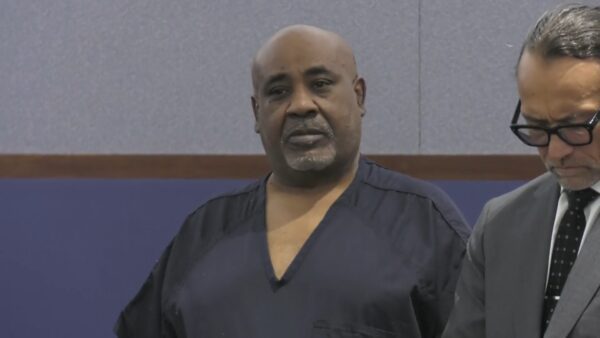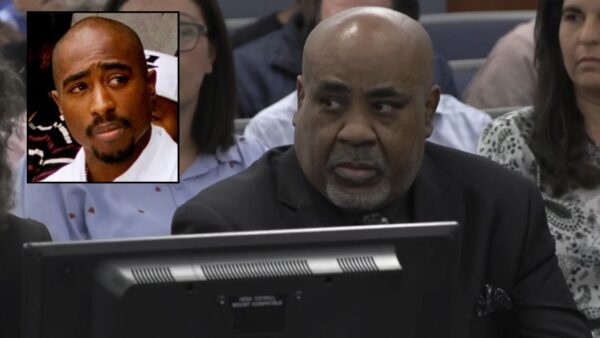

LAS VEGAS (Court TV) — Thirty years after rapper Tupac Shakur was gunned down in Las Vegas, a jury took less than three hours to convict Duane “Keffe D” Davis of his murder.
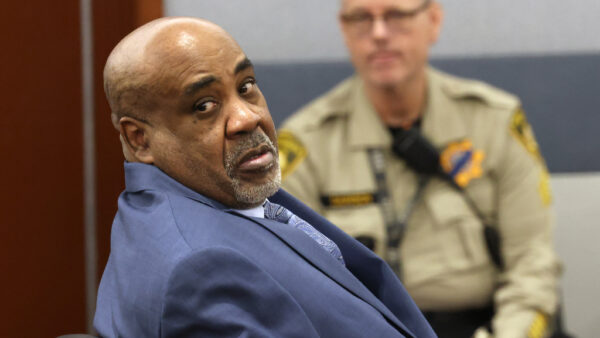
Duane ‘Keffe D’ Davis appears in court. (Bizuayehu Tesfaye/Las Vegas Review-Journal/POOL)
Davis, 63, was indicted in 2023 on one count of murder with a deadly weapon. Davis was well-known as one of the last living witnesses to the shooting that killed Shakur. On Sept. 7, 1996, Shakur was in a BMW with Marion “Suge” Knight in a convoy of cars when a white Cadillac pulled up next to his car and began shooting. The rapper died one week later in the hospital.
Investigators knew about Davis for years before his indictment; the defendant even admitted to being in the Cadillac in interviews and a 2019 tell-all book, “Compton Street Legend.” In that memoir, Davis said that he was in the front of the vehicle and that one of two people in the back seat of the car had fired the shots. The book also claims that Davis talked to investigators about his presence at the scene in 2010 when he was facing life in prison on unrelated drug charges. “They offered to let me go for running a ‘criminal enterprise’ and numerous alleged murders for the truth about the Tupac and Biggie murders,” he wrote, alluding to the murder of Christopher Wallace, known as “Biggie Smalls” or “The Notorious B.I.G.,” who was shot and killed six months after Shakur. “They promised they would shred the indictment and stop the grand jury if I helped them out.” Davis is the only surviving person who was inside the Cadillac.
In pretrial filings, Davis’s defense had argued his statements should not be used against him, contending that his descriptions of the shooting were “done for entertainment purposes and to make money.” His defense has also cited an immunity agreement he signed years earlier with federal and local prosecutors. Prosecutors have countered that the immunity was limited and that they had strong evidence against the defendant.
Months before Davis’s arrest, police raided his home in Nevada, seizing multiple computers, a cellphone, a hard drive and bullets. A detective involved in the search reported finding two bins of photographs that included magazines and numerous clippings related to Shakur’s 1996 death.
At the time of his death, 25-year-old Shakur had released four studio albums. He was nominated for six Grammy Awards; his song “How Do U Want It/California Love,” which debuted after his death, reached No. 1 on the Billboard Hot 100 chart.
Sentencing is scheduled for Oct. 13, 2026.
DAILY TRIAL HIGHLIGHTS
DAY 10 – 8/31/26
- LIVESTREAM: NV v. Duane ‘Keffe D’ Davis – Day 10 | Tupac Murder Trial
- The prosecution and defense delivered closing arguments.
- The jury began deliberating.
- The jury reached a verdict.
- MORE: Duane ‘Keffe D’ Davis says ‘I’d like to have my stuff back’ after jury convicts him of murdering Tupac
DAY 9 – 8/27/26
- LIVESTREAM: NV v. Duane ‘Keffe D’ Davis – Day 9 | Tupac Murder Trial
- Stan Height, Las Vegas Metropolitan Police Department (Ret.)
- Was working as a uniformed officer on Sept. 7, 1996, to keep the peace during the Mike Tyson fight night.
- Assigned to the guard gate at Knight’s residence.
- Observed an entourage of approximately 15 vehicles enter through the gate, noting the last was a cream-colored Cadillac occupied by two Black males.
- Knight’s entourage left roughly 30 minutes after arriving; Mike Tyson arrived separately about 10 minutes later and then left 10 minutes after that.
- Authored an officer’s report following the incident.
- Charlie Mangrum, Las Vegas Metropolitan Police Department (Ret.)
- Worked as an overtime supervisor with LVMPD, in charge of three officers on the night of the shooting.
- Identified aerial maps of the area around Knight’s house.
- Observed Knight driving a blue BMW with Shakur in the passenger seat leaving the gate between 10:10 and 10:15 p.m., followed by five to six other vehicles.
- Recalled a cream- or white-colored Cadillac occupied by two Black males leaving the residence area.
- Noted that Mike Tyson and Don King’s son later arrived in separate Bentleys but left after being informed the party was canceled.
- Authored a two-page report on Sept. 19, 1996, which was copied to LVMPD Homicide Detective Brent Becker, along with Allied Security gate logs.
- Det. Dan Long, Las Vegas Metropolitan Police Department (Ret.)
- In 1996, he was a gang crimes detective; on the night of the shooting, he was near Koval and Flamingo when he heard gunshots and responded to secure the shooting scene.
- Leadership sequestered hard copies of investigative files due to high curiosity/unauthorized views from other officers. Several of his own internal officer reports were lost during a computer system migration.
- Investigated a lead in 1998 from the Compton Police Department and Los Angeles Sheriff’s Department (a Glock .40 found buried in a backyard) and brought it to Las Vegas for testing; ballistics confirmed it was not the murder weapon.
- Conducted a recorded interview in 2009 in Los Angeles with Duane Davis and his attorney, Wayne Higgins. He noted Davis was trying to work off major federal/federal-adjacent drug charges.
- Attempted to corroborate Davis’ claims (checking hospital records for Anderson’s alleged arm injury and searching for 1996 rental car records for a white Cadillac) but found no supporting documentation or physical proof.
- Prosecutors ultimately instructed him to stand down on issuing an arrest warrant in 2009, due to legal complications surrounding federal proffer agreements.
DAY 8 – 8/26/26
- LIVESTREAM: NV v. Duane ‘Keffe D’ Davis – Day 8 | Tupac Murder Trial
- Adam Stoehr, Clark County District Attorney’s Office electronic evidence specialist
- Tasked with obtaining, reviewing and clipping YouTube videos of defendant Duane Davis.
- Synced and compiled courtroom video angles from different sources showing Davis mouthing words at witness Reggie Wright Jr.
- Reviewed and authenticated recorded jail calls made by Davis between October 2023 and July 2024.
- The prosecution rested its case.
DAY 7 – 8/25/26
- LIVESTREAM: NV v. Duane ‘Keffe D’ Davis – Day 7 | Tupac Murder Trial
- Malcolm Greenidge, victim’s friend
- Attended court under a court order compelling him to do so.
- Testified he was a childhood friend of Shakur’s and a member of the rap group Outlawz.
- Traveled in Las Vegas as part of a caravan behind Knight’s BMW on Sept. 7, 1996.
- Witnessed the shooting from the trailing vehicle, seeing an arm holding a gun extend from the rear seat of a white four-door Cadillac.
- The shooter’s arm appeared to be African-American.
- Shakur told him to “get on the ground” right before police held him at gunpoint after the U-turn.
- Jeffrey Scott, Las Vegas Metropolitan Police Department crime scene analyst
- Responded to a search warrant in Henderson, Nevada, on July 17, 2023.
- Processed photographs of the residence’s exterior and garage.
- Recovered three sheets of paper from inside a Dodge Challenger in the garage, which contained outline notes and a budget (less than $1 million) for a proposed episodic series.
- Steavie Fellabaum, Las Vegas Metropolitan Police Department crime scene analyst
- Documented items found in the master bedroom of the Henderson, Nevada, property, which included copies of “Compton Street Legend,” “Murder Rap,” and a November 1996 edition of Vibe Magazine.
- Documented two storage bins in the garage containing personal effects, as well as a jacket featuring “South Side City of Compton” on the back.
- Det. Justine Gatus, Las Vegas Metropolitan Police Department
- Assisted with the 2023 search warrant and evidence review.
- Authenticated evidence retrieved from the vault, including a scrapbook/photo album filled with 1996-1997 newspaper clippings detailing the murders of Shakur and Wallace, gang raids and Knight’s legal issues.
- Authenticated a 1997 Compton Police Department search warrant return found inside the scrapbook, listing a Monte Carlo Casino bill.
- Outlined efforts to serve orders and place phone pings on uncooperative out-of-state witnesses in California and New York.
- Officer Mark Hatton, Las Vegas Metropolitan Police Department firearms technician
- Re-entered the seven .40 Smith & Wesson cartridge casings recovered from the 1996 Las Vegas crime scene into the NIBIN (National Integrated Ballistic Information Network) system in 2023.
- All seven casings were fired from the same single firearm.
- The NIBIN database searches yielded no matches to any other logged crime scene or recovered firearm.
- Robert Ladd, author of “Once Upon a Time in Compton”
- Defined gang hierarchy (baby gangsters, gangsters, OGs/shot callers)
- Identified Davis as an OG/shot caller and high-level narcotics trafficker for the South Side Compton Crips.
- Explained the rivalry between the South Side Compton Crips and Mob Piru.
- Detailed the 10-day gang war in Compton following Shakur’s shooting, which included three murders and 10 drive-by shootings.
- Co-authored the October 1996 multi-location search warrant (38 locations) targeting both the South Side Compton Crips and Mob Piru.
- As the highest-ranking shot caller in the Cadillac, Davis would have had to sanction or authorize any shooting carried out by lower-level gang members (i.e., Orlando Anderson).
- MORE: Witness: Duane Davis was ‘shot caller’ who ordered Tupac Shakur’s murder
DAY 6 – 8/24/26
- LIVESTREAM: NV v. Duane ‘Keffe D’ Davis – Day 6 | Tupac Murder Trial
- Michael Dorsey returned to the witness stand.
- Testified outside the presence of the jury that during breaks in the 2017 BET/Creature Films production interviews, four to six crew members were constantly present in the small studio room with the defendant and his attorney, negating expectations of attorney-client privilege.
- Identified audio recordings from July 17, 2017, and July 18, 2017, where the defendant detailed gang history, drug trafficking operations, interactions with Christopher Wallace and Sean Combs and the events surrounding Shakur’s shooting.
- Confirmed that the defendant later published and publicly promoted the book “Compton Street Legend,” which mirrored biographical details and narrative accounts provided during his 2017 interviews.
- During cross-examination, acknowledged that he is not a law enforcement officer and did not interview detectives with the Las Vegas Metropolitan Police Department directly for the documentary.
DAY 5 – 8/21/26
- LIVESTREAM: NV v. Duane ‘Keffe D’ Davis – Day 5 | Tupac Murder Trial
- Leonard Jackson, eyewitness
- Was staying at the Monte Carlo in Las Vegas; he sold his fight tickets for $2,500 each in the MGM Grand lobby.
- He was driving a white Suburban north on Las Vegas Boulevard and stopped next to Knight and Shakur; he took a 35mm photograph of them at a red light.
- Followed Knight and Shakur’s caravan onto Flamingo Road and heard gunshots.
- He saw the BMW make a U-turn and followed traffic back toward Harmon and Las Vegas Boulevard.
- Saw bike officers arrive and Knight step out of the vehicle yelling, “My man Pac is shot” before he was thrown to the ground and searched by an officer.
- Returned to the scene later, at the request of a detective, rewound his camera’s 35mm film cartridge and gave it to Det. Kevin Manning.
- Denied internet conspiracy theories alleging he staged the scene, despite currently working as a picture car coordinator in the film industry.
- Mario Diaz, director
- Served as showrunner and director of the six-part docuseries “Death Row Chronicles,” produced by Creature Films/E1 for BET.
- Conducted two formal interviews, lasting two hours each, with Duane Davis in the summer of 2017 and filmed him at the scene.
- Davis was compensated between $10,000 and $20,000 for his participation, and brought his attorney, Wayne Higgins, to the interview.
- The documentary was unscripted and followed strict journalistic standards, with no pre-provided questions or coaching.
- Former LAPD detective Greg Kading and filmmaker Mike Dorsey were technical consultants.
- Audio from Davis’ 2008 proffer session filled narrative gaps.
- E1/BET initially released only aired footage to police, but after Davis publicly claimed his interviews were “scripted,” production supported releasing additional materials.
- Michael Dorsey, filmmaker
- Began investigating the case in 2012, based on Greg Kading’s book, “Murder Rap,” and LAPD case files.
- Served as the technical consultant on “Death Row Chronicles.”
- Listened live to Mario Diaz’s 2017 interviews with Davis and texted follow-up questions.
- Recorded his own audio feed of the 2017 Davis interviews with a cellphone, which he provided to law enforcement under subpoena along with transcriptions.
- Authenticated key background figures, including Eric “Zip” Martin (a mentor to Sean “Diddy” Combs and godfather to Wallace’s son).
- Identified key locations, including Greenblatts Deli on Sunset Boulevard.
DAY 4 – 8/20/26
- LIVESTREAM: NV v. Duane ‘Keffe D’ Davis – Day 4 | Tupac Murder Trial
- Devante Lee, gang member
- Testified that he was appearing under a court subpoena and did not want to participate in the trial.
- Described joining the South Side Compton Crips in the mid-1990s through a one-on-one fight, where Orlando Anderson made sure he was treated fairly.
- Identified Davis as a high-level drug “hustler” within the gang and noted that Anderson was Davis’ nephew.
- Outlined gang rivalries between the South Side Compton Crips and Mob Piru Bloods/Death Row Records, contrasting it with the relationship between the South Side Compton Crips and Bad Boy Records.
- Detailed a summer 1996 fight at the Lakewood Mall Foot Locker involving the South Side Compton Crips and Death Row affiliates, where Trayvon Lane’s Death Row medallion chain was snatched.
- Under cross-examination, Lee confirmed he worked as an informant/source for a DEA/ATF task force starting around 2006 and received approximately $5,300 in payments.
- The jury heard an audio recording of a 2008 interview/proffer where Davis discussed Shakur’s killing.
DAY 3 – 8/19/26
- LIVESTREAM: NV v. Duane ‘Keffe D’ Davis – Day 3 | Tupac Murder Trial
- Special Agent Wade Lee, FBI (Ret.)
- Assigned to the Safe Streets Task Force investigating gangs in South Central Los Angeles in 1996-1998.
- Identified Duane Davis in court and detailed his drug indictment involving two kilograms of powder cocaine, which carried a potential 10-year sentence.
- Outlined the nature of federal proffer agreements and authenticated FBI reports covering Davis’ July 14, 1998, proffer and April 15, 1999, prison interview.
- During the 1998 proffer, Davis provided details about gang structures, Death Row Records and drug trafficking, but denied any knowledge or involvement in Tupac Shakur’s murder.
- Detailed Davis’ claims that Death Row Records was funded partly by drug money and that Knight and Wright controlled gang security elements.
- In the 1999 prison interview, Davis again denied involvement himself and on Anderson’s behalf in the murders of Shakur and Wallace, speculating instead about Death Row or New York connections.
- Confirmed under cross-examination that the FBI did not audio record proffer sessions as standard policy at the time and that he did not personally verify every detail or location regarding Shakur’s homicide.
- Det. Daryn Dupree, Los Angeles Police Department (Ret.)
- Assigned to the 2006 task force investigating the death of Christopher Wallace following a civil lawsuit.
- Investigators leveraged potential federal drug charges (PCP and cocaine) against Davis to secure his cooperation in the Wallace murder investigation.
- During a proffer session with the federal prosecutor and his attorney, Davis denied involvement in the Wallace murder “that one” but spontaneously offered “we did the other one.”
- On Dec. 18, 2008, Davis provided a detailed, recorded account of Shakur’s shooting.
- Davis said that after Anderson was jumped at the MGM, Davis obtained a .40 caliber handgun, sat in the front passenger seat of a white Cadillac, passed the gun to the back seat, and Anderson ultimately grabbed the gun and shot Shakur and Knight.
- Davis became a confidential informant in March 2009 and traveled to New York to attempt an undercover operation targeting Eric “Zip” Martin, which yielded no results.
- Davis was initially targeted as a suspect in the Wallace murder but was later cleared.
DAY 2 – 8/18/26
- LIVESTREAM: NV v. Duane ‘Keffe D’ Davis – Day 2 | Tupac Murder Trial
- Thomas Kern, Las Vegas Metropolitan Police Dept. crime scene analyst (fmr.)
- Was in his first year at the dept and was training in Sept. 1996.
- Attended Tupac Shakur’s autopsy to document the body and collect physical evidence, including bullet fragments.
- Dr. Lisa Gavin, medical examiner
- Reviewed the original autopsy reports, medical charts and crime scene photographs generated by the medical examiner who performed the autopsy (now deceased).
- Detailed Shakur’s fatal injuries, including an entrance gunshot wound to the right chest that collapsed and damaged his right lung, an entrance wound to the right thigh/abdomen, and a gunshot wound through the right hand.
- Determined Shakur’s cause of death was gunshot wounds to the chest and abdomen; the manner of death was homicide.
- Clarified from juror questions that there were no gunshot wounds to the head and she did not know the caliber of the recovered bullets.
- Michael Ingram, investigator for MGM Resorts
- Authenticated original 1996 VHS surveillance footage from the MGM Grand, which showed corridors, elevator banks and casino floors.
- Oriented the jury on the MGM layout map, tracking Orlando Anderson (in a Dan Marino jersey) and the group fleeing toward the entrance on Las Vegas Blvd.
- Read into the record portions of an MGM security officer’s 1996 report describing Anderson pushing past a checkpoint before being chased, punched and kicked by a group near the Coyote Cafe.
- Sgt. Kenneth Rios, Las Vegas Metropolitan Police Department (Ret.)
- Responded to the MGM Grand elevator area on Sept. 7, 1996, and interacted with Orlando Anderson.
- Identified Anderson via his California driver’s license.
- Anderson refused medical attention and declined to file a police report.
- Authored a supplemental report from memory later that night, after learning about the drive-by shooting.
- William Hedemeyer, security officer at the Maxim Hotel and Casino
- Was on the third floor of the parking garage investigating stolen Dodge Caravans with two police officers when he heard three distinct volleys of gunfire (estimated 9 to 15 shots total).
- Looked over the retaining wall and observed a line of vehicles stopped on Flamingo heading east: a white Dodge Stratus at the front, a black BMW behind it, a white Chevy Suburban and others.
- Observed a young, well-dressed Black male outside the vehicles wearing a white three-quarter sleeve shirt, black pants, and a dress vest, holding a semi-automatic handgun at his side.
- Watched the entire convoy make an immediate U-turn across Flamingo heading west toward Las Vegas Blvd. as police pursued them.
- Det. Dean O’Kelly, Las Vegas Metropolitan Police Department (Ret.)
- Worked as a gang detective and in the cold case unit.
- Responded to a “Code Red” call after 11:17 p.m. on Sept. 7, 1996.
- Discovered spent shell casings and bullet fragments scattered across the travel lanes of the road.
- Protected the scene using traffic cones over evidence items.
- Physical inspection of the Winchester .40 S&W casings revealed rectangular firing pin impressions indicative of a Glock handgun.
- James “Mob James” McDonald, former gang member and head of internal security at Club 662
- Testified under a court order, saying he was unwilling to volunteer testimony or incriminate individuals.
- Described the Death Row Records dynamics and gang rivalries between Mob Piru Bloods and South Side Compton Crips as well as his role enforcing security for Marion “Suge” Knight.
- He was at Club 662 when news arrived that Shakur and Knight had been shot. He refuted conspiracy theories that Reggie Wright Jr. orchestrated the shooting.
- Returned to Compton immediately as a gang war erupted following Anderson’s beating at the MGM Grand.
- Reginald “Reggie” Wright Jr., former police officer, handled security for Death Row Records and Marion “Suge” Knight
- Outlined the history of Death Row Records and the escalating rivalry with Bad Boy Entertainment, as well as a confrontation involving a weapon at the Soul Train Music Awards.
- Explained security protocols for Shakur, saying that security was increased after the release of “Hit ‘Em Up.”
- On Sept. 7, 1996, legal counsel advised guards not to carry firearms inside Club 662 to protect the club’s pending liquor license transfer.
- Reviewed MGM Grand footage on the stand, identifying people involved in or fleeing the assault on Anderson, including Knight and Shakur.
- Described a post-shooting meeting between attorneys, Knight’s representatives and Anderson where a $60,000 settlement was discussed prior to Anderson testifying at Knight’s probation revocation hearing.
- MORE: ‘Talk to your lawyer, man’: Witness spars with Keffe D’s attorney at Tupac murder trial
DAY 1 – 8/17/26
- LIVESTREAM: NV v. Duane ‘Keffe D’ Davis – Day 1 | Tupac Murder Trial
- Binu Palal delivered the prosecution’s opening statement.
- Detailed the night of Sept. 7, 1996, at the MGM Grand, where Tupac Shakur, Suge Knight and gang affiliates assaulted Davis’ nephew, Orlando Anderson.
- Davis did not pull the trigger, but allegedly orchestrated the retaliation in the subsequent 2.5 hours.
- Palal said Davis got a .40-caliber Glock from Eric “Zip” Martin, assembled a crew in a white Cadillac and handed the firearm off to the back seat, where Anderson fired into Shakur’s BMW.
- At the time, the Mob Piru Bloods (associated with Death Row Records) and the South Side Compton Crips (led, in part, by Davis) were in an ongoing rivalry.
- Davis made several admissions, including a 2008 federal proffer, a 2009 police interview and his 2019 book.
- Played audio from a 2024 jail call showing Davis’ alleged ongoing hostility toward Shakur.
- Michael Sanft delivered the defense’s opening statement.
- Urged jurors to differentiate between verifiable physical facts and uncorroborated stories.
- Emphasized that 30 years of investigations produced no physical evidence, forensic ties, hotel/casino records or independent witness identifications placing Davis at the MGM Grand or the shooting scene.
- The investigation, which spanned several agencies, was fraught with missing reports, evidence mishandling and internal corruption.
- Davis’ media statements were fiction driven by financial motives.
- Officer Gary Dale, Las Vegas Metropolitan Police Department (Ret.)
- Assigned to the Strip bicycle unit on Sept. 7, 1996.
- Conducted a routine traffic stop on a Black BMW lacking license plates shortly after 11 p.m. He identified the occupants of the car as Suge Knight and Tupac Shakur. He noted that Shakur was wearing a large, gold medallion.
- Approximately 10 minutes later, he responded to a “shots fired call,” finding the same BMW mounted on the median with blown tires.
- Saw Knight bleeding from a head wound and accompanied Shakur in an ambulance to the hospital.
- Shakur refused to name his attackers, repeating, “No, we’ll take care of it.”
- Ingrid Stokes, eyewitness
- Was visiting Las Vegas on Sept. 7, 1996, with three friends, all in a rented Oldsmobile Cutlass convertible.
- The group pulled up alongside Knight and Shakur; one friend talked briefly to Knight, who invited them to follow the BMW to Club 662.
- They followed the BMW, and noticed multiple vehicles maneuvering erratically around them. She later realized that was the Death Row entourage.
- They stopped at a red light one lane over and slightly ahead of the BMW. As she and the driver ducked down to swap seats, she heard rapid gunfire. She did not see the shooter.
- Panicked, she hit the gas to flee and nearly hit a white Cadillac sedan turning away from the scene.
- Shakur was relaxed inside the vehicle, not hanging out of the window shouting at fans.
- Det. Brent Becker, Las Vegas Metropolitan Police Department (Ret.)
- Called out to investigate at 12:30 a.m. on Sept. 8, 1996.
- Interviewed four witnesses who were part of the entourage trailing the BMW. They described a white Cadillac pulling up alongside the car and firing from the passenger side.
- Bullet impacts were exclusively on the right/passenger side of the BMW and .40-caliber Glock casings were recovered from the road.
- Orlando Anderson was identified early as a suspect from tapes at the MGM Grand.
- Officers executed search warrants in Compton on Oct. 2, 1996.
- Generated 10 multi-photo lineups with key figures in the Crips gang (including Davis and Anderson).
- Becker said he locked physical files in his desk and saved reports to floppy disks due to leaks and unauthorized file access at the police department.
- Noted that several early police reports are missing.
- Confirmed Knight was “timid” and uncooperative during his formal interview while accompanied by three attorneys.
- Det. Fred Miller, Los Angeles Police Department (Ret.)
- Co-led the March 9, 1997, murder investigation into the death of Christopher Wallace, aka Biggie Smalls.
- Investigated Davis as a potential suspect in Wallace’s murder due to Davis attending the Vibe party, owning a dark 1996 Chevy Impala SS matching the suspect’s car description and alleged financial disputes with Bad Boy Entertainment.
- Executed a search warrant on Davis’ Impala SS in May 1997, recovering a Polaroid photograph of Davis, Anderson and associates.
- Davis was never charged in connection with Wallace’s death.
- A search of Davis’ California home yielded no evidence tied to Wallace’s or Shakur’s deaths.
- The jury heard Davis’ recorded interview at the LAPD on June 20, 1997. Davis recalled attending the Vibe party in a rented green Oldsmobile. He said he heard gunshots outside, saw crowds surge and was directed out by traffic police. He maintained he was not involved in Wallace’s shooting and did not see the shooter.