
TALLAHASSEE, Fla. (Court TV) — Charlie Adelson will not be getting a new trial.
In a ruling issued Wednesday, Florida’s First District Court of Appeal upheld the murder conviction in part because his attorney only made the arguments orally and not in writing.
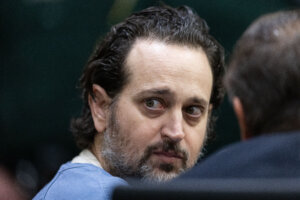
Charlie Adelson looks over his shoulder at the courtroom gallery before his sentencing Tuesday, Dec. 12, 2023. (Alicia Devine/Tallahassee Democrat/Pool)
Adelson was convicted in 2023 of first-degree murder, solicitation, and conspiracy to commit first-degree murder in the 2014 killing of former Florida State University professor Dan Markel. In January 2025, the First District Court of Appeal denied a motion by Adelson’s team seeking to relinquish jurisdiction to the trial court.
Judges Lori S. Rowe, Thomas D. Winokur and M. Kemmerly Thomas heard arguments in February; Adelson was not present at the hearing but was represented by his attorney, Michael Ufferman.
MORE | Charlie Adelson all smiles during transport for mother’s murder trial
Ufferman focused most of his arguments on the idea that Judge Stephen Everett erred when he denied a change of venue in the case. Ufferman said that the jury seated to hear Adelson’s murder trial was inherently biased because of pervasive media exposure.
The judges hearing the appeal pushed back on the idea, noting that in Florida, the defense must submit a formal written motion to change venue after the jury is seated but before it is sworn in. Ufferman argued the defense never waived its objection to the jury, but offered that if the judges were to believe the defense had waived the objection, then they should consider that waiver as fundamental error, which would then be considered for the case to be overturned.
Charles Lee, representing the state of Florida, fired back in his arguments that the defense waived the issue by accepting the jury without voicing an objection; Lee argued that whether that failure to voice an objection was a structural error was moot, since it was not raised in the initial appeal brief.
In the ruling, the appellate court said there was no evidence of bias on the jury. Many of the jurors said in questionnaires sent out before the trial that they had limited knowledge of the case — or none at all. All of them said they had not formed an opinion as to Adelson’s guilt.
“Adelson has failed to show that the trial court encountered difficulty in seating an impartial jury,” the court writes. “After questioning 130 prospective jurors over three days, the trial court evaluated their credibility and determined that the jurors seated for Adelson’s trial could be impartial. And nothing in the record supports an argument that any of the seated jurors were not impartial. For this reason, Adelson cannot show that it was impossible for the trial court to seat an impartial jury.”