ATLANTA (Court TV) — Georgia Supreme Court justices had tough questions for a prosecutor on Wednesday after revealing that cases cited in her brief were nonexistent.
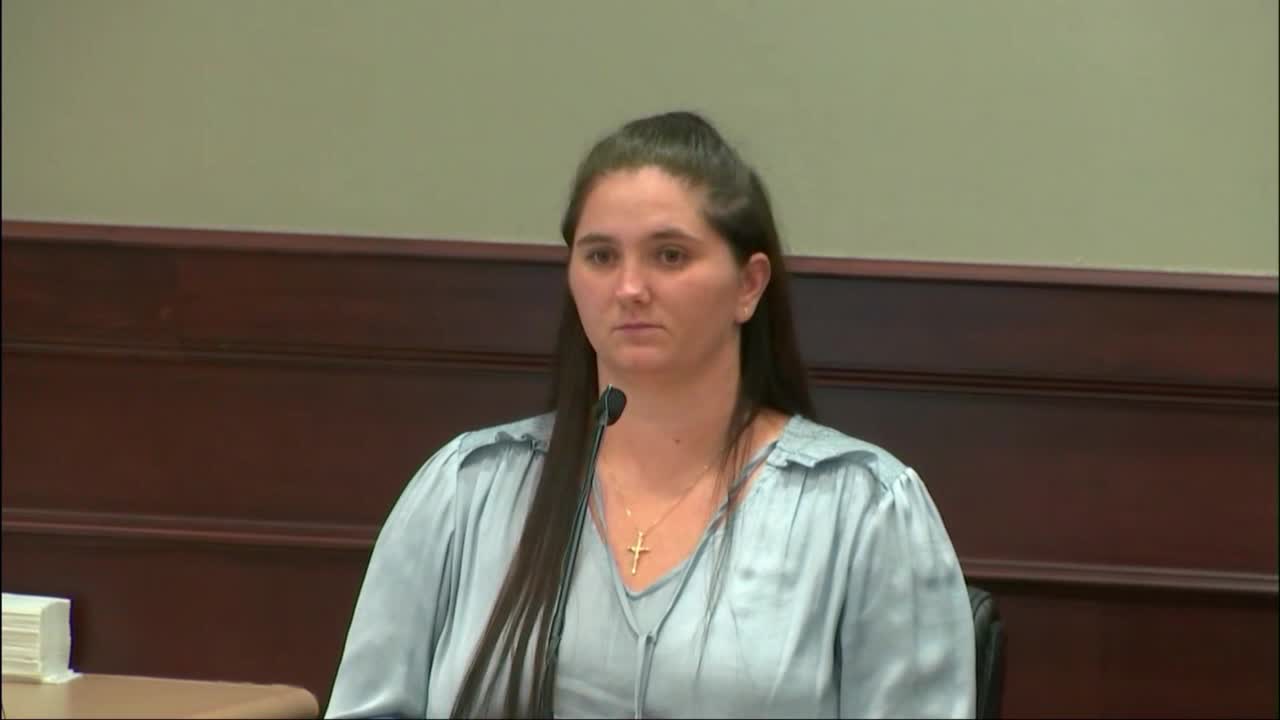
Hannah Payne was convicted of murder, aggravated assault and false imprisonment after shooting and killing Kenneth Herring during a traffic dispute in 2019. She filed an appeal claiming ineffective assistance of counsel; the Georgia Supreme Court heard arguments in her case on Wednesday morning.
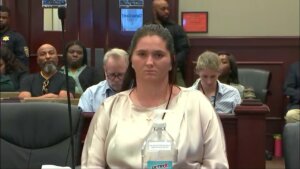
Hannah Payne sits in court on the first day of her trial, Dec. 6, 2023. (Court TV)
Herring, 62, was driving a pickup truck that ran a red light and hit a semi-trailer before taking off. Payne, who was a witness to the initial crash, called 911 but then also chose to follow Herring to try to stop him. She used her vehicle to block Herring and then approached his truck before firing on him. Prosecutors painted Payne as a vigilante; her defense said she acted in self-defense after Herring grabbed her when she approached him.
MORE | GA v. Hannah Payne: Car Crash Vigilante Trial
Payne’s appellate attorneys argue that her trial attorney, Matthew Tucker, was ineffective because he did not realize that there were two defenses he could have used at trial: defense of others and citizens’ arrest. Andrew Fleischman, representing Payne in her appeal, told the Court on Wednesday that Tucker failed to research whether the two defenses would work. “Failure to research a basic point of law is almost, but not quite, deficient performance de facto,” Fleischman said. “Trial counsel’s failure to understand the law dictated the result of this trial, regardless of the facts, and that is why this was ineffective assistance of counsel.”
Fleischman argued that Payne was well within her rights to conduct a citizen’s arrest after witnessing the crash, and that she had a strong case for defense of others based on the risk of another crash on the road. But Tucker focused instead on fighting the false imprisonment charge, Fleishman argued, because he fundamentally misunderstood the law and believed that you could only use defense of others if you knew the people you would be defending. “He was only stuck with this avenue, that’s not a very sound strategy, because he did not know that he could raise defense of others.”
Deborah Leslie, representing the state, argued that whether Payne had raised the alternate defenses or jury instructions wouldn’t have mattered.
Justice Charles Bethel: “Now, just because there’s slight evidence, and just because a charge may have been allowable if asked for, doesn’t make it ineffective assistance of counsel not to ask for it. I just want to make sure that I understand the state’s argument as to why the charge was unavailable as a matter of law.”
Deborah Leslie: “Because the law does not permit a citizen to chase, block, strike, and fatally shoot an unarmed, non-aggressive motorist.”
After arguing for the State, Leslie then faced a tough question from Chief Justice Nels S.D. Peterson, who said that in reviewing the trial court’s order denying a new trial for Payne, “there are at least five citations to cases that don’t exist, and there’s at least five more citations to cases that do not support the proposition for which they’re cited, including three quotations that don’t exist.” Leslie responded that the order she had initially submitted to the court had been revised and took no responsibility for the errant citations.
Justice Peterson: “Those nonexistent cases were cited in your initial brief opposing the motion for a new trial.”
Leslie: “Your honor, I’m not aware of that, but I would be glad to research and provide the court with a supplement.”
The justices took the case under consideration; they did not offer any timeline for when they might issue an opinion.
Payne was sentenced to life in prison plus 13 years for her convictions.