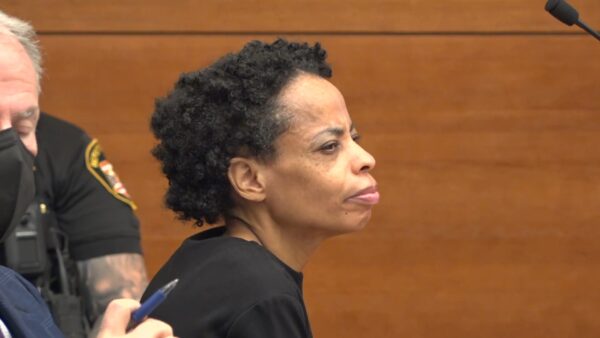

COLUMBUS, Ohio (Court TV) — A jury rejected a defense claim that a woman was insane when she killed her 5-year-old foster son, taking just three hours to find her guilty of murder.

Pammy Maye sits in court on Nov. 10, 2026. (Court TV)
The jury also returned guilty verdicts on charges of tampering with evidence and abuse of a corpse for Pammy Maye, 51, who had admitted to killing Darnell Taylor but maintained she was insane when she did so.
“This is a gut-wrenching tragedy of proportions that are really impossible to put into words,” Maye’s attorney, Samuel Shamansky, told the jury in his closing argument on Tuesday. “What in the world is going on with this woman? She’s either just evil personified, or she is so sick that, of course, she could not appreciate the wrongfulness of this act.”
While Shamansky had urged the jury to consider Maye’s mental health, prosecutor Katherine Wolfe insisted that the defendant’s mental illness had nothing to do with the crime. “The state is not disputing that Maye is severely mentally ill, that she suffers from severe mental illness. We don’t dispute that,” Wolfe said. “We dispute that her mental illness rose to the level that she didn’t know what she was doing at the time that she smothered Darnell Taylor to death.”
Testimony at Maye’s trial, which lasted just one day, revealed that Maye had been upset with Darnell the day before his death because he had taken snacks into his room. Then, on Feb. 14, 2024, Maye waited for her husband to leave for work before going into the child’s room and suffocating him with a plastic bag.
“This was premeditated,” Wolfe said. “She looked specifically for a black trash bag, slowly putting it over his head so he didn’t know it was happening. She told detectives multiple times she planned it. She wanted the result of her actions to be him being suffocated. She even corrected one of the officers when they said she strangled Darnell. She said, ‘No, suffocated,’ just to make that clear.”
An expert who testified at Maye’s trial concluded that the defendant both understood the wrongfulness of her actions and was intentionally exaggerating her mental health symptoms to make them appear worse than they actually are. In his closing, Shamansky challenged the doctor’s assessment. “She’s not feigning anything. She’s sick. She cannot help herself. And that’s the truth,” he said. “It is well understood that people who are mentally ill may nevertheless exaggerate their symptoms. For that reason, evidence of exaggeration should not be used to categorically dismiss valid symptoms. I’m begging you not to do that here.”
After the jury found her guilty on all five charges, Judge Mark Serrott said sentencing would be scheduled in two to three weeks, allowing time for a presentence investigation.