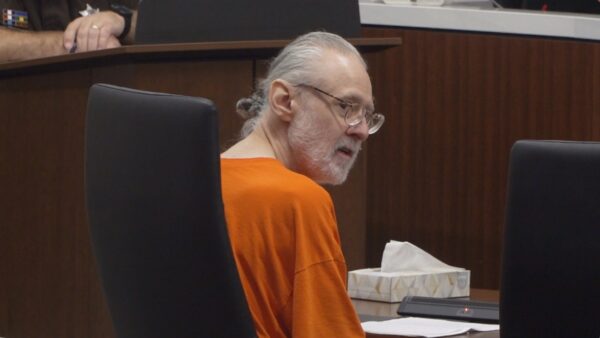

WAUKESHA, Wis. (Court TV) — A Wisconsin man was convicted of killing his neighbor after a trial in which he struggled to represent himself.
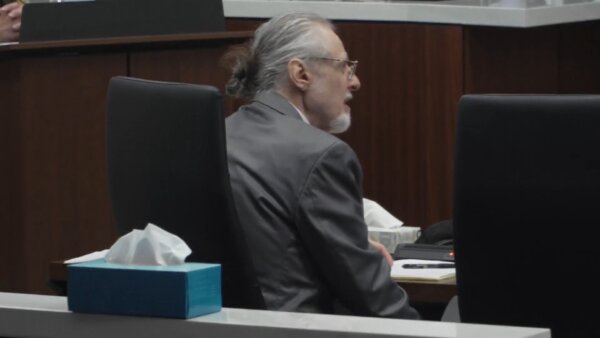
Kevin ‘Conrad’ Lychwick delivers an opening statement. (Court TV)
Kevin “Conrad” Lychwick, 63, was found guilty of first-degree intentional homicide and hiding a corpse in the death of Carlos Maldonado, 55, who disappeared in April 2024. A conviction on the first charge carries a mandatory sentence of life in prison, though the court has the discretion to offer a potential for early release. Sentencing is scheduled for Aug. 20.
“I am not a killer,” Lychwick told the jury during his opening statement. “I am not guilty of this crime. I feel sorry for my poor neighbor, but I did not know him well enough to have any animus against him, and I have never killed anyone in my life. The largest warm-blooded animal I ever killed was a skunk that walked in front of my car by accident years ago.”
Prosecutor Daniel Tombasco told the jury that the evidence in the case tells a different story. Maldonado was last seen alive on April 14, 2024; his daughter reported him missing days later after she was unable to get in touch with him. Months later, on Oct. 30, 2024, a maintenance worker at the apartment complex where both the defendant and the victim lived found a blue tarp in the woods; that tarp covered Maldonado’s decomposing remains. A medical examiner determined that the victim had been shot twice — once in the torso and once to the center of the face. Two projectiles were found with the body.

Carlos Maldonado’s remains were found months after his disappearance. (court exhibit)
Video from a trail camera in the woods allegedly shows Lychwick walking around the area where the remains were found on April 29, 2024. Investigators reviewed the video and said “they saw the defendant carrying a white trash bag. They saw him suspiciously looking in windows of the apartment complex as if he was looking to see if somebody was watching what he was doing,” Tombasco said. The video also appears to show the defendant carrying a tool of some sort, investigators said.
Police said that when they began investigating Lychwick, they made several startling discoveries. A search warrant served on Lychwick’s home allegedly revealed handwritten notes “with several ‘operations’ listed on them. One of those “operations,” titled “Operation Slop Shop” had the victim’s name written beneath it and identified Maldonado “as a threat.” A second paper “indicated that Operation Slop Shop had been completed, that the threats from the first stop had been ‘neutralized,'” prosecutors said. An additional piece of paper listed “several other operations listed with many other individuals” with a connection to the defendant, Tombasco said.
Tombasco told the jury that investigators uncovered “the Holy Grail of evidence” when they stopped Lychwick’s car for speeding. Inside the trunk was a 1939 Luger firearm; the ballistics matched the two projectiles found with the victim’s body.

Handwritten notes were allegedly found in Kevin ‘Conrad’ Lychwick’s apartment. (court exhibit)
Lychwick struggled to argue against the mountain of evidence in his opening statement, with prosecutors repeatedly objecting when the defendant tried to claim the police searches were illegal. “The court has made a ruling that the searches in this case were valid and they were constitutional, so I’m not going to permit arguments that the searches were not legal,” Judge David Maas warned Lychwick.
Lychwick also tried to paint himself as the victim of police determined to frame him for the crime. “I am unprepared for this trial. I am in poor health,” he told the jury. “I enter these proceedings under protest. … I am not an attorney and I have no access to my assets right now and I had no access to a telephone or lawyer.” When Lychwick tried to explain to the jury why he is representing himself — calling his former attorney “grossly inadequate” — the judge cut him off again. “I should not weigh their — sway their decision one way or the other whether or not you’re in custody; you are your attorney and you are held to the standards of an attorney, whether that attorney is well-prepared or prepared at all. Nonetheless, the trial’s going, so that’s not going to be considered by the jury either.”
DAILY TRIAL HIGHLIGHTS
DAY 4 – 6/11/26
- LIVESTREAM: WI v. Kevin Lychwick – Day 4 | ‘Hit List’ Homicide Trial
- Detective Ben Stern, City of Waukesha Police Department
- Detailed the grid search conducted.
- Testified to a June 10th recording.
- The prosecution delivered closing arguments.
- Kevin Lychwick delivered a closing argument, but was interrupted repeatedly when he tried to offer the jury information not in evidence.
- The jury deliberated for less than an hour before finding the defendant guilty.
DAY 3 – 6/10/26
- LIVESTREAM: WI v. Kevin Lychwick – Day 3 | ‘Hit List’ Homicide Trial
- Amy Sheil, Assoc. Medical Examiner
- Arrived at the scene; removed vegetation and branches to reveal a blue tarp.
- Ribs and vertebrae were visible from within the tarp.
- The tarp was placed into two body bags — one inside the other — due to decomposition.
- Remains were identified as “October Doe” initially because there was no way to make an identification at the scene.
- Dental records confirmed the remains were Carlos Maldonado.
- A gunshot to the torso would have hit his right kidney, ascending colon, vena cava, small intestine and pancreas.
- The estimated date of death was April 14, 2024.
- Pamela Taylor, DNA analyst, Wisconsin State Crime Lab
- Explained StarMix, a computer program that separates DNA contributors by percentage.
- Gun was presented as evidence.
- Lychwick denied the gun was his.
- Jana Marie Truesdell, Forensic anthropologist
- 189 of Maldonado’s 206 bones were recovered. Missing bones included the xyphoid process (chest bone), four bones of the right wrist, three bones of the left wrist and a metacarpal.
- 26 complete teeth recovered and three incomplete teeth.
- Victim estimated to be 50 to 80 years old.
- Detective Ben Stern, Waukesha Police Dept.
- Saw autopsy and saw four ropes removed from around the victim’s body.
- The ropes appeared to have been tied after death.
- Reviewed surveillane footage.
DAY 2 – 6/9/26
- LIVESTREAM: WI v. Kevin Lychwick – Day 2 | ‘Hit List’ Homicide Trial
- MORE: ‘I refuse to be a part of this’: Angry pro se defendant spars with judge
- Anthony LeFebvre, neighbor
- Interacted with the defendant in passing, who referred to himself as Conrad.
- Knew of the victim.
- Installed a trail camera in the summertime of 2024 because he was building a garden (with the permission of the apartment complex).
- Trail camera video showed Kevin Lychwick appearing to hold a trash bag on May 2, 2024, at 12:41 a.m.
- Police Officer Carren Gummin (Ret.)
- Was a cadaver dog handler and worked with Moxie, who was trained for human remains detection.
- Moxie conducted a search on November 19, 2024, in a parking garage, where she gave a trained final response indicating the presence of human remains in the door frame of a maintenance room.
- Searched the boiler room and garage and indicated a response in the boiler room near a workbench and in a corner with carpet remnants.
- Inside apartment 13, Moxie detected human remains in the kitchen near the sink and in the bedroom near an empty dresser area.
- A canine search was conducted on the property, where the dog detected the odor of human remains in multiple locations. However, no actual human remains were identified in those areas.
- Detective Tyler Bauer
- Assisted in executing a search warrant at Lychwick’s apartment on Nov. 26, 2024.
- A white rope was on a chair in his bedroom. The rope was consistent with the rope found on the victim’s body.
- Found notes and files related to an operation called “Operation Slop Shop” during a search of the defendant’s living room. The notes reference the defendant’s connection to a subject named Carlos Maldonado and potential threats.
- Erin Christensen, specialist
- Focused on location data records and went over the data locations for Carlos Maldonado on April 14, 2024.
- Tried to get data from Lychwick but was unable to get data dating back to April 14.
- Detective David Feyen
- Extracted cell phone data from Carlos Maldonado and Kevin Lychwick.
- Went through browser history on April 13 and activity on the 14th; Maldonado called Home Depot.
- Did the same process for Lychwick and sent the information to another detective for analysis.
- Detective Bryce Scholten
- Responded to the search warrant at Lychwick’s apartment on Nov. 26, 2024.
- Talked about the makeshift desk and boxes found in the living room.
- Discussed “Operation Slop Shop” and “Operation Starling.”
- Lychwick was looking for storage units on Google.
- Detectives followed Lychwick to a U-Haul rental place.
- Brianna Maloney, U-Haul facility assistant manager
- Testified to Kevin moving his items out of the facility and closing his storage unit.
- David Platta, specialist
- Called to the scene on Oct. 30, 2024, and assisted with the search of the victim’s apartment. The apartment appeared fairly clean and normal.
- Performed a more detailed search on Nov. 1, 2024.
- Searched Kevin Lychwick’s vehicle and found a firearm in the trunk.
- Andrew Schmidt, specialist
- Transported evidence to the crime lab on Nov. 8, 2024.
- Analyzed a white rope in connection with the case.
- Testified to the firearm and shell casings.
- Analyzed the defendant’s boots.
- Jessica Crawford, Firearms and toolmark examiner
- Received a German Bowser Model Luger 1939 9mm caliber semi-automatic in her lab for testing.
DAY 1 – 6/8/26
- LIVESTREAM: WI v. Kevin Lychwick – Day 1 | ‘Hit List’ Homicide Trial
- Prosecutor Daniel Tombasco delivered an opening statement.
- Carlos Maldonado was shot twice in the torso and the face on April 14, 2024.
- A maintenance worker found the victim’s body on Oct. 30, 2024.
- Videos show the defendant acting suspiciously and carrying a trash bag.
- Kevin Lychwick delivered his own opening statement.
- He is not guilty and he did not know the victim.
- He feels sorry for Maldonado; the only thing he’s ever killed is a skunk.
- He is not prepared for this trial and is in poor health.
- This case should have been dismissed eight months ago.
- He is a law-abiding citizen of the Christian faith; he said he served as a security officer in the U.S. Air Force.
- Glenda Rose, apartment manager
- Lived at the apartment complex for 36 years and knew both the victim and the defendant.
- Maldonado lived between Rose and Lychwick.
- Received a call on Oct. 30 that a body was outside.
- Last saw the victim on April 14; after that he was not around the property, which was unusual.
- Nichelle Nelson, crime scene technician
- Called to the scene of a possible body found on Oct. 30.
- Went over crime scene photos.
- Talisa Maldonado, victim’s daughter
- She was close to her father at the time of his death; they were rekindling their relationship.
- Talked to her dad on April 13. When she tried to call him after that he did not answer, which was unusual.
- She was worried and confused when her father disappeared.
- Called homeless shelters and hospitals to search for her father.
- Dr. Alex Wiedenhoft, botanist
- Discussed plant material evidence and analysis using microscopes.
- Detective Christopher Bloom
- Called to the victim’s storage unit in November 2024.
- Recovered a saw that Carlos had rented the last time he was seen alive.
- Detective Lukas Hallmark
- Discussed the purchases the victim made along with the saw on April 14.
- Detective Jessica Behrendt
- Responded to the scene on Oct. 30.
- After the victim’s death, Lychwick purchased gloves, scrub pads, large gloves, masking tape, dish soap and Febreze at the Dollar Tree. At Walmart, he bought trash bags and gloves. He returned to the Dollar Tree on May 7 to buy bleach.