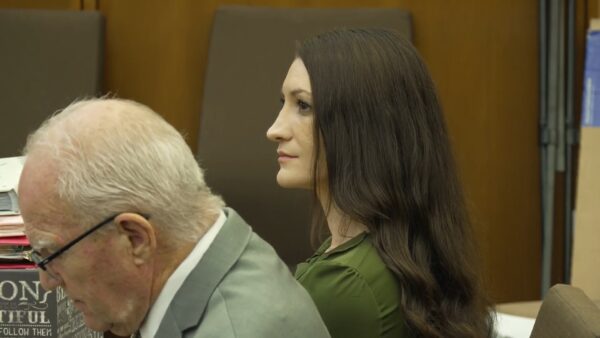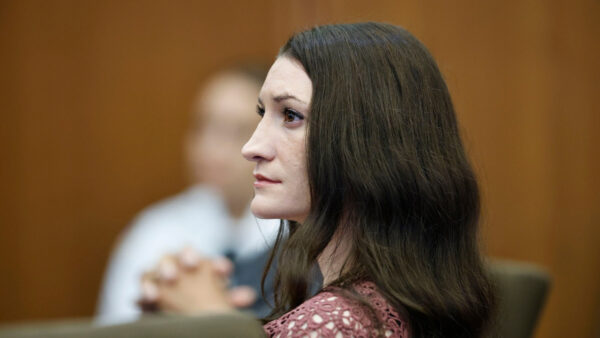

PLYMOUTH, Mass. (Court TV) — A state police officer who testified in Lindsay Clancy’s murder trial on Wednesday told the jury that the prosecution had a theory that a doctor told the defendant to claim she heard voices.
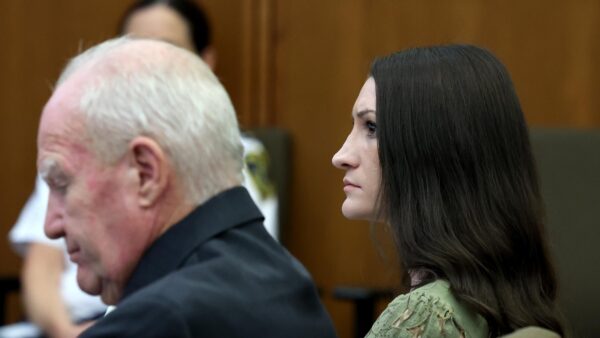
Lindsay Clancy appears in court on Aug. 12, 2026. (Mark Stockwell/Pool)
Lindsay Clancy, 36, has pleaded not guilty to charges that she murdered her children — Cora, 5, Dawson, 3, and Callan, 8 months — by strangling them with exercise bands in the basement of the family’s home. The defendant has conceded that she killed the children, but has maintained that she was suffering a mental health crisis brought on by postpartum psychosis at the time and is not criminally responsible.
After killing the children, Lindsay Clancy sliced her arms and neck with a knife and jumped from a second-story window. Her husband, Patrick Clancy, returned from picking up dinner to find her in the yard and the children in the basement.
Cora and Dawson were pronounced dead after they arrived at the hospital; Callan survived for three days before he was removed from life support. Lindsay Clancy was hospitalized for months after the incident and is paralyzed from her injuries.
While she was hospitalized, Lindsay Clancy was not allowed to have any visitors or speak to anyone. To ensure this, police were stationed outside of her room at Brigham and Women’s Hospital. On Wednesday, Massachusetts State Police Sgt. Dan Lawlor testified that he was among those tasked with guarding her door.
Lawlor testified that on one day, he was instructed to allow psychiatrist Paul Zeizel to enter the defendant’s room after Lindsay Clancy’s attorney, Kevin Reddington, obtained a court order allowing her to be seen by the doctor. Lawlor said that during the visit with Zeizel, the door to the defendant’s hospital room was closed.
During that visit with Zeizel, the doctor allowed Lindsay Clancy to use his phone to call Patrick Clancy — and it was apparently during that phone call that the defendant first mentioned that she had heard a voice compelling her to kill the children. “Isn’t it fair to say that one of the contentions of the district attorney’s is that …. I got a court order to go in to see her, told her to call Pat and tell him that she heard voices?” Reddington asked Lawlor.
Lawlor testified that he understood the prosecution’s theory to be that Zeizel encouraged the defendant to call Patrick Clancy and claim she heard voices.
Prosecutor Shanan Buckingham fired back at the accusation. “You never had a conversation with the prosecution about their theory of the case, did you?” she asked Lawlor. Lawlor confirmed that his understanding came not from prosecutors, but from a conversation he’d had with the lead detective assigned to the case.
Other medical professionals who treated Lindsay Clancy in the days and weeks before her children’s deaths previously testified in the trial that while the defendant appeared anxious and reported depression, there was no indication that she was suffering from psychosis or was a danger to herself or others.