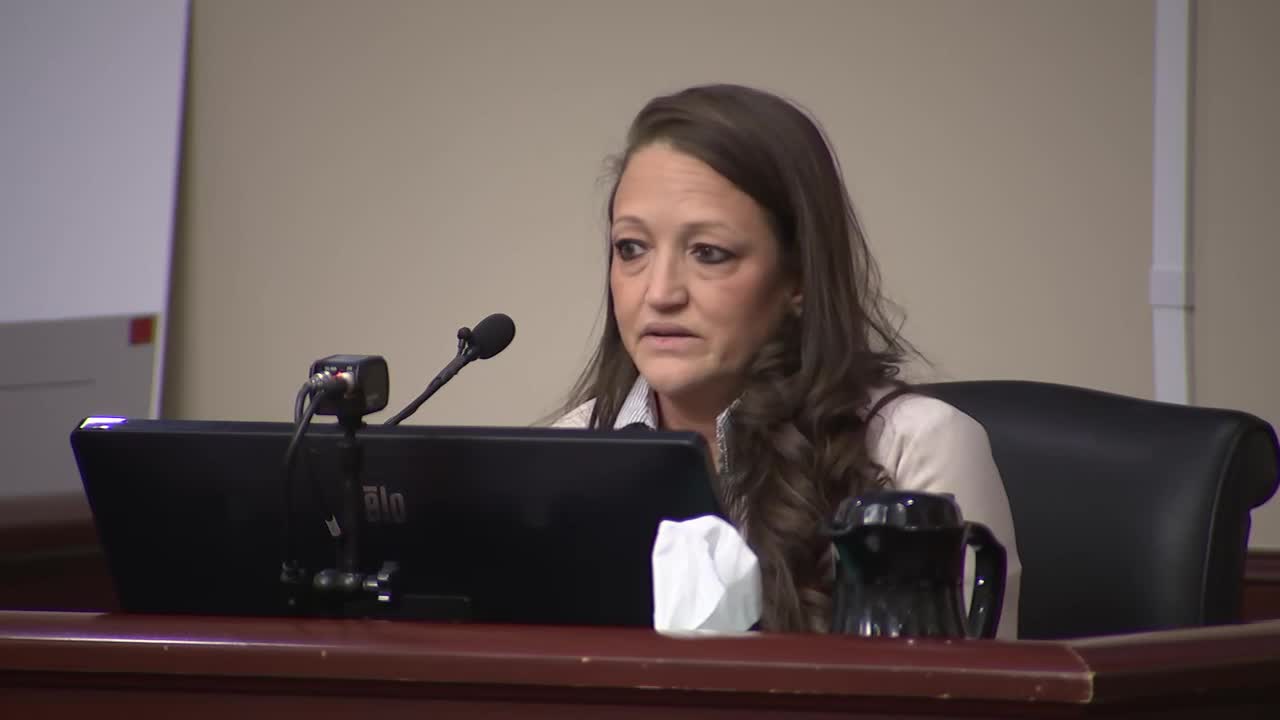
ATHENS, Ga. (Court TV) — Edrick Faust is facing life in prison after being convicted in the cold case murder of University of Georgia law student Tara Louise Baker.
Baker, a first-year law student, was last seen on the evening of Jan. 18, 2001, studying in the UGA law library. A close friend testified that she spoke with Baker by phone just before 10 p.m. that night — a brief conversation in which Baker checked to make sure her friend was safely home and ended the call saying they would talk the next day. According to the indictment, firefighters responding to a fire at Baker’s apartment later discovered her body, and investigators determined the blaze had been intentionally set.

(L) Edrick Faust appears in court on Feb. 3, 2026. (Court TV), (R) Tara Louise Baker (GBI)
Prosecutors told jurors that Baker was sexually assaulted, stabbed in the neck, strangled with a printer cord and left on her bedroom floor just hours before her 24th birthday. Her bed was deliberately set on fire using a blanket taken from the living room, an act the state says was meant to destroy evidence.
“The physical evidence tells a coherent story of the crime,” prosecutors said, pointing to the knife found beneath Baker’s body and the stopped clock in her room.
WATCH | Tara Baker Murder Trial: State’s Opening Statements
Investigators found signs of staging at the crime scene, including wiped surfaces, tampered doors and windows, and no usable fingerprints. Even the bathtub drain was removed in an exhaustive effort to preserve potential evidence.
For more than two decades, the case went unsolved. Prosecutors emphasized the persistence of investigators and advances in forensic science, noting that in 2024, the Georgia crime lab finally isolated male DNA from preserved evidence. That DNA was identified as a major contributor and run through CODIS, a database containing roughly 26 million profiles.
On April 30, 2024, DNA evidence matched Faust, marking the first time his name appeared in the case in 23 years. Prosecutors say a warrant was then obtained to confirm the DNA match through additional swabs.
The defense countered aggressively, telling jurors there is no direct evidence placing Faust at the crime scene. Defense attorneys stressed the absence of fingerprints, eyewitnesses or contemporaneous links between Faust and the victim. They highlighted that hair found in Baker’s hands was Caucasian, not African American, and warned jurors against allowing moral judgments about Faust’s lifestyle or choices to influence their decision.
WATCH | Tara Baker Murder Trial: Defense’s Opening Statements
Defense counsel also revived scrutiny of Chris Melton, Baker’s boyfriend at the time, noting his initial status as a prime suspect, alleged inconsistent statements and visible injuries to his hands documented shortly after the murder. The defense framed the state’s case as an attempt to retrofit a suspect to a cold case using DNA alone, urging jurors to focus on reasonable doubt rather than the emotional weight of the crime.
A heated moment unfolded in court when defense attorney Ahmad Crews was held in contempt and fined $1,000 after prosecutors objected twice to comments made during opening statements. Crews said the comments were not intended to circumvent the statute, but rather to show Chris Melton’s consciousness of guilt in his conflicting statements. Judge Lisa Lott ruled the remarks violated Georgia’s rape shield law, known as Rule 412, which limits references to an alleged victim’s sexual history without prior court approval. The judge went on to explain that if the defense believes the evidence is relevant, they must file a formal notice and obtain court approval before referencing it before the jury.
A jury found Faust guilty of all charges, including malice murder.
This story was generated with the assistance of AI using information gathered and verified by a human journalist. Our editorial team verifies all reporting on all platforms for fairness and accuracy before publication.