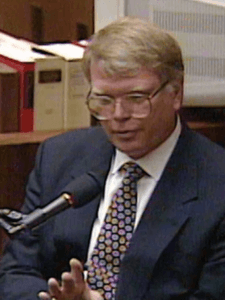
Testimony of Dr. Henry Lee  
   
THE COURT: All right. Thank you, ladies and gentlemen. Please be seated. Let the record reflect that we have been rejoined by all the members of our jury panel. Good morning, ladies and gentlemen.

THE JURY: Good morning.

THE COURT: All right. Dr. Henry Lee.

DR. LEE: Yes.

THE COURT: Dr. Lee, would you resume the witness stand, please.

DR. LEE: Your Honor. Good morning.

Henry C. Lee, the witness on the stand at the time of the evening adjournment, resumed the stand and testified further as follows:

THE COURT: The record should reflect that Dr. Henry Lee is again on the witness stand. Good morning, Dr. Lee.

DR. LEE: Good morning, sir.

THE COURT: Doctor, you are reminded that you are still under oath. And Mr. Goldberg, you may commence your cross-examination.

MR. GOLDBERG: Thank you.

CROSS-EXAMINATION BY MR. GOLDBERG

MR. GOLDBERG: Good morning, Dr. Lee.

DR. LEE: Good morning.

MR. GOLDBERG: How are you doing today?

DR. LEE: A little tired.

MR. GOLDBERG: Good morning, ladies and gentlemen.

THE JURY: Good morning.

MR. GOLDBERG: Now, Dr. Lee, I just wanted very briefly to ask you a few questions about some of the qualifications that you went over with Mr. Scheck when you began your testimony. Just so we are clear, you are an expert in forensic DNA technology; is that correct?

DR. LEE: A lot of people refer me as an expert, yes.

MR. GOLDBERG: Okay. And you consider yourself to be an expert in forensic DNA technology?

DR. LEE: I know something about DNA. Little bit; not everything.

MR. GOLDBERG: Quite a bit, right, in terms of its forensic application?

DR. LEE: Forensic application, yes.

MR. GOLDBERG: All right. And Mr. Scheck was asking you about some of the things that your laboratory does in the forensic area. Is this laboratory exclusively a forensic laboratory?

DR. LEE: Yes.

MR. GOLDBERG: All right. And are you using RFLP technology in forensic cases?

DR. LEE: Yes.

MR. GOLDBERG: And are you also using PCR technology in forensic cases?

DR. LEE: Yes.

MR. GOLDBERG: Dr. Lee, are you using PCR technology in criminal cases both to include and exclude people as having committed a crime?

DR. LEE: Yes.

MR. GOLDBERG: All right. Now, you were asked about some of the cases that you and your lab people have participated in involving the identification of human remains. Do you remember that?

DR. LEE: Yes, sir.

MR. GOLDBERG: Now, most of the cases that were referred to happened abroad, I think one in South America and then there was a number of instances in Europe; is that correct?

DR. LEE: Some in this country, too, yes.

MR. GOLDBERG: What were the technologies that are being used in the cases that you referred to on direct examination for purposes of human identification?

DR. LEE: Human identification basically bone technique, depends on the bone sample. Smaller sample, we have to use PCR, no other choice. If no high molecular weight DNA, with extract from the sample, we will have to do the best we can do. If have a large amount of sample, of course RFLP is a choice.

MR. GOLDBERG: Okay. And sir, when you are saying that you used PCR technology, does that include the cases that you were referring to in--as a result of the conflicts in Europe to identify people that have been killed as a result of the war there?

DR. LEE: Yes. Those are victim was found on an unnamed grave or masked grave, unidentified human remains. For humanity reason we want to find out what is the loved one, so we try to help those country identify those human remain.

MR. GOLDBERG: And Dr. Lee, is it your stated position that forensic scientists are in the best position to evaluate whether PCR technology is ready to make the technology transfer into the forensic field?

DR. LEE: I think forensic scientists should have a good say about what method we should do, what is the reliable procedure, what kind of applications. Certain sample, doesn't matter what we do, we have problems. Other samples, forensic scientists, we should have a choice not dictated by molecular biologist or other scientists tell us what to do.

MR. GOLDBERG: Okay. Now, Dr. Lee, I wanted to just mention very briefly or ask you very briefly about one of the matters that you just alluded to a few moments ago.

DR. LEE: Yes, sir.

MR. GOLDBERG: Regarding identification of human remains in cases here in the continental United States.

DR. LEE: Yes.

MR. GOLDBERG: Your most famous such case where you were personally involved at the crime scene, not at the time of the crime, but afterwards.

DR. LEE: Thank you very much.

MR. GOLDBERG: Yes.--was the People versus Crafts case; is that correct?

DR. LEE: Yes, sir.

MR. GOLDBERG: Okay. And was that a case, sir, where the victim in that case, Helen Crafts, was killed by her husband and she was--he disposed of her by putting her body through a wood chipper machine?

DR. LEE: Yes.

MR. SCHECK: Your Honor, may we approach?

THE COURT: With the court reporter, please.

(The following proceedings were held at the bench:)

THE COURT: All right. We are over at the side bar.

MR. SCHECK: As the jury was filing in Miss Martinez walked over and handed me this rather thick volume and said, "Oh, we are also going to be asking about the Crafts case." So I would like to know--he may know all about Dr. Lee's cases, but I certainly don't.

MR. GOLDBERG: Your Honor, I don't intend to use this for impeachment purposes because I think he is going to tell me everything I want to know. And I'm going to ask him about this case for about three or four minutes very, very briefly.

THE COURT: What are we talking about? Using DNA to tell us who this was?

MR. GOLDBERG: And conventional serology.

MR. SCHECK: Well, could he tell me with some specificity so I know? I may not regard it as impeachment, but I'm entitled no know what he is going to be referring to.

MR. GOLDBERG: I don't know if he is actually. The body was chopped up, was spread outdoors, it was there for some time, the police collected it, think--

THE COURT: Bits and pieces.

MR. GOLDBERG: Yes. It is a very famous case.

THE COURT: Yes, I am familiar with it.

MR. SCHECK: I am the only one that isn't.

THE COURT: This is the one where the guy kills his wife, chops her up and puts her in a wood chipper.

MR. SCHECK: This is the wood chipper case?

THE COURT: There is little bits of bones and they do DNA and he says the wife took off. He gives some alibi that she--

MS. CLARK: She split.

THE COURT: --she split or left him or something like that, but she is actually spread over the north forty.

MS. CLARK: Remind you of Trott's case?

THE COURT: Okay. Let's proceed.

(The following proceedings were held in open court:)

THE COURT: All right. Thank you. Mr. Goldberg, you may proceed.

MR. GOLDBERG: Thank you, your Honor.

MR. GOLDBERG: And in that particular case is it a fair summary of what happened that the biological evidence was spread over a very significant amount of territory, about 2500 square feet, in the snow by a river as a result of the body having gone through the wood clipper machine?

DR. LEE: The majority this and probably wound up in the river. Only small fragment were found scattered around the river bank.

MR. GOLDBERG: Okay. And when you got out to the crime scene the police officers were picking out one little piece of evidence at a time; is that correct, in a very laborious process?

DR. LEE: We actually melt the snow inch by inch and we don't know what we picked up, just leaves, debris, and go through preliminary recognition and identification through that.

MR. GOLDBERG: Okay. That was the suggestion that you came up with to speed things up, because you saw that the police method was just going to take too long; is that correct?

DR. LEE: No. We work together. It is a team effort.

MR. GOLDBERG: Right. And just so it is clear, what was done in this case is large amounts of snow were put in buckets and then taken into tents and melted and the biological evidence would tend to fall or sink to the bottom of the bucket and all the debris would tend to rise to the top and you just throw the debris out and take the biological evidence out in the bottom?

DR. LEE: Not exactly. Any recognizable material, for example, we found a fingernail, you can recognize, you don't have to throw in a bucket. You just taken it out. If it is bone chips, we can recognize, or a tooth. We have a team of scientists, team of investigator work together since we can see and recognizable right away, you remove it. For example, I can see a scissor, I collect a scissor. I don't have to throw the scissor in the bucket. Things we cannot visually recognize, we use the second procedure.

MR. GOLDBERG: And that included some of the biological evidence in the case?

DR. LEE: Yes.

MR. GOLDBERG: And Dr. Lee, when that occurred, when the items would fall to the bottom of the bucket, various different biological samples could get mixed together or were mixed together; is that correct?

DR. LEE: Yes, yes.

MR. GOLDBERG: And it also mixed together human biological samples with others that were out there, like deer bones and the like; is that correct?

DR. LEE: Yes, correct.

MR. GOLDBERG: Yes. And despite that, sir, it was proper and you did decide to attempt DNA technology on this evidence; is that correct?

DR. LEE: That's correct.

MR. GOLDBERG: All right. But this case was a little while ago, as I recall, it was in the mid-eighties?

DR. LEE: Yes.

MR. GOLDBERG: So with the state of the technology at that time, you were not actually able to do DNA, true?

DR. LEE: No. We did some DNA work.

MR. GOLDBERG: Oh, you did?

DR. LEE: We did some X, Y, determine male, female.

MR. GOLDBERG: Okay. You were also able to do--when I say "You" I'm also including your laboratory people--

DR. LEE: Yes.

MR. GOLDBERG: --able to do some conventional serology; is that true?

DR. LEE: We did with laboratory scientists also are some consultant life code scientists, University of New Haven, Dr. Gaensslen, and we bring in a lot of other expert together work on the evidence.

MR. GOLDBERG: Okay. And you were able to get results that identified the human remains in that case even though all the biological evidence was mixed together at the time that it was collected?

DR. LEE: Yes, sir.

MR. GOLDBERG: And in fact in that case, to your recollection, did the police transport the biological evidence to the lab in sealed containers?

MR. SCHECK: Your Honor, I think that this is outside the scope of direct and irrelevant.

THE COURT: Overruled.

DR. LEE: We--those material collect in a container is a plastic cup, have a screw-up cap. Also put in an envelope, it is a sealed paper bag.

MR. GOLDBERG: Okay. All right. Now, when you were looking at the soil samples in this particular case, you didn't find biological material such as deer bones or anything like that at the Bundy location, did you?

DR. LEE: I found some biological material, as I testified, hair, that is considered as a biological material. I did not look for deer bone.

MR. GOLDBERG: Okay. Now, you were also asked some questions about your laboratory in general and the people that work for you and such, the environment in which you are working as a forensic scientist, and I wanted to ask you a couple questions there, if I may.

DR. LEE: Yes.

MR. GOLDBERG: Do you agree, sir, that one of the practical realities that criminalists face who are working for law enforcement, is budgetary problems and monetary shortfalls?

DR. LEE: Yes.

MR. GOLDBERG: And is it true that even recently, after you got into your new laboratory, you had to lay off some people due to some financial difficulties in the state?

DR. LEE: Have to remove, no, that is not correct.

MR. GOLDBERG: Was that slightly--

DR. LEE: Before. A couple years ago we have to lay off some people. After we moved to the laboratory we have some vacant positions and with the assistance of governor and legislature, we was able to fill those positions.

MR. GOLDBERG: So would you agree, sir, that generally speaking, forensic resources are scarce in the sense that we can't do all the testing and all the study in every case that we would like to do?

DR. LEE: That is absolute correct. Of course if you have the support of the leadership, for example, I have a good boss, my commissioner very supportive to forensic science, so we try to do what supposed to do. Of course impossible to do every possible test in this earth for a certain case.

MR. GOLDBERG: Okay. So in theory there are theories about the ideal in terms of crime scene processing and handling a case that are stated in the textbooks; is that correct?

DR. LEE: Handling crime scene and laboratory tests, that is two separate things. Handling crime scene, you don't need sophisticated instruments such as SEM or mass spectrograph, or handling crime scene basically is training and experience and some mechanic issues.

MR. GOLDBERG: Let me give a concrete example. We talked about using videotapes at crime scenes.

DR. LEE: Yes.

MR. GOLDBERG: And ideally that would be a good idea if we could use that at every crime scene?

DR. LEE: Yes, sir.

MR. GOLDBERG: But based upon your experience, not only at your own lab, but traveling around the country as you do into other countries, is it correct to say that even in very serious crimes a videotape is not now currently being used as a standard technique at crime scene identification, crime scene investigation?

DR. LEE: It is difficult to--most--most of crime scene involve homicide usually we suggest use videotaping and most the cases I see videotape when it submit to me, but once in a while cases without videotaping.

MR. GOLDBERG: Okay. And that is because we don't have the resources necessarily to do all the videotaping we would like to do; is that correct?

DR. LEE: That is a judgment call. If you want to find a videotape, you always can find a camcorder. Whether or not the department has that, I don't know. I cannot come here to tell you what the LAPD budget looks like.

MR. GOLDBERG: Okay. Now, does financial difficulty also play a little bit of a role in terms of testing at the laboratory and the amount of testing that do you in a like--

DR. LEE: Yes. That is an excellent question. We usually have to determine what type of test to do first, second, third, so non-destructive test. Basically visual examination, microscopic, microscopic examination, that don't cost any money, then the rest of tests, some are more sophisticated, them cost money, you have to make a judgment call.

MR. GOLDBERG: And to face a lot of problems along those lines over the years in your laboratory, for example, in the old facilities, is it true that when you would use the electrophoresis machines the air conditioning would shut down?

DR. LEE: Yes.

MR. GOLDBERG: All right.

MR. SCHECK: Your Honor, I think that this line is going to be irrelevant.

THE COURT: All right. Let's move on.

MR. GOLDBERG: I'm almost finished, your Honor. I just have a couple more questions.

MR. GOLDBERG: And for example, in the DNA testing, you have used paper towels as blotters instead of the blotter paper, to save money?

DR. LEE: Early days. Early days we have to--my laboratory is a mens room, literally a mens room, so you have to do the best you can.

MR. GOLDBERG: Yeah.

DR. LEE: You can't just say I'm in a mens room, I don't do any tests.

MR. GOLDBERG: Right. And the drying facilities, up until quite recently, for biological evidence, was in the yard of the laboratory; is that correct?

DR. LEE: That is about fifteen years ago. We don't have a drying room, so everything have to dry in the yard. Even now sometimes dry my clothes in the yard. Nothing wrong dry in the yard.

MR. GOLDBERG: I'm not saying there is anything wrong with it, no, not at all, and that was particularly true in the summer months, some of the biological evidence you would try to dry in the yard because it was smelly?

DR. LEE: Yes. The older really terrible, you don't want to have the whole laboratory evacuate. Sometime the odor the young and normal person can take.

MR. GOLDBERG: And was the practice of drying the biological evidence in the yard discontinued once when a dog absconded with a rape victim's panties?

DR. LEE: Not really. There are numerous clothing. One of my analysts was assigned to guard those clothing. Somehow a wild dog took a piece of garment and run away and luckily that just one piece of an undergarment. It is not all decomposed.

MR. GOLDBERG: Okay.

DR. LEE: So since then we have to post two guards to watching the clothing.

MR. GOLDBERG: All right. And despite these kinds of problems and issues that we have been discussing this morning, generally, Dr. Lee, would it be fair to say that you and your laboratory people in the area of DNA and conventional serology have still been doing a very high quality work?

DR. LEE: We try our best.

MR. GOLDBERG: Yes. These are little obstacles that have to be overcome; is that true?

DR. LEE: Yes.

MR. GOLDBERG: Now, Dr. Lee, I would like to turn to the shoeprints at Bundy and let's try to divide our discussion up into three categories, if we can. I want to talk about the shoeprints, or excuse me, the--the items that we cannot say are impressions at all for sure.

DR. LEE: What I testify is imprint evidence.

MR. GOLDBERG: Yes.

DR. LEE: Imprint evidence.

MR. GOLDBERG: Okay. Now, is one category, though, items where you can't even be sure that it is in fact an imprint; it could be an imprint, it might not be?

DR. LEE: Well, imprint it is different--it is a term we use to differentiate from impression. Impression is a three-dimensional pattern. An imprint is a two-dimensional pattern. What I testified first day I was here to report to you those two-dimensional imprint pattern I observe on different areas.

MR. GOLDBERG: All right. Now, what I'm asking you, though, Dr. Lee, at the Bundy location and the evidence that came from the Bundy location--

DR. LEE: Yes.

MR. GOLDBERG: --were there certain instances where you saw something and it was your opinion I can't tell whether that is an imprint or not?

DR. LEE: Yes, sir.

MR. GOLDBERG: Okay.

DR. LEE: Some evidence I see a pattern because I examine picture. When you examine picture, you are examining something through photographer's camera lens. I wasn't there myself. If I see something, I can tell that is some kind of an imprint. As far as a shoeprint or not, I don't know. I don't want to make an opinion on that.

MR. GOLDBERG: All right. Well, let's see if we can get into some of the specifics here. Regarding Ron Goldman's jeans--

DR. LEE: Yes.

MR. GOLDBERG: --with respect to some of the items on the jeans, was it your opinion "I see to parallel line imprint consistent with imprint"?

DR. LEE: Yes.

MR. GOLDBERG: Okay. And by that did you mean I'm not positive whether this is an imprint or not?

DR. LEE: Well, I'm pretty sure it is an imprint; however, as a scientist I usually report to you what I see. I did examine the blue jean, by the way, however, I don't know the blue jean--when somebody wear the blue jean, that is three-dimensional setting.

MR. GOLDBERG: Your Honor, I think he has answered the question.

THE COURT: Next question.

MR. GOLDBERG: It will make things a little faster. I will give you the opportunity to explain.

MR. GOLDBERG: Dr. Lee, so with respect to some of the items on the blue jeans, it was a situation where you cannot state to a scientific certainty that they were in fact impressions at all; is that true?

MR. SCHECK: Objection, vague, as to which items.

THE COURT: Sustained. Rephrase the question.

MR. GOLDBERG: Well, as to the prints that you were talking about on the right portion of the lower leg--

MR. SCHECK: Objection.

THE COURT: That is vague, "Right portion lower leg."

MR. GOLDBERG: On the right leg, lower portion, Dr. Lee?

MR. SCHECK: There is a board, your Honor. There is a lot on the right--

THE COURT: Overruled.

DR. LEE: I see some patterns, parallel pattern consistent with imprint.

MR. GOLDBERG: Okay. And "Consistent with" is a phrase that is used when we are not certain; is that right?

DR. LEE: (No audible response.)

MR. GOLDBERG: Sometimes?

DR. LEE: Yeah.

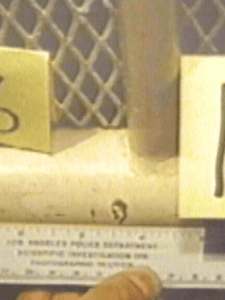
MR. GOLDBERG: Now, there was also a photograph that you were shown that depicted the caged-off area and we will get to that in a little more detail later.

DR. LEE: Okay.

MR. GOLDBERG: But there was something that looked like a hole in that. Do you remember that?

DR. LEE: Yes.

MR. GOLDBERG: Okay. And with regard to that hole, was it your view that you don't know whether it is an imprint or not, it could just be a hole?

DR. LEE: I say that is an indentation. It is not an imprint. Definitely not a two-dimensional thing. It is an indentation.

MR. GOLDBERG: In other words, it could be something that the dog or the gardener dug out?

DR. LEE: I don't know.

MR. GOLDBERG: Now, were there also some items at the Bundy location where you were able to determine that was an imprint but you weren't sure that it was a shoeprints?

DR. LEE: Yes.

MR. GOLDBERG: And with regard to that, would the envelope fit into that category?

DR. LEE: Yes.

MR. GOLDBERG: And could that be a fabric pattern on the envelope?

DR. LEE: I compare some known fabric pattern. I cannot match the pattern.

MR. GOLDBERG: And that was the jeans and the shirt?

DR. LEE: Shirt.

MR. GOLDBERG: But is there any way of matching it to the fabric that the suspect was wearing?

DR. LEE: I don't know what the suspect or suspects wearing.

MR. GOLDBERG: Okay. What I'm asking you, Dr. Lee, is could it be some type of fabric pattern on the envelope?

DR. LEE: It could be a parallel line. Any type of object have this same design--

MR. GOLDBERG: Okay.

DR. LEE: --cause a replicate.

(Discussion held off the record between the Deputy District Attorneys.)

MR. GOLDBERG: Are you familiar, sir, with the kind of parallel lines that are sometimes on the cuffs of men's sweatsuits?

DR. LEE: I don't know what kind of sweatsuit you refer to. If, say, a fabric design, you have a weave pattern, that couldn't be just a parallel line. It is no other horizontal weave pattern I can see.

MR. GOLDBERG: So if we have a parallel line, for example, on a cuff--

DR. LEE: It may be.

MR. GOLDBERG: It may be. And this could be fabric of some type that imprinted the envelope; is that true?

DR. LEE: It is difficult to--if you just look at a surface, it is a flat surface. Something has to be--are a certain force or flat. We say certain force applied have a very definitive line, not something being a curvature surface. I did not see a curvature pattern. Neither I did not see any fabric design.

MR. GOLDBERG: Okay. We will get back to that a little later then. Now, Dr. Lee, with respect to--well, did you form the opinion that that was a shoeprint?

DR. LEE: No. I said consistent--could have made by a shoe.

MR. GOLDBERG: Now, with respect to the prints on the Bundy walk--

DR. LEE: Yes.

MR. GOLDBERG: --there were two parallel line prints that you saw on the walk; is that correct?

DR. LEE: Yes, sir.

MR. GOLDBERG: And those were in fact shoeprints, correct?

DR. LEE: In June 25th that--yes, I did issue opinion one definite is a shoeprint.

MR. GOLDBERG: Now, would it be fair to say, Dr. Lee, that the only items that you identified that you are certain that it is, one, an imprint?

DR. LEE: Yes.

MR. GOLDBERG: And two, a shoeprint?

DR. LEE: Yes.

MR. GOLDBERG: Are those two items on the Bundy walk?

DR. LEE: Yes, sir.

MR. GOLDBERG: And would it be correct to say that in your opinion you determined that they were in blood?

DR. LEE: Yes.

MR. GOLDBERG: And would you say, therefore, Dr. Lee, would it be fair to say that from a forensic science standpoint by far the most important compelling imprint evidence that you discovered would be those imprints?

DR. LEE: All the imprint evidence important. If you say shoeprints, you are right, you are correct, that, too, is compelling. If you say imprint, those--every imprint is equally important.

MR. GOLDBERG: But only those that you were able to identify are the ones on the Bundy walk?

DR. LEE: That's correct.

MR. GOLDBERG: And there were two of those?

DR. LEE: Yes.

MR. GOLDBERG: And we will come back to those a little bit later, but let's just move on to bindle 47, which was the one that had the transfer stains in it. Do you recall what I'm talking about?

DR. LEE: Yes.

MR. GOLDBERG: Now, is it your view, Dr. Lee, that often science cannot provide explanations for every phenomena that we see?

DR. LEE: Yes. I spend my life in this. Still a lot of phenomena I still cannot explain and report to you.

MR. GOLDBERG: And the way, you sometimes put that is that life is complex, right?

DR. LEE: Yes.

MR. GOLDBERG: Okay.

DR. LEE: Yes, I do.

MR. GOLDBERG: Now, does that mean that if you look at something and you can't explain it as a forensic scientist, that there is something wrong?

DR. LEE: Yes, there is something wrong.

MR. GOLDBERG: Okay. But isn't it often that you look at something and you can't explain it?

DR. LEE: If everything right, I should be explainable. If something I cannot explain, I see something, I observe, for example, you mention 47 like imprint. Doesn't matter what, you see a wet transfer which means something wrong.

MR. GOLDBERG: I'm not asking you about that. We will get back to that in a few seconds. But just in general, Dr. Lee, are there many occasions where you said as a forensic scientist where you look at a case or a piece of evidence and you just don't have all the answers?

DR. LEE: That's correct.

MR. GOLDBERG: And there is nothing surprising about that, is there?

DR. LEE: Nothing surprising.

MR. GOLDBERG: Now, if there is in fact a situation where a swatch is packaged when it is still damp, in a bindle, and there is a transfer, is that situation going to cause the blood to change into someone else's blood?

DR. LEE: That is a difficult question. If that is original bindle, therefore should not change. If it is not the original bindle, am going to change.

MR. GOLDBERG: Okay. Let me just give you a hypothetical so we are clear on what you are saying.

DR. LEE: Right.

MR. GOLDBERG: Let's say that I'm a criminalist and I take some swatches out of a drying cabinet in a test-tube. I don't touch them to see whether they are dry.

DR. LEE: Okay.

MR. GOLDBERG: All right. But I think that they look dry. I'm looking through the test-tube and they look dry, and I dump them out into the bindle. Are you following me so far?

DR. LEE: Yes, sir.

MR. GOLDBERG: Now, by the way, is it okay, from a forensic science standpoint, that I did not take off my glove and touch the swatches with my hand to check to see whether they were dry?

DR. LEE: Usually experienced criminalist--

MR. GOLDBERG: I'm just asking you that question. Should I have done that?

MR. SCHECK: Your Honor--

THE COURT: Let him finish his answer.

DR. LEE: Experienced criminalist should know how long to get dry. Once you dump out on paper, you should see whether or not dry. To touch or not touch, the amateur does that. We don't do that.

MR. GOLDBERG: It would be a very bad idea to actually take my glove off and touch it to make sure, wouldn't it?

DR. LEE: Well, some people does that, but I don't do that.

MR. GOLDBERG: And you wouldn't recommend doing that, would you?

DR. LEE: I would not suggest people--you should make sure it dry basically.

MR. GOLDBERG: But not with your hands, right?

DR. LEE: Not your hand.

MR. GOLDBERG: Now, Dr. Lee, let's say that I dumped it out into the bindle and I just didn't wait long enough, okay, and I closed up the bindle and there is a transfer in the bindle. Following me?

DR. LEE: Yes.

MR. GOLDBERG: Now, is that going to change the blood into someone else's blood in my hypothetical?

DR. LEE: In theory will not.

MR. GOLDBERG: And that would be your forensic opinion?

DR. LEE: Yes, sir.

MR. GOLDBERG: As a leading--as an expert in conventional and DNA technology?

DR. LEE: Yes, sir.

MR. GOLDBERG: All right. Now, would it change the DNA pattern of the evidence?

DR. LEE: Sometime it will change the pattern, make it unreadable.

MR. GOLDBERG: Okay. It might cause more degradation?

DR. LEE: Yes, sir.

MR. GOLDBERG: Right. But if we were able to test that, for example, and get a five-probe match--

MR. SCHECK: Objection. I think this is now irrelevant and hypothetical, no foundation.

THE COURT: Overruled.

MR. GOLDBERG: And if we were able to get a five-probe match, would the packaging procedure have caused that five-probe match to have occurred erroneously?

DR. LEE: In theory not.

MR. GOLDBERG: And that is your opinion?

DR. LEE: Yes.

MR. SCHECK: Move to strike, misstates the evidence--

THE COURT: Overruled.

MR. SCHECK: --on the item in question.

THE COURT: Overruled.

MR. GOLDBERG: We are just trying to get the principles.

MR. GOLDBERG: And if you were able to do conventional serology, same answers, correct?

DR. LEE: In theory should if you get an answer, the answer should be there.

MR. GOLDBERG: Should be correct?

DR. LEE: If you did not get that answer or the answer become so ambiguous you cannot make a determination, now you have a--

MR. GOLDBERG: So in other words, you might get an inconclusive result or no result as a result of degradation?

DR. LEE: Yes.

MR. GOLDBERG: All right. For--now, I would like to show you the exhibit that has been marked as Defense 1362 for identification if we could put that up. It is the large swatch blow-up.

(Brief pause.)

(Discussion held off the record between the Deputy District Attorneys.)

THE COURT: All right. 1386, can you see that?

JUROR NO. 1386: (Nods head up and down.)

THE COURT: 165, can you see this?

JUROR NO. 165: Yes, sir.

THE COURT: All right. Thank you. Mr. Goldberg.

MR. GOLDBERG: Now, Dr. Lee, would it be correct to say that the four transfers you saw on this item, item 47, were in fact relatively light?

DR. LEE: Relative--

MR. GOLDBERG: Light?

DR. LEE: No, that is not say relative light. I saw lighter than those kind of transfer. In my opinion this transfer sort of consider pretty--some are pretty defined and heavy. Other maybe classify lighter.

MR. GOLDBERG: So that we are clear, though, Dr. Lee, this is the interior of the bindle so that if I unfolded it, this is the inside; is that correct?

DR. LEE: That's correct.

MR. GOLDBERG: And did you see any evidence of blood on the outside of the bindle?

DR. LEE: I did not see that.

MR. GOLDBERG: All right. Now, Dr. Lee, if we had a situation where I was working with a reference vial standing approximately where I am right now and this bindle were sealed closed in a coin envelope that was taped shut and sitting on the little podium in front of you and I'm working with the reference vial, you wouldn't expect that to account for these transfers, would you?

DR. LEE: If the envelope sealed with tape, put in an envelope, in theory should not get to the envelope.

MR. GOLDBERG: It would be very difficult to imagine that happening, correct?

DR. LEE: Very, very difficult.

MR. GOLDBERG: Okay. Now, Dr. Lee, we use the term here wet and dry in connection with discussing exhibit 1362; is that correct?

DR. LEE: Yes, sir.

MR. GOLDBERG: And from a forensic science standpoint, as a forensic scientist, is there a little bit of an ambiguity when we are talking about the word wet and dry in relationship to blood?

DR. LEE: Yes.

MR. GOLDBERG: Okay. And is that because the threshold between wet and dry is somewhat fuzzy?

DR. LEE: Wet and dry, that is not fuzzy at all.

MR. GOLDBERG: Okay. Either wet or dry, but they are in between damp. Not say soaking wet. What the definition of the wet? You kind of get into a semantic issue. As a scientist, if a swatch dry, it is dry. If it is not dry, anything else I call it wet.

MR. GOLDBERG: All right. I will come back to that in just a second. But doctor, can you tell us when a swatch is dry in the sense that it looks dry and if I felt it, it would feel dry--

DR. LEE: Yes, sir.

MR. GOLDBERG: --how much water does it have in it?

DR. LEE: I have no idea how much water.

MR. GOLDBERG: But it does have water in it?

DR. LEE: I don't know.

MR. GOLDBERG: Well, doctor, I just want to ask you a little bit about the book that you participated in "Forensic science handbook," Richard Saferstein. You are very familiar with it?

DR. LEE: Sort of.

MR. GOLDBERG: This is one of the references that you talked about when you were talking about the twenty books?

DR. LEE: Yes.

MR. GOLDBERG: Okay. And sir, would you agree with the proposition that--

THE COURT: Excuse me, Mr. Goldberg. Can you show Mr. Scheck whatever it is.

MR. GOLDBERG: I'm looking at page 385.

(Brief pause.)

MR. GOLDBERG: He has it.

(Discussion held off the record between Deputy District Attorney and Defense counsel.)

THE COURT: All right. Mr. Goldberg.

MR. GOLDBERG: Sir, do you agree with the proposition that: "The threshold between wet and dry is somewhat fuzzy. Most importantly, dry material does in fact contain some water. Proteins, for example, bind water very tenaciously."

DR. LEE: Yes, agree.

MR. GOLDBERG: Okay. And do you agree that: "The water contents of dried materials is an equilibrium with a fractional saturation of water vapor in the surrounding atmosphere, that is, the relative humidity. Thus, for example, blood dried to an equilibrium in air at 25 percent relative humidity may contain about five percent of its total weight in water."

DR. LEE: May, yes.

MR. GOLDBERG: All right. And sir, what would the amount of water be if swatches were dried at 50 percent relative humidity?

DR. LEE: I don't know how to calculate at this moment. May contain some water.

MR. GOLDBERG: Okay. Well, would you agree that it would contain as much as ten percent of its weight in water?

DR. LEE: Maybe.

MR. GOLDBERG: And if the swatches were dried at 75 percent relative humidity, what would the percentage of water be in the swatches?

DR. LEE: I have no idea.

MR. GOLDBERG: Would 20 percent sound reasonable to you?

DR. LEE: Reasonable.

MR. GOLDBERG: Okay. Did you happen to go back and check the Saferstein reference book before testifying here about the swatches in this case?

DR. LEE: No.

MR. GOLDBERG: Okay. So there would be a number of facts that we would have to know, such as relative humidity, in order to figure out how much water the swatches in this case had after they looked dry?

DR. LEE: It doesn't matter. If seven swatches--

MR. GOLDBERG: Well, I'm just asking you that.

MR. SCHECK: Objection, your Honor.

DR. LEE: If it dry--

THE COURT: Wait. Finish your answer.

DR. LEE: Thank you. Even if dry, should be all dry. If, say, some contains 20 percent of water, seven all should contain 20 percent of water.

MR. GOLDBERG: Motion to strike.

THE COURT: Overruled.

MR. GOLDBERG: Would we have to know the relative humidity to know how much water was in the swatches?

DR. LEE: That is why I say I don't know.

MR. GOLDBERG: Okay.

DR. LEE: I have no idea what the percentage.

MR. GOLDBERG: Well, can you explain for us a little--in a little bit more detail the relationship between relative humidity and amount of water that is in a dried swatch?

DR. LEE: I guess the best person have to explain that is whoever wrote that chapter. I did not read that. I want to see it. Is that my writing, then I have to explain. If it is not my writing, I don't have to explain.

MR. GOLDBERG: Actually I think it is in Mr. Sensabaugh's chapter.

DR. LEE: Okay. Let George examine that--explain that. That is not my problem.

MR. GOLDBERG: Would you like to take a look at it?

DR. LEE: No, no. If that is not my writing, I don't have to explain.

MR. GOLDBERG: Okay.

DR. LEE: Because very difficult for you to determine in a swatch how many percent of a humidity. If he come up with a number, I'm not going to argue with George; he is the one have to explain.

MR. GOLDBERG: The bottom line is that after something is drying it still does have to water in it, correct?

DR. LEE: Yes, I agree.

MR. GOLDBERG: Now, doctor, would you also agree that there are a lot of variables in determining how long something takes to dry?

DR. LEE: Yes, sir.

MR. GOLDBERG: And have you looked at the labor and Epstein materials that they put together in connection with MacDonnell's book dealing with experiments and blood spatter analysis?

DR. LEE: A long time I did read some of their material.

MR. GOLDBERG: Okay.

DR. LEE: Excellent material.

MR. GOLDBERG: Okay. And sir, do you agree with the proposition that the amount of time required for a bloodstain--

MR. SCHECK: Is he reading something, your Honor?

MR. GOLDBERG: I'm actually reading it out of my notes.

THE COURT: Proceed.

MR. SCHECK: Your Honor--

THE COURT: Proceed.

MR. GOLDBERG: At any rate, for the record, we have handed him a copy of labor and Epstein.

MR. SCHECK: Wait, wait, wait. Can I see what he is reading?

THE COURT: He says he is reading his notes. He can ask questions as he chooses.

MR. SCHECK: Your Honor--

THE COURT: Proceed.

MR. GOLDBERG: Sir, do you agree with the proposition that the amount of time required for a bloodstain to dry is dependent upon various factors, such as weather conditions, temperature, air movement, humidity, size and depth of stain or blood pool, and the nature of the surface upon which the blood is shed?

DR. LEE: Yes.

MR. GOLDBERG: All right. And do you also agree that it is very difficult to predict all of the factors that go into determining how long something is going to take to dry?

DR. LEE: Not necessarily.

MR. GOLDBERG: Well, let me just ask you this, sir: Do you agree that there are so many combinations of factors that exist that affect the time required for blood to dry that it would be impossible to make determinations in every situation how long it is going to take?

DR. LEE: If you look at a crime scene, bloodstain, I agree whole heartily, totally, because that beyond our control; weather, rain, sunlight, shade, concrete versus carpet. If you are talking about a swatch, that is a totally separate situation.

MR. GOLDBERG: Sir, according to your recollections of the labor and Epstein materials, didn't they do a number of drying experiments of a single drop of blood on cotton to show that there were extremely wide ranges of how long--

MR. SCHECK: Object to this, your Honor, unless he is able to be shown the material and look at it for whether he relies on it and what it is.

THE COURT: Overruled.

MR. SCHECK: I thought those were our procedures.

THE COURT: No, he doesn't have to see it. It has to be exhibited to counsel.

MR. SCHECK: Well, that I haven't seen.

THE COURT: Do you have that?

MR. GOLDBERG: I think he has all of labor and Epstein.

MR. SCHECK: Your Honor, he just handed me as he is asking questions.

MR. GOLDBERG: Your Honor, I object.

THE COURT: Have a seat, Mr. Scheck. Proceed.

MR. GOLDBERG: I'm sorry, did I--

DR. LEE: Do I answer the question now?

MR. GOLDBERG: Yes, you may answer the question if you remember it?

DR. LEE: Well, in contrast I think they come up some tables, give some general guideline. For example, single drop on cotton, if I remember correctly, is about five minute or something, or 45 minute, something like that. I don't remember exactly. I read long time ago. They have a table published in there, I see appendix, back of the book, give more or less specific time.

MR. GOLDBERG: Well--

DR. LEE: If you give me the book I can show you where it is.

MR. GOLDBERG: Well, let me--yes, I am familiar with what you are talking about.

(Brief pause.)

MR. GOLDBERG: May I approach the witness, your Honor?

THE COURT: You may.

MR. GOLDBERG: Dr. Lee, is it your understanding--

MR. SCHECK: May I approach?

THE COURT: You may.

MR. GOLDBERG: --that they concluded that the single drop on blood on cotton cloth could take from 55 to 330 minutes depending on the circumstances when they changed circumstances around?

DR. LEE: Right. That is the--if you look at condition 3, that is a total different condition.

MR. GOLDBERG: Yeah, right, and the purpose of this was to try to educate forensic scientists how difficult it is to ever predict how long it is going to take something to dry; is that true?

DR. LEE: At the crime scene again it is difficult to predict. In the laboratory setting should be controllable condition, we should know take how long a swatch can dry.

MR. GOLDBERG: Okay. Wasn't the purpose of their exercise to educate the forensic science student in how difficult it is, even in a laboratory setting, with the single drop of blood on a cotton, to predict how long it is going to take to dry? Wasn't that what labor and Epstein--

DR. LEE: I don't think that you can--you can call them on the stand. I don't think they are going to say a single drop of bloodstain on the cotton cloth going to be unpredictable.

MR. GOLDBERG: Well, what I'm asking you, doctor, is what the intent was of this material, and wasn't the intent to get across to the forensic science student be careful because it is hard to figure out how long something is going to take to dry, even in a laboratory?

DR. LEE: Yes, in certain condition, yes, that's correct.

MR. GOLDBERG: Okay. Now, let's move on to the socks, doctor.

DR. LEE: Yes.

MR. GOLDBERG: On the socks, there was a sock that you were asked about that we've numbered 13-A. Do you know what I'm talking about?

DR. LEE: Yes.

MR. GOLDBERG: And would you agree, sir, that it is difficult, if not impossible, to reconstruct all of the various ways that different parts of a sock could come into contact with each other when you are taking it off?

DR. LEE: Yes, sir.

MR. GOLDBERG: And would it--and there is a stain on the sock that has been labeled 42-A?

DR. LEE: Yes.

MR. GOLDBERG: And you know what I'm talking about?

DR. LEE: Ankle stain.

MR. GOLDBERG: And are you generally aware that that has been identified as having blood that was consistent with Nicole brown?

DR. LEE: Yes.

MR. GOLDBERG: Okay. And then there is another stain that we have been referring to in the testimony that is on the inside, what we've been referring to as wall 3. Do you know what I'm talking about?

DR. LEE: Yes, yes.

MR. GOLDBERG: Now, doctor, is it your position that we cannot say with positiveness whether stain 42 is in fact related to the stain on wall 3?

DR. LEE: That's correct.

MR. GOLDBERG: Now, could the quantity of blood on stain 42--42-A--be as much as a milliliter?

DR. LEE: 42-A? You mean surface 1 or surface--

MR. GOLDBERG: Surface 1.

DR. LEE: Surface 1. Again the calculating of the volume of the blood is a difficult chore and I probably the only one wrote a paper in that; however, I entitled the paper called "Estimation of the volume of the blood--bloodstain." I choose the word "Estimation" not "Determination." As a scientist I cannot come here to determine that is one cc of blood.

MR. GOLDBERG: Okay.

DR. LEE: There are so many way to calculate, so many way to try to come up some reasonable explanation. Unfortunately, although these socks--probably I would say the most examine socks in the world, so many people look at these socks, but a big hole being sampled. Now, I look at the remainder, try to go back, say what's the volume? I did not look at the center portion. I cannot come here, in fairness, tell you how much blood in there.

MR. GOLDBERG: Okay. And this is another one of those examples of something where a leading forensic scientist or a number of forensic scientists can look at an item and they just can't provide us with all of the answers; is that correct?

DR. LEE: Yes, sir.

MR. GOLDBERG: All right. That doesn't mean something is wrong, does it?

DR. LEE: It does mean something wrong. If at the beginning first day I have an opportunity to look at the socks, I can give you a really, really close estimation, but since a big hole there, I cannot create or recreate a hole.

MR. GOLDBERG: Well, weren't there photographs, though, of the socks before the hole was cut out?

DR. LEE: I was not privileged to have a photograph shows the bloodstain intact.

MR. GOLDBERG: Okay. But the point is, is that even with all those things, sometimes we can't do anything more than give a rough estimation; is that correct?

DR. LEE: Yes, sir, that's correct.

MR. GOLDBERG: That doesn't mean something is wrong, does it?

DR. LEE: No.

MR. GOLDBERG: All right. Now, let's talk a little bit about the mechanism of transfer. You've explained what a compression transfer is. Can you just give us a very, very brief additional explanation of that, sir?

DR. LEE: The liquid blood either on an object or already on surface have certain pressure applied to it. I cannot come here again tell you how big the pressure, certain pressure. This liquid transfer onto the surface, that is called compression stain.

MR. GOLDBERG: And can you give us a brief explanation as to what a swipe is?

DR. LEE: A swipe you start generally when first moment contact, that probably can be a compression. Then with a lateral movement you--either the surface--receiving surface move or the applying surface move and could be both surface moved. That is called a swipe.

MR. GOLDBERG: And those are two separate things; is that correct, doctor?

DR. LEE: They are two separate definition.

MR. GOLDBERG: And to a forensic scientist, such as yourself, that has some expertise in the area of blood splatter, that is an important distinction, isn't it, between swipe and compression?

DR. LEE: It is important, but sometime again have a gray area. You can't really tell too clearly that is a compression or a swipe. Sometime it is a combination.

MR. GOLDBERG: But if you can make a distinction, that is an important one from--for a forensic scientist, correct?

DR. LEE: Yes.

MR. GOLDBERG: And if Mr. MacDonnell testified that that distinction was not important, would you agree with it?

DR. LEE: I don't know exactly he refer to. If you refer a special situation, that is not wrong. If, say, every case you shouldn't distinguish a compression or a swipe, then it is wrong. Certain situation a compression and swipe may be a combination. That is again each individual have their own opinion and I'm not going to argue with other--everybody entitle, other expert entitled to their opinion. Certain scientific fact should not be argued about it. As far as the opinion, they are entitle give their opinion.

MR. GOLDBERG: Okay. Well I don't want to ask you to criticize someone else, but would it be fair to say that whether or not to that part of Mr. MacDonell's testimony you take a little bit of a different view?

DR. LEE: Again, as I indicate, if on the particular item may be no differences. Giving overall picture a crime scene, a swipe, a compression, maybe make a difference.

MR. GOLDBERG: Well, you heard that part of the testimony, didn't you?

DR. LEE: I did not pay much attention on everything.

MR. GOLDBERG: No, no, that particular part that I'm talking about where we got into the distinction between swipe and compression?

DR. LEE: I don't recall. Some people may discuss with me; however, I did not really firsthand hear from herb MacDonell.

MR. GOLDBERG: You weren't in the courtroom?

DR. LEE: I wasn't in the courtroom.

MR. GOLDBERG: Right.

DR. LEE: I wasn't.

MR. GOLDBERG: Okay.

DR. LEE: No, I don't think I was in the courtroom.

MR. GOLDBERG: All right. Now, Dr. Lee, with respect to the socks, getting back to the socks, is the stain 42-A that we've been talking about--

DR. LEE: Yes, sir.

MR. GOLDBERG: --consistent with a person at the crime scene touching the socks?

DR. LEE: You just look at surface 1 or you look at the whole socks?

MR. GOLDBERG: Okay. Let's take surface 1 so far.

DR. LEE: Surface 1, in order to have that, that is my interpretation now, okay? In order to have somebody touch somebody else socks, the pants and the shoes have to have a separation to expose the surface. The best example I can give to you, have to wear the pants like Michael Jackson. Certain portion of socks have to expose. If I wear my pants and socks like that, if touch, have to touch my pants, not going to be the socks, so that is one condition. The second condition the blood has to be liquid, not coagulate, not dry, has to be in liquid state. Third thing has to have certain pressure. I don't--I cannot tell you how much pressure. Not just a gentle touch.

MR. GOLDBERG: Okay. Well, having said all that, if the pants are pulled up--

DR. LEE: Yes, sir.

MR. GOLDBERG: --or if someone is bent over or however it happens, the sock is exposed and someone didn't grab the socks, but touched the sock with a bloody finger, wet bloody finger--

DR. LEE: Has to be single finger.

MR. GOLDBERG: Single finger?

DR. LEE: Yes.

MR. GOLDBERG: Okay. And could it also be a--a result--this transfer, of or consistent with someone wearing that sock and the sock coming up against a bloody object?

DR. LEE: Has to have a pressure in that one location, because we look at that--just that one location and very defined parameter.

MR. GOLDBERG: Okay. So the answer is yes?

DR. LEE: Has to be certain condition to cause that transfer.

MR. GOLDBERG: Well, yeah. If someone come into contact with some pressure with some object that has wet blood on it, you can get that transfer?

DR. LEE: Right.

THE COURT: All right. Mr. Goldberg, would be a good spot?

MR. GOLDBERG: Thank you.

THE COURT: All right. Ladies and gentlemen, we are going to take our mid-morning break. Meals remember all my admonitions to you. We will stand in recess for fifteen. Dr. Lee, you can step down.

(Recess.)

(The following proceedings were held in open court, out of the presence of the jury:)

THE COURT: All right. Back on the record in the Simpson matter. All parties are again present. The jury is not present. All right. Deputy Magnera, let's have the jurors, please.

MR. SCHECK: Your Honor, please?

THE COURT: Yes, Mr. Scheck. Hold on, Deputy Magnera.

MR. SCHECK: Your Honor, my apologies for making a statement to the court in the presence of the jury about these exhibits. I just want to be clear about the rules. If the witness is going to be questioned about a section from a treatise, it has to be established, as I understood, that he relied upon it, and I thought as well that counsel would be given an opportunity.

THE COURT: Correct.

MR. SCHECK: I just want to make it clear to the court that we had some discussion about what would be used with Dr. Lee and I was handed this paper seconds before the question was asked and that is the only reason I wanted time to see exactly what was being asked of the witness.

THE COURT: You were given--you see, let me tell you what my perspective is, Mr. Scheck, so we understand each other.

MR. SCHECK: Yes.

THE COURT: I did not hear the foundational questions to Dr. Lee that he was about to be cross-examined as to somebody else's opinion in a learned treatise. I didn't hear the questions. I didn't hear anything read from an article, so I assumed that your objections were premature. And that is the way I felt at that time and I think that is the way the testimony unfolded, that is what came out, because he was not cross-examined or impeached as to anything in a learned treatise that he didn't rely upon or agree with.

MR. SCHECK: Well, if I--

THE COURT: I have much more confidence in this witness than apparently the lawyers do.

MR. SCHECK: No, nobody can--I yield to no one in my confidence in this witness. But the point is simply a procedural one because I don't want to be in the position of where I say something in front of the jury that--

THE COURT: But understand the context of my comment.

MR. SCHECK: --if you and I get into a dialect--

THE COURT: This witness is not going to argue with either side about other scientist's opinions.

MR. SCHECK: Your Honor, the point I want to maybe, for the record--

THE COURT: You are entitled to it, and if he is about to be cross-examined, you have the opportunity to read to see what it is.

MR. SCHECK: And he did. And just so that I'm clear on the practice, he was asked about labor and Epstein generally he said excellent people, and then Mr. Goldberg read something from his notes which in fact it was my understanding was either a direct quote or a summary of this and I thought at that point--

THE COURT: It was such an innocuous question, aren't there variables that have to do with how long it takes something to dry? That is a question that doesn't have to come out of a learned treatise and was obviously the focus of where Mr. Goldberg was going. It was not directly from this article. I agree with you, you have got the materials, if he is going to use specific passages to cross-examine before he goes into it.

MR. SCHECK: Just for the record, I will make a copy. What then unfolded is that specific tables were used with different conditions for drying cloth swatches with one drop of blood.

THE COURT: But the objection should been then foundation.

MR. SCHECK: Well, I thought I was trying to make them, but I also--

THE COURT: Mr. Scheck, that was a speaking objection. If you had said "Foundation" you probably would have been sustained.

MR. SCHECK: Well, your Honor, I will get to it. I just want to have any misunderstanding between us--

THE COURT: We have none.

MR. SCHECK: Okay. And I will make an application when this is done, I want you to take a look at it, because I think it opens the door to some other things that had previously been--

THE COURT: It may very well might.

MR. SCHECK: Thank you, your Honor.

THE COURT: That thought crossed my mind when I heard it.

MR. COCHRAN: Ours, too, your Honor.

MR. GOLDBERG: I didn't ask about any experiments. I asked him about the generalized knowledge that he has which is what he testified to on direct. He was testifying from his generalized knowledge.

THE COURT: I understand, but then you went into this chart where somebody else did an experiment about drying times.

MR. GOLDBERG: He was the one that told me about it. I wasn't going to get into that except Dr. Lee wanted to.

THE COURT: Just because they go into it doesn't mean you should cross-examine on that. I thought he left you with a pretty wide parameter, if you set it out to dry at night and you come back the next morning it ought to be dry. I think that left you a wide enough parameter to work with, but you insisted on making it tighter, so I don't know. But I will see what the article says and probably get to read the article over the lunch hour, not that I have other things to occupy my time with.

(Discussion held off the record between the Deputy District Attorneys.)

THE COURT: If the Defense insists on pursuing this particular line.

MR. SCHECK: I read you, your Honor, but you should look at it.

THE COURT: But you got the transfers. I mean, what more do you want?

MR. SCHECK: Yes.

(Brief pause.)

(The following proceedings were held in open court, in the presence of the jury:)

THE COURT: All right. Thank you, ladies and gentlemen. The record should reflect that we have been rejoined by all the members of our jury. Dr. Henry Lee is still on the witness stand under going cross-examination by Mr. Goldberg. And Mr. Goldberg, you may continue.

MR. GOLDBERG: Now, Dr. Lee, you distinguished in your testimony between the manner of transfer as opposed to the mode of transfer; is that correct?

DR. LEE: Yes, sir.

MR. GOLDBERG: And the mode of transfer would be the exact mechanism, in other words, was it a hand, was it a gloved hand, was it an object, what is it exactly that caused that blood transfer; is that correct?

DR. LEE: That's correct.

MR. GOLDBERG: Now, with respect to that issue, the mode of transfer, were you able to render any opinion regarding the mode of transfer onto the socks?

DR. LEE: There are numerous possibilities. I cannot tell you which one is definitively one method.

MR. GOLDBERG: So would it be fair to say that on that this is an area where you were unable to render an opinion on that question, mode of transfer?

DR. LEE: Yes, sir.

MR. GOLDBERG: Now, you were asked a little bit about trace analysis on direct examination and you said that it fell in the area of hair examination somewhere in between class characteristics and individualization; is that correct?

DR. LEE: Yes.

MR. GOLDBERG: And did you explain this--excuse me. Do you agree with the following statement: "While it is difficult to make absolute individualizations in these areas, the trace analyst can make identifications with a high degree of certainly and can often establish partial individuality of a specimen with confidence based on experience and analytical results"?

DR. LEE: I would say eighty to ninety percent that statement correct. They forgot one thing. Depends on samples. Not all the sample you can reach that degree of certainty. Some of the sample, yes, you can. Other sample maybe only can do a class characteristic identification.

MR. GOLDBERG: Sir, have you ever publicly stated the comment that I just made in any public forum, whether it is published or oral?

DR. LEE: Maybe in certain context. I try to tell the investigator how important trace evidence is in solving crime or to disassociate a person from a crime. Trace evidence have particular value. Don't overlook trace evidence. Although trace evidence we cannot approach positive identification, two extreme. One, called individualization; one called identification. A lot of physical evidence fall in between; degree, different degree. Fingerprint, that is a possible identification. A hair we cannot reach to that, say, just from this person, no other person.

(Discussion held off the record between the Deputy District Attorneys.)

MR. GOLDBERG: Well, let me ask you this, doctor. Maybe I can just approach counsel for a moment.

(Discussion held off the record between Deputy District Attorney and Defense counsel.)

MR. GOLDBERG: Sorry, your Honor. I just need to look at my index for a second.

(Brief pause.)

MR. GOLDBERG: I will come back to it later.

(Brief pause.)

MR. GOLDBERG: Let me just ask you this, Dr. Lee--

DR. LEE: Yes.

MR. GOLDBERG: --with respect to trace analysis, would it be your position that in some cases regarding hair comparisons that identifications can be made with a high degree of certainty and can often establish partial individuality of a specimen with confidence?

DR. LEE: Yes, sir.

MR. GOLDBERG: Okay. And there were certain items that you looked at where you packaged some hair and trace evidence in bindles in this case; is that right?

DR. LEE: Yes, sir.

MR. GOLDBERG: And one was the envelope and one was Ron Goldman's boots, and the other one was the soil sample; is that correct?

DR. LEE: No.

MR. GOLDBERG: That you were--

DR. LEE: Actually 21 bindles.

MR. GOLDBERG: Well, that you testified to on direct examination?

DR. LEE: I testify on direct, yes, only three, but in reality when I examine I found 21 separate bindles of trace evidence.

MR. GOLDBERG: I'm sorry, I was asking about the testimony. Now, with respect to these three items, Dr. Lee, did you do any comparisons yourself on any of the hair and trace evidence in those bindles?

DR. LEE: No, I did not.

MR. GOLDBERG: Okay. And is there any forensic significance to finding the materials that you found in those three items?

DR. LEE: Unless examined, maybe some significance.

MR. GOLDBERG: Well, sir, is it common to find stray hair and trace materials when you are analyzing a particular piece of evidence for hair and trace?

DR. LEE: Yes.

MR. GOLDBERG: And is there anything unusual about that?

DR. LEE: Just shows the presence of trace and of course what type of trace becomes significant. Whether or not can link a person or disassociate a person now become significant. If you found trace, that is uncommon. If you give me time, I go to jewelry box, I can probably find hundreds of hairs, all different fibers.

MR. GOLDBERG: And we might be able to find some hairs and fibers--we would be able to find some hairs and fibers in the jury box that don't belong to any of the jurors in this case?

DR. LEE: If you give me time I will found a lot of hairs and fibers, maybe nothing to do with the jury panel.

MR. GOLDBERG: Even though this jury panel has been sitting in this jury box for quite sometime?

DR. LEE: Sure. Maybe I can find your hair there, too.

MR. GOLDBERG: Okay. So there wouldn't be anything unusual about being able to find hairs and fibers at a crime scene that don't belong to the suspects and the victim; is that true?

DR. LEE: Yes, that's correct.

MR. GOLDBERG: Now, you were asked a little bit about the generalities of crime scene identification and the Defense used a chart that was Defense 1350, if we could just take a look at that.

(Brief pause.)

MR. GOLDBERG: Now, sir, this chart was intended in order to represent the basic steps in terms of categories of forensic examination from crime scene forward; is that correct?

DR. LEE: That's correct.

MR. GOLDBERG: And I just want to make sure that I'm understanding exactly how to interpret the chart correctly. Let's say that we have a situation, doctor, where the biological evidence at a crime scene, let's say it is blood, is stepped in by a Defendant and it is deposited on the sole of his shoes and then he takes it to some other location.

MR. SCHECK: Objection to the form of this hypothetical.

THE COURT: Overruled.

MR. GOLDBERG: Okay. Now, in that hypothetical scenario that I have given you has the collection, in effect, been done by the suspect himself instead of by a police officer?

DR. LEE: The collection actually involve two force. You start with recognition. If say an individual step in the blood, walk on the surface, you deposit some evidence on that walking--say walkway surface. Not--it is not by Defendant himself. The detective or the criminalist at the scene have to see it to recognize it, try to enhance it and then collect it. If you forget about that you create a big problem for future reconstruction. The second half you are correct, the shoe itself become a valuable piece of evidence. Unless you find the shoe you can't really do a side-by-side comparison.

MR. GOLDBERG: Okay. And in that kind of a hypothetical situation where you had found the shoe like that, say, you would still be able to test that shoe for conventional testing and for DNA testing; is that correct?

DR. LEE: Yeah. The shoe again, the testing involve quite a bit now. Not only serological analysis, you have to--the most valuable is a pattern comparison, side-by-side the shoe and the footprint. You will have compare not only look at general characteristic, also look at the wear, cut, pattern, so-called individual characteristics. Grouping just one part of it, whether or not you can link to certain source of a blood, just like hair, soil, whether or not you are link to the--back to the scene, so the whole process is involved in recognition, preservation, documentation, collection, everything.

MR. GOLDBERG: Okay. And you would agree that--that--let me ask another question. Let's change the hypothetical a little bit.

DR. LEE: Yes, sir.

MR. GOLDBERG: And let's say that instead of a suspect at the crime scene we have a brand new police officer at his first crime scene.

DR. LEE: Uh-huh.

MR. GOLDBERG: And he accidentally steps in some blood.

DR. LEE: Yes.

MR. GOLDBERG: And he is a little panicked and he is nervous about doing that, obviously, and he--but he immediately takes his shoe off, Dr. Lee.

DR. LEE: Okay.

MR. GOLDBERG: And he brings it to you.

DR. LEE: Yes.

MR. GOLDBERG: You would still be able to analyze the blood on that shoe, wouldn't you?

MR. SCHECK: Your Honor, I haven't heard--no foundation.

THE COURT: Overruled.

DR. LEE: If the shoe bring to me, yes, I will be able to identify whether or not that is blood. If in fact blood, human blood or not. If it is human blood, of course just like you indicate that additional serological grouping type A, type B, type O, DNA typing try to see whose blood. Equally important I have to look at a scene whether or not have same type of shoeprint.

MR. GOLDBERG: So there is a variety of testing that you could do even in the hypothetical that I gave you?

DR. LEE: All start with recognition.

MR. GOLDBERG: Yeah.

DR. LEE: You have to see it first.

MR. GOLDBERG: Okay. And in my particular hypothetical, though, doctor, the police officer obviously didn't recognize the blood at the time that he stepped in it, right?

DR. LEE: Yes.

MR. GOLDBERG: And he didn't accurately document it or--or photograph it; is that correct?

DR. LEE: Yes.

MR. SCHECK: Your Honor, I object to this on foundational grounds and 352 grounds.

THE COURT: Overruled.

MR. GOLDBERG: And would you agree, doctor, that a police officer dabbing his foot in blood is--and then using his shoe for analysis wouldn't be the recommended collection technique?

DR. LEE: I'm lost.

MR. GOLDBERG: Okay. Well, you go out and lecture police officers?

DR. LEE: Yes, sir.

MR. GOLDBERG: Let's say a police officer raises his hand, he is in the audience. "Dr. Lee, if I don't have any swatches or I don't have any bindles to scrape off the blood, can I just dab my foot in it and submit my shoe for analysis?"

MR. SCHECK: Objection, assumes facts not in evidence, no foundation.

THE COURT: Overruled.

MR. GOLDBERG: Would you tell the officer, "Well, I don't recommend that"?

DR. LEE: I probably tell don't dab, just give me your shoes and don't do it next time.

MR. GOLDBERG: Okay. All right. So even though we have a big mistake in terms of recognition, in terms of preservation, documentation, collection, identification, we can still do comparison, we can still do individualization; is that correct, in my hypothetical?

DR. LEE: You going to be on shaky ground because unless we recognize everything where we can do partial reconstruction.

MR. GOLDBERG: We probably can't do reconstruction?

DR. LEE: Cannot do a complete reconstruction.

MR. GOLDBERG: If I may approach for a second.

MR. GOLDBERG: So in my hypothetical we are probably going to--

THE COURT: Excuse me, Mr. Goldberg. You are blocking juror no. 7.

MR. GOLDBERG: We botched preservation documentation and collection in the hypothetical. Identification we nailed, right?

DR. LEE: Yes.

MR. GOLDBERG: Comparison we nailed?

DR. LEE: Yes.

MR. GOLDBERG: Correct? Individualization depends on how many problems?

DR. LEE: Right.

MR. GOLDBERG: Okay. Reconstruction probably not?

DR. LEE: Yes, that's correct.

MR. GOLDBERG: So doctor, if we wanted to change the title of the chart from "Steps in forensic examination" to "Garbage in, garbage out," that would be incorrect from a scientific standpoint, wouldn't it?

DR. LEE: No, you cannot change my title.

MR. GOLDBERG: Okay. Thank you. Good.

DR. LEE: But garbage in, garbage out, that is a common thing I use in lecture. You collect a lot of garbage from the crime scene. Laboratory scientist, my report going to like garbage. You don't really don't know where it come from, what is going to happen, like a garbage report. You have to do a so-called total team approach. Everybody have to work together do the best job.

MR. GOLDBERG: Right. But known cases, just as the one I related, sometimes--I won't say that you can save the case, but you can still get some very meaningful test results, very meaningful evidence?

DR. LEE: Yes, that's correct.

MR. GOLDBERG: Now, if we changed our hypothetical again, Dr. Lee, see that the police officer photographed the bloodstain properly--

DR. LEE: Uh-huh.

MR. GOLDBERG: --before he stepped in it, then we might even be able to do some reconstruction as well; is that true, limited?

DR. LEE: Limited.

MR. SCHECK: Your Honor, I will again object to--unless there is facts in evidence, I think the hypotheticals and changes have no basis in foundation.

THE COURT: Overruled. Overruled.

MR. GOLDBERG: Doctor, when I was questioning you a little while ago, you were talking--I think that you said something to the effect that you wouldn't recommend someone using their hands to touch the swatches to see whether they were dry?

DR. LEE: Yes.

MR. GOLDBERG: But if we had someone who did that, and let's say our same police officer, our new police officer who is new, oh, my heavens, not only did I do all those other things, I also touched the swatches with my hands--

MR. SCHECK: Your Honor, this is foundation, facts not in evidence; swatches.

THE COURT: Overruled. Overruled.

MR. GOLDBERG: Dr. Lee, would your procedure there be that you would take a blood sample from the police officer, correct?

DR. LEE: Yes.

MR. GOLDBERG: And you would test his--depending on what testing you were doing, you might do conventional serology, you might do PCR and RFLP, correct?

DR. LEE: Yes.

MR. GOLDBERG: And you would still then test the evidence; is that true?

DR. LEE: Yes. I will test the evidence with the control. If somebody touch it, the body cell may contaminate to the evidence. That is one possibility. Second, only for the protection of the individual may have a cut, some hepatitis or aids or other virus may infect the individual, so touching, not only is a contamination, also protection. If have some body material transfer to that sample, now you are going to have a contaminated sample. We have to have a known control compare, try to resolve, see what we can do.

MR. GOLDBERG: And although things like that aren't supposed to happen, every once in awhile there are cases where something like that does occur?

DR. LEE: Yes.

MR. GOLDBERG: All right. Now, you were asked about the socks being packaged together in an envelope and I just wanted to clarify your testimony on this topic. Is the packaging--let's say that you have two socks at a crime scene and you collect them together and you put them in the same bag together.

DR. LEE: Yes.

MR. GOLDBERG: Is it your position that there could be a transfer from one sock to another sock?

DR. LEE: Could be.

MR. GOLDBERG: Okay. And that transfer could be hair and trace?

DR. LEE: Also could be biological material.

MR. GOLDBERG: If the socks are wet at the time they are collected?

DR. LEE: If the socks are wet, if have some body tissues or body material can cause a transfer.

MR. GOLDBERG: Are you going to expect a transfer, in your experience, at that time if the socks are dry?

DR. LEE: If have dry skin, tissue, those you don't need any wet material. If it is bloodstain, sometime this touch can have a trace transfer. If it is wet, you definitely going to expect transfer.

MR. GOLDBERG: Is packaging the socks together the way that I just described going to change the DNA type on the socks that was deposited there?

DR. LEE: I cannot say specifically will relate to this case, but if a case, for example, a simple example, let's say ABO typing, the victim is type A, the decedent is type B. If have a transfer, our reading going to be type AB, a mixture. What AB means could be an AB type. There are people AB type. There could be a mixture of a and B. In other words, the interpretation gets so complicated now. Sometime possible to resolve; other times just impossible. You just call it could be a mixture.

MR. GOLDBERG: All right. Let me make the hypothetical a little bit more specific then. Let's say that in our hypothetical we have a 15-probe RFLP match--

DR. LEE: Uh-huh.

MR. GOLDBERG: --on one of the stains on our hypothetical socks that were packaged together at the time they were collected.

DR. LEE: Yes, right.

MR. GOLDBERG: Does packaging at the time that they were collected change the DNA type?

DR. LEE: In theory shouldn't; however, if let's say hypothetical because a lot of impossible, let's say just happen, I have to look at the band, I have a homozygote or heterozygote--let's call the band a heterozygote, two bands instead of one, it is remote, almost remote, but do have a possibility two individual, each one have one band mixed together become two bands.

MR. GOLDBERG: Okay. Now, if we know the contributors to the biological evidence on that sock and let's say we know there is more than one donor--

DR. LEE: Uh-huh.

MR. GOLDBERG: --to the blood on the two socks--

DR. LEE: Uh-huh.

MR. GOLDBERG: --then we can eliminate some of those mixture problems; is that correct?

DR. LEE: If we have a complete profile maybe we can be able to do that.

MR. GOLDBERG: And would you agree that even if the two socks are packaged together, a 15-probe match would be an extremely significant piece of evidence?

DR. LEE: If it is genuine, that is an important piece of evidence.

(Discussion held off the record between the Deputy District Attorneys.)

MR. GOLDBERG: Now, Dr. Lee, just very briefly on the issue of collecting clothes and then we will move on to a different topic. Is it your position that in training police officers that where clothes are in a pile, for example, a number of different articles of clothes, they should in fact collect the clothes as a group and package them together in the same package? Is that the way that you train them?

DR. LEE: Yes.

MR. GOLDBERG: Okay. So there is not an absolute that you always have to package the clothing separately?

DR. LEE: If they are separate, you should package separate. If you have clothing on top of each other, or mingled together, for example, certain people take off their pants, the underpant come with it altogether, you don't have to separate them in the crime scene, you should collect as one group.

MR. GOLDBERG: And would you agree that with respect to the sock photos that you have seen in this case, in your analysis of the sock, we could never exclude the possibility that the sock came into contact with one another prior to being collected anyway?

DR. LEE: I only can testify what I see. I saw the picture, there is two socks separate.

MR. GOLDBERG: Right.

DR. LEE: Clearly. Before that, I don't know.

MR. GOLDBERG: Thank you. Now, the--getting back just to our chart, do you have another chart that you sometimes use in explaining the concept of crime scene investigation called your four-way transfer theory that is contained in the--excuse me. I think it is four-way linkage. I got it wrong. That has become an international well-known four-way linkage theory?

DR. LEE: That is one of my theory, yes.

MR. GOLDBERG: Okay. Can we mark as People's next in order, it will be 591, your Honor.

THE COURT: All right. You have given a copy of this item to Mr. Scheck?

MR. GOLDBERG: Umm, I don't know if we gave him a copy or whether we just showed it this morning.

(Peo's 591 for id = document)

THE COURT: All right.

MR. GOLDBERG: But it is also--

(Discussion held off the record between the Deputy District Attorneys.)

MR. GOLDBERG: Your Honor, I'm just going to give Mr. Scheck a copy of the--I'm not going to give it to him, I'm going to let him borrow the page in the book.

MR. SCHECK: That is okay.

THE COURT: All right. Proceed. This is a slide you had made up?

MR. GOLDBERG: Yes.

(Brief pause.)

MR. GOLDBERG: And Dr. Lee, is this exhibit that we have just marked as "Henry Lee's four-way linkage theory," a--

DR. LEE: I wish only one Henry Lee. There are too many people called Henry Lee. I just found out in L.A. the telephone books a lot of Henry Lee.

MR. GOLDBERG: Okay. Is this a summary of your concept of four-way linkage?

DR. LEE: Yes, sir.

MR. GOLDBERG: And is it true that this is the goal of crime scene processing?

DR. LEE: Yes.

MR. GOLDBERG: So if we are--if a criminalist goes out to a crime scene, what he is trying to accomplish is the idea of--I'm sorry--what he or she is trying to accomplish is the idea of four-way linkage?

DR. LEE: Yes.

MR. GOLDBERG: Can you please explain this to the ladies and gentlemen of the jury.

DR. LEE: With a pointer, your Honor, or if is--

MR. GOLDBERG: I don't know if there is a pointer.

THE COURT: No, we don't have that working right now.

DR. LEE: The crime scene--

MR. GOLDBERG: I think that we can use the telestrator.

DR. LEE: Just the pointer is fine.

MR. GOLDBERG: Okay.

DR. LEE: Any investigation involve four important elements. One is the scene, the crime scene itself has to be in fact preserved. Anytime have a crime, have a victim, so victim itself become a crime scene. For example, a hit and run case, a pedestrian got hit, the pedestrian's body become a crime scene. A rape case, same thing. The rape victim become a crime scene. Of course the suspect who person or persons commit the crime become a crime scene itself. And physical evidence such as guns, shoeprint, hair, sometime earring can become a piece of physical evidence, tire track. All those four area as a good investigator, good criminalist, we have to have a concept of this back in our mind. When you walk through the crime scene you should understand this nature. To link you need the four-way linkage. You can link the suspect to the scene if you find certain crucial physical evidence. Also you can link the physical evidence back to the suspect or suspects. Also you can link the physical evidence to the victim. So this four-way linkage is rather important by using same analogy to case, let's say, a hit and run case. On that street we have a scene. At the scene you can find blood, you can find tire track, you can find glass, metal, soil. The victim's body take to the hospital. On his chest maybe we find tire track. On his clothing we may find imprint pattern. Maybe have glass fragment. The vehicle itself become a physical evidence which--such as a broken lens, lost--of course ideally lost an muffler, we can pick up the muffler, and it physically fit, you can have a link. And the suspect, of course if the suspect after hit and run stopped, step in the blood, now we have a footprint. We can link the suspect. So this so-called four-way linkage you have to always consider all the possibilities.

MR. GOLDBERG: Doctor, can we perhaps use a simpler analogy or fact pattern. Let's say that we have a crime scene.

DR. LEE: Yes.

MR. GOLDBERG: Let's say it is a robbery.

DR. LEE: Yes.

MR. GOLDBERG: Just so we are understanding the concept. And there is an article of clothing at the scene that has a hair that is consistent with the suspect that he dropped at the crime scene.

DR. LEE: Yes.

MR. SCHECK: Your Honor, I think at this point it is foundational, 352.

THE COURT: Overruled.

MR. GOLDBERG: And on that same article of clothing there is also a hair that is consistent with the victim.

DR. LEE: Yes.

MR. GOLDBERG: Can you explain how that would work with your four-way linkage theory?

DR. LEE: Let's say piece of garment which we do have cases, for example, robbery or burglary, getting too hot, they take off their jacket, somehow left in a hurry leaving the scene. We found hairs. That hair can link to a victim. That hair also can link to a suspect. This hair also can link to a crime scene.

MR. GOLDBERG: And if the suspect and victim hair is found on the same item, it also links the victim to the suspect?

DR. LEE: Yes. Link depend on the condition of the hair, depends on whether or not this hair so-called secondary transfer.

MR. GOLDBERG: And it would also, if the clothing is found at the crime scene, link the physical evidence up to the scene?

DR. LEE: Yes, sir.

MR. GOLDBERG: All right. And is it true, Dr. Lee--I think we are finished with that. Is it true, Dr. Lee, that the hallmark of a crime scene identification is whether or not we were successful in establishing four-way linkage?

DR. LEE: Yes.

MR. GOLDBERG: Now, would you agree that it is very often that very experienced capable criminalists or crime scene technicians or police will go out to a crime scene and very carefully systematically process the crime scene, but they can't establish four-way linkage?

DR. LEE: Yes. Do have cases, either failure of recognition or failure of any of those steps, and sometime maybe just not exist.

MR. GOLDBERG: And is it also true that sometimes a less careful processing of the crime scene, less capable processing of the crime scene can, nevertheless, result in four-way linkage?

DR. LEE: Yes, sir.

MR. GOLDBERG: Now, let's get to the issue, Dr. Lee, of the Bronco that you testified to a little bit in your direct testimony. Now, did you ever physically inspect the Bronco yourself?

DR. LEE: No. As I indicate to the jury, I never physically personally look at the Bronco.

MR. GOLDBERG: And were you present--excuse me. Did you know that there was a search of the Bronco that was done on August 26th of 1994?

DR. LEE: I don't remember specific date.

MR. GOLDBERG: Okay. Were you generally aware of some search of the Bronco that was done in August of `94 at which some Defense people and some--

DR. LEE: Yes.

MR. GOLDBERG: --Prosecution people were present?

DR. LEE: Yes.

MR. GOLDBERG: And did someone disallow you from coming there?

DR. LEE: Not exactly the situation disallow me. I only can work on my spare time on weekends.

MR. GOLDBERG: Okay.

DR. LEE: I cannot come here--I have an official duty also. The world cannot stop just because this case.

MR. GOLDBERG: Okay. So with respect to your analysis in this case, is it true that part of the limitation was your own busy schedule?

DR. LEE: Yes, because the day I wanted was not available to me, and the day they wanted I cannot come here.

MR. GOLDBERG: Okay. Now, with respect to the amount of blood that we are going to expect to find in an item such as the Bronco, do you agree with the idea that we can only interpret the bloodstains that are physically present and that no one should speculate as to why a Defendant was not blood stained except in the most unusual cases?

DR. LEE: Yes, in general.

MR. GOLDBERG: Okay. And do you agree, sir, that in the forensic scientific literature that there is a lot of literature that indicates: "Numerous references state assailant is not always blood stained as a result of their active participation in the blood letting events."

DR. LEE: That again in general depends on type of crime and what condition of the crime, what type of physical force involved.

MR. GOLDBERG: Do you also agree that forensic scientists have to interpret what they see as opposed to what they don't see?

DR. LEE: I disagree that. Absence of evidence not necessarily wasn't there. Absence of evidence may be wasn't there; maybe somebody just not experienced enough or incapable or inability to see that.

MR. GOLDBERG: Okay. All right. Have you read Mr. MacDonnell's article on the "Absence of evidence is not evidence of absence"?

DR. LEE: (No audible response.)

MR. GOLDBERG: "Absence of evidence is not evidence of absence"?

DR. LEE: I'm a Chinese. Take me a while to think about this double-talk. Absence--

MR. GOLDBERG: Let me see if I can get that for you and--

(Discussion held off the record between the Deputy District Attorneys.)

MR. GOLDBERG: Okay. I put some lines on my copy. May I approach the witness?

THE COURT: Can you show Mr. Scheck?

(Discussion held off the record between Deputy District Attorney and Defense counsel.)

MR. GOLDBERG: May I approach?

THE COURT: Yes.

MR. SCHECK: May I?

MR. GOLDBERG: Dr. Lee, why don't you just take a quick look at that and see if that refreshes your recollection if you have read that article?

DR. LEE: I have read a lot of article. Which part do you want me to read?

MR. GOLDBERG: You don't have to read it. I just want to see if looking at it silently to yourself if you recognize it?

DR. LEE: Okay. (Witness complies.)

THE COURT: All right. Dr. Lee, do you recognize the article?

DR. LEE: Sort of. I don't remember every line.

MR. GOLDBERG: I know, there is an enormous amount of forensic science literature out there, isn't there?

DR. LEE: Yes.

MR. GOLDBERG: And do you agree generally with the findings of MacDonnell in this particular article?

DR. LEE: In general, yes, but the specific example he give maybe not totally cover the whole situation.

MR. GOLDBERG: Okay. But in general do you agree with the proposition that we really can't infer that someone cannot participate in a crime involving a bloody event simply because they don't have blood on them, on their clothing or on their person?

DR. LEE: Again, as I indicate before, depend on situation. One example said beat up a rabbit. Rabbit, human two different scene. You beat up a rabbit, did not get blood spatter on your clothing. Doesn't mean you beat up a human did not get blood on your body, and I guess depends on situation. If you standing a distance, firing a shot, gunshot, thirty feet away, kill somebody, I don't expect to find blood spatter on somebody's clothing. That is correct. However, if you put the gun next to somebody's head, fire a shot, nothing, no clothing, block the back spatter, I expect to find some blood spatter, so it varies. I cannot in certain senses, correct. In other situation maybe not.

MR. GOLDBERG: Okay. Isn't there a lot of forensic science literature out there that generally cautions the forensic scientists who are involved in blood spatter that you can't really say that someone didn't participate in a crime just because they are not covered in blood even if it is something like a stabbing?

DR. LEE: Yes, sir.

MR. GOLDBERG: All right.

(Discussion held off the record between the Deputy District Attorneys.)

MR. GOLDBERG: Your Honor, perhaps I can mark the article as People's next in order. I guess that would be 592.

THE COURT: All right. People's 592.

(Peo's 592 for id = article)

MR. GOLDBERG: I will put a 592 on it.

(Brief pause.)

MR. GOLDBERG: Sir, do you agree with the concept that we can only interpret the bloodstains that are physically present and that no one should speculate as to why a Defendant was not blood stained except in the most unusual cases?

MR. SCHECK: Objection. Is he reading from something, your Honor?

MR. GOLDBERG: These are my notes.

THE COURT: Overruled.

DR. LEE: Again, generally we only can interpret a certain pattern which we can see. If you did not see it, not necessary wasn't there. You cannot interpret something you did not see. Then you say not there.

MR. GOLDBERG: What I want to know, doctor, is do you agree with that particular quote that I just read?

DR. LEE: In general.

MR. GOLDBERG: Okay. Now, have you been involved--let me ask a couple other questions first. Is it true generally that stabbings, generally speaking, involve less blood than beatings?

DR. LEE: No. Stabbing depends where you stab. You can have a lot of blood. Beating depends where you beat. If you beat somebody's rear end, when I was young my mother used to discipline me, I don't see blood spatter, so all different.

MR. GOLDBERG: Well, I'm talking about beating deaths.

DR. LEE: Beating death?

MR. GOLDBERG: Where someone was--

DR. LEE: Beat the head, beat the body, it is all different.

MR. GOLDBERG: Let's say that we have a situation where someone has beaten another person to death in the head with a brick.

THE COURT: This is not particularly relevant, counsel.

MR. GOLDBERG: Well, it goes to the Bronco and a number of other items that the Defense got into.

THE COURT: The cause of death here is clear.

MR. GOLDBERG: Well, I'll just--

THE COURT: Let's proceed.

(Discussion held off the record between the Deputy District Attorneys.)

MR. GOLDBERG: All right. Now, sir, have you had some cases yourself in your own career as a forensic scientist where the crime scene was extremely bloody?

DR. LEE: Yes, sir.

MR. GOLDBERG: Yet--yet the suspect did not have a lot of blood on his clothing?

DR. LEE: Off my head I don't really remember every crime scene I went. In general more blood, I should expect to find some blood on the suspect. Again, depends on situation. You have a shooting at a distance, yes, the victim lying there, have a lot of blood. Suspect with a long gun, you don't expect to find that. Those are correct. If a closed compact situation, maybe different.

MR. GOLDBERG: Okay. Now, with respect to the Rockingham location, Dr. Lee, you saw some spots in the foyer; is that correct, of blood?

DR. LEE: Yes.

MR. GOLDBERG: And can you determine the difference, as a forensic scientist, between a one-centimeter cut and a two-centimeter cut based upon those six spots?

DR. LEE: If the cut into a blood vessel, maybe; if not, I cannot tell you.

MR. GOLDBERG: So if we are dealing with a cut that did not go into a blood vessel, then we cannot say from the number of dots that you had how big the cut was?

DR. LEE: No, just can say a small cut.

MR. GOLDBERG: All right. Now, in addition to that, doctor, when you were at the Rockingham location did you have occasion to find any item that in your forensic opinion was consistent or appeared to be blood in the area of air conditioning near Kato Kaelin's house?

DR. LEE: Yes, sir.

MR. GOLDBERG: And was that something that you believed that--that you thought appeared to be blood?

DR. LEE: I test some doorknobs, some sink traps and air conditioner.

MR. GOLDBERG: I'm just asking about the air conditioner.

DR. LEE: I saw in different places.

MR. GOLDBERG: That is all right, your Honor. I will move on. I think he has answered the question.

MR. GOLDBERG: Now, sir, with respect to the Bundy crime scene location, I would like to ask you a little bit about what you did in terms of the reconstruction at that location.

DR. LEE: Yes.

MR. GOLDBERG: And I would like to mark--

MR. GOLDBERG: Well, first of all, let me ask you, were your opinions that you offered regarding the Bundy location based upon what you saw in the photographs or did you also take into consideration the testimony of pathologists in this case?

DR. LEE: What my observation regards to imprint is my direct observation on June 25th on the tile. Also look at some physical evidence. Regards to this closed-in area, basically looking at photograph, the distribution of the pattern, the location of scene. Regard to some other information, they did relate to me some number of cut or stab or injury.

MR. GOLDBERG: Okay. Let me just make sure we are clear. So is it your position that as a forensic scientist looking at the Bundy location you have to set aside what the pathologists say and just concentrate on what you see?

DR. LEE: And the majority part. Of course I considered a number of injury. Not only one thing I look at. I did not look at stomach contents, lividity or postmortem change.

MR. GOLDBERG: Okay. So in other words, things that you can see yourself in pictures?

DR. LEE: Right, right.

MR. GOLDBERG: Now, I would like to mark as People's next in order an exhibit that is going to be 593 and it is a board of the Bundy location concentrating on what we've referred to in this case as the caged area and some photographs. Your Honor, one of the photographs is perhaps one that should not be suited for display. All right.

(Peo's 593 for id = posterboard)

THE COURT: Mr. Bancroft acknowledges that.

(Brief pause.)

THE COURT: All right. Why don't you set the easel up here.

(Brief pause.)

THE COURT: All right. Mr. Bancroft, stay off the bottom row.

MR. BANCROFT: Yes, your Honor.

(Brief pause.)

MR. GOLDBERG: Dr. Lee, directing your attention to the exhibit that we've marked as People's 593 for identification, can you see that?

DR. LEE: May I step down, your Honor?

THE COURT: Yes, you may, Dr. Lee?

DR. LEE: (Witness complies.) Yes, I can see those in general.

MR. GOLDBERG: And, doctor, do those appear to be the same exact photographs that were used on a Defense exhibit that you were using to explain to the jury some of the blood pattern or blood reconstruction analysis in the case?

DR. LEE: (No audible response.)

MR. GOLDBERG: The nine photographs you used?

DR. LEE: Some appear to be the same; some maybe there are differences.

MR. GOLDBERG: Are there any--which are the ones that you think are different?

DR. LEE: The picture I use, for example, this key, I did see some reddish stain; however, this picture, one look at now, I don't see any reddish stain.

MR. GOLDBERG: Because we are getting a different view of the key?

DR. LEE: I have no idea.

MR. GOLDBERG: Okay.

DR. LEE: And this boots, (Indicating), the picture provide to me have more like a bloodstain, compared to this, yes, I do see bloodstain, soil material, trace, but much less. And this one, (Indicating), is a much closer--it is a closer shot, but in general this is the same. And some of those--this, (Indicating), must be a so-called first generation, better picture than what I get is a printout of a print. I would say in general it depicts the scene. I wasn't there. I wasn't the one took those pictures, so I can't really come here misled you, say that is exactly what I see at the crime scene.

MR. GOLDBERG: Okay. For the record, the ones that Dr. Lee indicated could be somewhat different than the photos that he saw are on the right-hand side of this exhibit in what would be the extreme right portion as you are facing the exhibit; the bottom photograph depicting Ronald Goldman's boots and the photograph above that depicting the keys and the photograph above that appears to be a close-up of the card that has item no. 108 in it.

MR. GOLDBERG: Is that correct, doctor?

DR. LEE: Yes.

MR. GOLDBERG: All right. Now--but other than that, we've depicted all of the areas that were the subject of your testimony in terms of the reconstruction of what happened at the Bundy location; is that correct?

DR. LEE: Yes, sir.

MR. GOLDBERG: All right. Now, Dr. Lee, could you use some red tape, if you have any, to show us where these items are on the diagram. I think I have some red tape here.

DR. LEE: I have some. You don't have a pole here. Basically it is around here, (Indicating). I don't have a diagram of body, so I really cannot tell you.

MR. GOLDBERG: Okay. Just give us the--

DR. LEE: General location, all right.

MR. GOLDBERG: What are you pointing from? From what to what?

DR. LEE: The pole should be like this area, landmark, (Indicating).

MR. GOLDBERG: The--you have put some tape from the sapling?

DR. LEE: Right.

MR. GOLDBERG: Over to the general location.

DR. LEE: I cannot tell you the specific location. This diagram has no what you call, sapling?

MR. GOLDBERG: Sapling, a small tree. Here, let me ask you this--

DR. LEE: Is this a tree? It look like a 2-by-4 to me. In front have a pole.

MR. GOLDBERG: Take a close look. Does that look like a tree that is attached to a stake for support?

DR. LEE: Yeah.

MR. GOLDBERG: All right. Now, maybe we could just indicate--you could indicate for us this from the gate, the stain.

DR. LEE: (Witness complies.)

MR. GOLDBERG: Okay. You are connecting to--let's not cover it up. Let's go like this. Would that be okay?

DR. LEE: Sure.

MR. GOLDBERG: So you have connected two photographs; is that correct?

DR. LEE: Right.

MR. GOLDBERG: And those are the photographs in the upper right-hand corner of the exhibit. Can you connect this gate that has the photo card 108 in it to where the gate would be, approximately?

DR. LEE: Okay.

MR. GOLDBERG: At the crime scene?

DR. LEE: If you draw the picture, diagram with the number of pole, I will tell you exactly. I only go tell that is no. 8 (Sic) here in the picture. I would say approximately in this location, (Indicating).

MR. GOLDBERG: Is that a little close to the corner?

DR. LEE: You have one--one, two, three, four, five, six--six.

MR. GOLDBERG: Six bars?

DR. LEE: You have eight bar. When you look at this picture, when you look at this picture, give you a round projection. That is called depth of the view. When we take a picture, the closer place looks like bigger. The distance one like a distance shorter. Can you see the gap here? Much bigger, (Indicating). In real sense all those gaps should be identical.

MR. GOLDBERG: And with respect to the photo of the keys, can you connect that up to the general location?

DR. LEE: Yes, sir. Again just a general location. I don't have a plane here shows me exactly the scene. I would say around here, (Indicating).

MR. GOLDBERG: So that is somewhere--understanding this is an approximation of the area of where Mr. Goldman's feet would be?

DR. LEE: Very general. Very general.

MR. GOLDBERG: Well, I don't know if we should connect up the shoe--let me think. I don't know if we should.

DR. LEE: Because after--

MR. GOLDBERG: Let's not connect that, but can we connect the photograph that has photo card 119 in it?

DR. LEE: Again I have to make some assumption this is here again, (Indicating), because the picture--the diagram did not show me. I would say in this general location, (Indicating).

MR. GOLDBERG: So that is kind of like the post that you would expect the gate to swing opened and closed on?

DR. LEE: Right.

MR. GOLDBERG: Now, directing your attention, now we are going to move over to the left-hand side of this exhibit.

DR. LEE: Uh-huh.

MR. GOLDBERG: Why don't you just describe this for us orally and then we will connect it. The gate portion--excuse me. Gate is the wrong word. The fence portion at the bottom?

DR. LEE: Yes.

MR. GOLDBERG: Where is that?

DR. LEE: This looks like somebody took a picture from other side, (Indicating), other side of the fence look into the fence. For example, let's say jury box here is the fence, I'm taking a picture from here, not inside of jury box, so has to be other side.

MR. GOLDBERG: Okay. Now, Dr. Lee, would it appear to you then that the photo card bearing 109 is the same stain that is contained in the lower photo only it is the--this is from the inside view?

DR. LEE: Definitely different. It is same location but here shows different stain, (Indicating).

MR. GOLDBERG: You mean this stain in the bottom photograph is not the same as this--

DR. LEE: This one, (Indicating), is this, (Indicating). This dripping, not showing in this photo.

MR. GOLDBERG: Because we are showing--

DR. LEE: Here have more spatterings along the column that is not showing in this photograph, (Indicating).

MR. GOLDBERG: Okay. But would it be fair to say that at least the 109 stain is showing the stain with the photo card 109 is showing in the lower photograph?

DR. LEE: Barely, partially.

MR. GOLDBERG: And from the other side?

DR. LEE: From the other side.

MR. GOLDBERG: Would it be fair then for us to link these two photographs up?

DR. LEE: I will try, unless we put the tape other side.

MR. GOLDBERG: Let's try to block as little of the picture as we can.

DR. LEE: Right, right.

MR. GOLDBERG: Do you want me to put this over here, (Indicating)?

DR. LEE: (Witness complies.)

MR. GOLDBERG: Can we just trim this a little bit so it is not blocking too much of the stain.

DR. LEE: Actually we should--if for real we have to go other side.

MR. GOLDBERG: Right.

DR. LEE: Not this side, (Indicating).

MR. GOLDBERG: And can you tell us where this--the photograph that we are seeing now also has a stain on the lower portion of the rail. Is that stain the same as the 109 stain?

DR. LEE: Yes, sir.

MR. GOLDBERG: Okay. Can we connect those--well, I don't want to block too much of the--without blocking the picture, can we connect those two stains?

DR. LEE: (Witness complies.)

MR. GOLDBERG: So the view that we have with the 109 card in it is simply a closer up view of the view that we have with the 101 card that shows the beeper well; is that correct?

DR. LEE: Yes, sir.

MR. GOLDBERG: Okay. And then the view above that also shows the beeper, so can we connect the two beeper photos.

DR. LEE: (Witness complies.)

MR. GOLDBERG: Let's not block that. Let's cut this a little bit.

DR. LEE: (Witness complies.)

MR. GOLDBERG: Now, can you locate for us, using our diagram, the approximate location of the beeper?

DR. LEE: Okay. Now, we know that is pole no. 6; however, again I don't know--no indication of a sort of a measurement. All I can say, it is a round here, general location, (Indicating).

MR. GOLDBERG: Could this beeper be in the approximate location--if Ronald Goldman's head was up against a tree stump that is depicted in the photo that has the 101 card in it, could the beeper be a little bit further to the Bundy--the Bundy side of the street?

DR. LEE: Just stretch it a little bit.

MR. GOLDBERG: Should we add a little bit--do you want to add a little bit more tape on that?

DR. LEE: This is typical example of a two-dimensional background. We try to visualize a three-dimensional setting, it is almost impossible, but in general probably this location, (Indicating). If this diagram give me number of pole, I can tell you exactly.

MR. GOLDBERG: But at least we are getting a general location?

DR. LEE: Right, right.

MR. GOLDBERG: Is there anything else that you feel should be connected up on this--hold on for a second. Let me just give you a photograph first, Dr. Lee. I think it has been marked as People's--I want to show him People's 56-D, but this is a photograph that also should not go out over the elmo. We are going to show you a photograph.

MR. SCHECK: Can I see that first?

(Brief pause.)

MR. GOLDBERG: Dr. Lee, I just want you to take a look at this photograph for a moment and try to get yourself oriented a little bit.

DR. LEE: (Witness complies.)

MR. GOLDBERG: Particularly on the beeper.

DR. LEE: This beeper shows under almost no. 3 pole and here you may less in between here no poles, then you have too big a gap, looks like no. 4 pole.

MR. GOLDBERG: Dr. Lee, if you take a closer look at this, does it appear that what we've been referring to as the sapling in photograph that bears the 101 card, that is more of a perspective shot that the sapling and the stake are blocking one of our poles?

DR. LEE: Yes.

MR. GOLDBERG: All right. So would the beeper be a little bit further back towards Ron Goldman's buttocks?

DR. LEE: That is two-dimensional. Looks like this picture could be even little further here, (Indicating). It is kind of difficult now. If I go that far, here impossible to have three poles in that little corner area. Something wrong with this area, something wrong with perspective of this picture. You can eat the pie both ways.

MR. GOLDBERG: Is it correct to say that when we are interpreting photographs we have some problems with perspective and distortions that occur?

DR. LEE: Exactly.

MR. GOLDBERG: As a result of the photography?

DR. LEE: Yes.

MR. GOLDBERG: All right. So is there an area where you would be more comfortable with placing this red dot--this red tape than where you have it now?

DR. LEE: If I know exactly how many pole, if you give me a number, I can evenly divide it up and count the number of pole, tell you exactly the location.

MR. GOLDBERG: Would it be safe to say that the beeper appears to be far east or at least east of Ronald Goldman's shoulder?

DR. LEE: That doesn't make too much difference.

MR. GOLDBERG: So Dr. Lee, would it be fair to say that with respect to all of the bloodstains that we referred to or that you referred to on the board that you were shown by the Defense, when you were discussing Bundy, that all of them happened in an area that is west of the--the portion of the fence that is parallel to Bundy, they are west of there?

DR. LEE: Yes.

MR. GOLDBERG: And all of them are south of the fence that is parallel to the neighbor's yard?

DR. LEE: With this particular set of picture, I don't have an overall shows this part, (Indicating). I did see another picture relate to really, so in other words, there are other patterns which are inability for me to see it. I only can testify on the picture I saw.

MR. GOLDBERG: All right. As to the pictures that you saw, all of the bloodstains are to the east of--

DR. LEE: West.

MR. GOLDBERG: Of--

DR. LEE: West. That is the west direction.

MR. GOLDBERG: Okay. Well, I want to ask you about toward the east.

DR. LEE: Toward the east.

MR. GOLDBERG: Okay. All of the bloodstains are to the east of the area where the stump is located?

DR. LEE: No. The stump is located here, (Indicating). Clearly it is the west side of the stump.

MR. GOLDBERG: When I was saying "Stump" I was referring to what appears to be--

DR. LEE: Oh, okay. A good portion is to the east. There are some, for example, this three--those little spatter drops, it appear to be to the west of the stump.

MR. GOLDBERG: So would it be fair to say, doctor, that with respect to the photographs that you discussed on direct examination--

DR. LEE: Uh-huh.

MR. GOLDBERG: --that these photographs and the location of the blood spatters indicate that the murder occurred in an area with respect to Ron Goldman about the size of a very small walk-in closet?

DR. LEE: Like my house.

MR. GOLDBERG: Maybe like my house.

DR. LEE: I don't know a definition of a small walk-in closet. I do know this area is 68 inches total. If we divided it by the pole, then we can get the number.

MR. GOLDBERG: Your Honor, could I just--

(Discussion held off the record between the Deputy District Attorneys.)

MR. GOLDBERG: Could I have a few more minutes or did you want to break for lunch now?

THE COURT: Do you have just a few more minutes?

MR. GOLDBERG: Yeah. I just wanted to tie up this last--I just wanted to--

THE COURT: All right. Let's finish the exhibit.

(Discussion held off the record between the Deputy District Attorneys.)

MR. GOLDBERG: Doctor, using the scale on the bottom of this exhibit, can we just get a measurement--let's see if we can do this--as to the approximate area that would contain all of the bloodstains that we have here?

MR. SCHECK: Your Honor, I think I have an objection to this on foundational grounds.

THE COURT: Sustained.

MR. GOLDBERG: As to what?

THE COURT: Foundation, scale.

MR. GOLDBERG: Well, I have to be heard on that, your Honor, so perhaps we need to break for the--

THE COURT: All right. All right. Ladies and gentlemen, we are going to take our recess for the morning session. Please remember all my admonitions to you. Don't discuss the case among yourselves, form any opinions about the case, conduct any deliberations until the matter has been submitted to you, or allow anybody to communicate with you with regard to the case. We will stand in recess until 1:15. All right. Dr. Lee, you can step down.

(At 12:04 p.m. the noon recess was taken until 1:15 p.m. of the same day.)

LOS ANGELES, CALIFORNIA; MONDAY, AUGUST 28, 1995 1:15 P.M.

Department no. 103 Hon. Lance A. Ito, Judge

APPEARANCES: (Appearances as heretofore noted.)

(Janet M. Moxham, CSR no. 4855, official reporter.)

(Christine M. Olson, CSR no. 2378, official reporter.)

(The following proceedings were held in open court, out of the presence of the jury:)

THE COURT: All right. Back on the record in the Simpson matter. All parties are again present. The jury is not present. Counsel, anything we need to take up before we launch back into it?

MR. GOLDBERG: Well, there was the issue of the use of the scale diagram, your Honor. And the diagram that we brought to court today is a combination basically of three exhibits. It has part of the exhibit that we used with Bill Bodziak of the Bundy walk.

THE COURT: Let me see the diagram.

MR. GOLDBERG: Your Honor, is it okay if I put the board here?

THE COURT: Why don't you put it on the jury box rail so I can see the diagram portion.

MR. GOLDBERG: Your Honor, basically this is a combination of three diagrams. Part of the diagram is the Bundy walk diagram that was testified to by Bill Bodziak, which is to scale, and the tiles are approximately 11 and a half inches, and also the scale is the same as in the Bodziak diagram. So that's part of it. Then we also combined it with another diagram that just shows the close-in on the caged-in area, which the court will probably recall with the outline of Ron Goldman's body and Nicole's body. And then of course, we combined the Defense diagram on here with all the photographs. So that's all this is, is a compilation.

THE COURT: All right. Any--

MR. GOLDBERG: What?

THE COURT: All right. Any further comment on that, on the scale objection?

MR. GOLDBERG: No. That's the scale.

MR. SCHECK: Your Honor, I take it--Mr. Goldberg, before you take that down--the--the feet then refers to the Bodziak diagram. Is that--I mean, the scale, where did that come from? Is that the Bodziak--

MR. GOLDBERG: The scale is from the Bodziak diagram.

MR. SCHECK: See, I think the problem I have with this is, your Honor--a few of them. No. 1, I don't hear Mr. Goldberg making any representation that those bodies are drawn to scale in relation to the first--as Mr. Goldberg refers to it--the first plain walkway area and the closed-in area, nor is Mr. Goldman's body as depicted in that diagram necessarily in scale in relation to the tree or the rest of the closed-in area. And the problem that I think we've had with Dr. Lee and these photographs is, he was being asked to draw lines, is that in our photographs, he did everything by pole placements, and then we have different photographs of Mr. Goldman's body in relation to these things. They're taken from different angles, and frankly, it seems to me that it's already misleading. Dr. Lee has indicated, as he was drawing the various--extending the tape, what some of these limitations were. But my concern at the end of the morning and frankly my concern now is that I had thought that somehow those bodies were drawn to scale. I wasn't too sure what the purpose of this was initially. But now it's apparent to me that it is misleading in terms of trying to place the beeper in relation to the body over the shoulder and the poles. I think that there's no foundation whatsoever that we can do that through this diagram. In fact, the photographic evidence seems to be in contradiction to the way that this is drawn.

MR. GOLDBERG: Well, then this is a different objection than the one he made, which was simply to the scale. Does the court want me to address that?

THE COURT: Well, the objection is to the scale of the bodies.

MR. SCHECK: And the closed-in areas.

MR. GOLDBERG: Well, the scale of--first of all, the scale of Nicole is irrelevant basically for the purpose for which this is shown. But see, some of these things, your Honor, can be handled through independent evidence that's already been introduced.

THE COURT: No. The simple question is, was there an attempt made to place the depiction of Ron Goldman's body--was that--any attempt to keep that in scale?

MR. GOLDBERG: Yes. And I'm telling--what I'm telling your Honor is that the only way that that can be done, to try to accurately to do that, is by looking at the crime scene photographs to figure out where he was placed, and we already have extensive crime scene photographs showing that. If the court and counsel want me to introduce every crime scene photograph on Ron Goldman with this witness so that we can make sure this is proper, I'll do it, but I don't think that is what Mr. Scheck wants. I don't think that is in anyone's interest here, and the jury can simply look at the crime scene photographs we have and say yeah, that's about right; his foot was about there, his head is up against the stump.

MR. SCHECK: Your Honor, my point--this--I have a proposal for resolving this, and that is that I think the pictures speak for themselves in terms of what they show. My problem is that now it's clear to us that the closed-in area and the bottom walkway area and the bodies and where they're placed there in are not drawn to scale whereas this diagram with its scale at the bottom seems to give the impression that the entire thing is drawn to scale when in fact all that's drawn to scale are the placement of the footprints and essentially the lifting of the Bodziak diagram. What I would request of the court is that there's an agreement of the parties that that is the only part of this diagram that is drawn to scale.

MR. GOLDBERG: Well, that's just not true. I mean, the whole thing--

THE COURT: Well, don't interrupt his comment.

MR. GOLDBERG: Well, he was finished.

MR. SCHECK: I'm only t