Logo
 
 
Updated June 5, 2004, 12:28 p.m. ET

O.J. Simpson: Week-by-week

Week 27

July 24 - 28, 1995

JULY 24 - The defense offered scientific evidence to support its claim that O.J. Simpson was a victim of a police conspiracy to frame him.

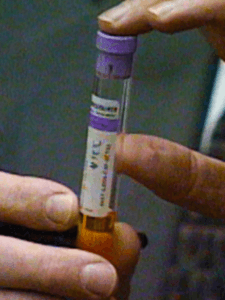
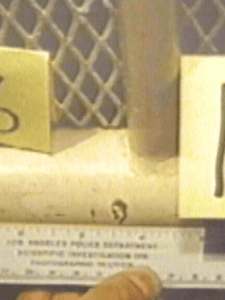
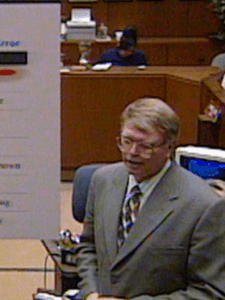
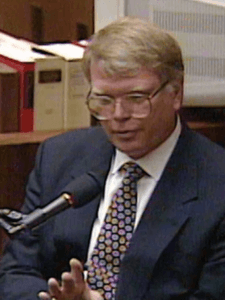
Fredric Rieders, a forensic toxicologist, testified that blood found on a sock in Simpson's bedroom and on a back gate of Nicole Brown Simpson's home appeared to contain the chemical preservative EDTA. The defense claims the presence of EDTA proves the blood on the sock came from a vial of Nicole Brown Simpson's autopsy blood and the gate blood came from a vial of blood Simpson gave to police the day after the murders.

Rieders testified that the EDTA on the sock was present only in the blood stain and nowhere else on the sock. This testimony negated a prosecution theory that laundry detergent accounted for the presence of the preservative.

Rieders, founder of National Medical Services laboratory in Willow Grove, Penn., based his conclusions on an examination of tests performed by the FBI.


Story continues
advertisement

Rieders testified that the FBI tests did not allow for a determination of the quantity of EDTA present in the stains. As a result, he said, it was not possible to make that determination, thus preventing the prosecution from showing that EDTA levels in the stains were lower than those found in the test tubes containing the blood samples.

Rieders also testified that even though EDTA is present in human blood, its presence is minimal. The quantity of EDTA in the two blood stains, he said, was much higher.

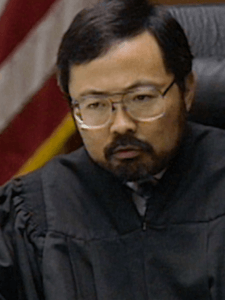
Judge Lance Ito had ruled Rieders could testify, despite prosecutors' arguments against it. Deputy District Attorney Brian Kelberg had asserted that Rieders' analysis could show only that the FBI tests were presumptive of the preservative, the same kind of test the judge previously ruled inadmissible at the request of the defense.

But the judge said prosecutors could question Rieders on mistakes he allegedly made in a past murder case.

Prosecutor Marcia Clark questioned Rieders about an alleged mistake in the case of a funeral home director accused in the death of a competitor. Rieders had concluded the victim could have died of oleander poisoning, but subsequent tests found no sign of oleander and charges against the defendant were dismissed.

Clark also tried to show that Rieders had misread a report by the Environmental Protection Agency, and that humans actually had much more EDTA in their blood than he said.

JULY 25 - An FBI scientist told jurors that he detected only vague signs of what could be a preservative on blood on a sock found at the foot of O.J. Simpson's bed and on a gate near the bodies of Simpson's ex-wife and her friend.

The testimony of Roger Martz contradicted Monday's defense witness, Fredric Rieders, a toxicologist who reviewed Martz's data and concluded that the preservative, EDTA, could have been present on the evidence.

Rieders didn't actually do any of his own testing. Instead, he relied on Martz's data. Since Martz had not testified for the prosecution, which didn't get into the preservative issue at all in its case, the defense was forced to call him as a witness.

During his questioning, defense lawyer Robert Blasier walked a fine line in trying to cast doubt on Martz's testing for EDTA without totally destroying the validity of the tests. Blasier's questioning on the credibility of the tests focused on Martz's lack of advanced education and experience, his possible motive in testing for limited results, and his lack of thoroughness.

Martz conceded that the evidence blood shared some of the physical properties and molecular characteristics of EDTA. He said the blood samples "responded like EDTA responded" and "was consistent with the presence of EDTA."

But Martz said Rieders had jumped to conclusions. "It is not appropriate to identify EDTA based on the data I have provided for the sock and the gate," he testified.

Martz insisted his tests not only failed to show that the evidence blood had anything close to the levels of EDTA in the test-tube blood, but that his data couldn't even support the theory that there was any EDTA at all in the evidence blood.

He said tests on his own, unpreserved blood showed the same kind of EDTA indicators present in the gate and sock blood, and that his data would suggest there was just as much EDTA in a clean piece of Nicole Brown Simpson's dress as in a blood stain elsewhere in the same dress.

The defense did win a victory Tuesday when Judge Lance Ito said it could present evidence of an experiment on glove shrinkage.

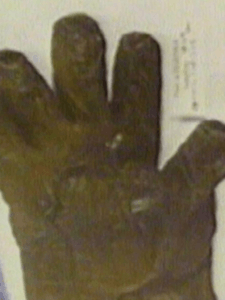
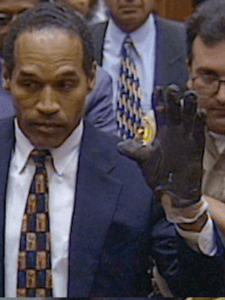
The judge ruled that defense expert Herbert MacDonell could discuss an experiment that found that leather gloves don't shrink very much when they get wet. These findings contradict the prosecution's contention that the evidence gloves didn't appear to fit Simpson during a courtroom demonstration because they shrank from being soaked in blood.

In another development, prosecutors sought to bar defense testimony about whether Detective Mark Fuhrman, who found the bloody glove at Simpson's estate, is a racist. They filed a motion saying the defense has "abysmally failed" to show Fuhrman planted evidence against Simpson.

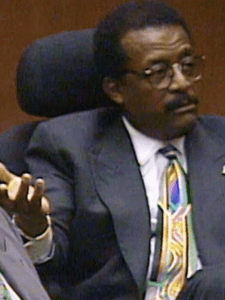
Also, defense attorney Johnnie Cochran, Jr. is scheduled to appear in North Carolina court Friday to try and enforce the subpoena of Laura Hart McKinny, a screenwriting professor who interviewed Fuhrman and other Los Angeles police officers about their jobs. The defense thinks McKinny has tapes and transcripts that can show Fuhrman making numerous racist remarks.

JULY 26 - The third day of testimony over a blood preservative was highlighted by the defense accusing one of its own witnesses of being biased for the prosecution.

FBI Special Agent Roger Martz initially testified that his tests on a bloody sock and a blood stain from the gate behind Nicole Brown Simpson's house suggested the presence of a chemical preservative, EDTA. Later Martz said that he could not identify any EDTA on the samples.

He then reiterated that tests on his own unpreserved blood found a level of EDTA presence similar to the levels found in the evidence stains. However, Martz had to admit that he actually was unable to positively identify any EDTA in his blood or in the blood on the socks and gate.

Before starting his re-direct examination, defense lawyer, Robert Blasier asked Judge Ito to declare Martz a "hostile witness," allowing him to ask leading questions of the witness.

The prosecution objected, but the judge agreed with the defense. Blasier proceeded to accuse Martz of biased testing and research.

Blasier suggested that Martz was biased in favor of the prosecution, in part by eliciting testimony that the witness was surprised at being called to testify for the defense. Martz denied the accusation. The defense called Martz because he conducted the tests that defense witness Fredric Rieders used to determine the presence of EDTA.

Martz said that environmental conditions would not affect EDTA because it is a stable substance. But he admitted under questioning by Blasier that he was not aware of any literature to support this conclusion.

JULY 27 - In a day shortened by a juror's illness, the defense presented physical evidence to supports its theory that police conspired to frame O.J. Simpson for murder.

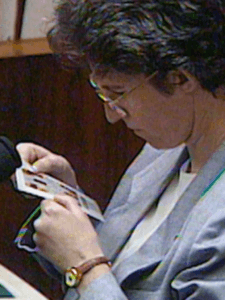
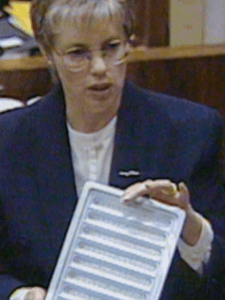
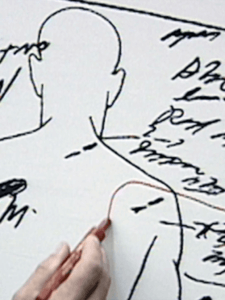
Blood splatter expert Herbert MacDonell told jurors that the stains on socks found in Simpson's bedroom looked like they were applied to the fabric, and that some of the blood had seeped through - something that could not have happened if Simpson was wearing the socks at the time.

MacDonell of the International Association of Blood Stain Pattern Analysts in Corning, New York, examined the socks on April 2, 1995 and concluded the stains were not splatter stains. He said the stain on the ankle of one sock was more consistent with a smear.

Splatter stains, he explained, are projected by a liquid and would go through the fibers while a smear remains only on the surface of the fiber. Even the drops of blood that look like splatters, he said, were likely caused by dripping because the dimensions of the spot were too large to be consistent with blood projecting.

MacDonell also testified that he saw evidence on the inner surface of one side of the sock that the blood had soaked through the outer surface of the opposite end -- suggesting that it must have soaked through while no one was wearing the sock. He said he saw six or seven little red balls that appeared to be blood bonded to the fiber. The fact that they were balls, he said, indicated that they were wet when they came into contact with the fiber. This testimony contradicted the testimony of prosecution witness Gary Sims of the California Department of Justice. Sims said the blood inside Simpson's sock consisted of flecks that had already dried when they landed there.

MacDonell's testimony was cut short when a juror became ill during the lunch break and was taken to the hospital. The juror, a 43-year-old black male, reportedly was suffering from chest pains, dizziness and stomach cramps.

In addition to testimony offered Thursday, Simpson's attorneys forged ahead with other aspects of their conspiracy theory.

First, they told Judge Lance Ito that they have three more witnesses prepared to testify about hearing Detective Mark Fuhrman use a racial epithet.

The judge has already authorized the defense to call two witnesses to describe Fuhrman as a racist who loathed intermarried couples and routinely called blacks "niggers" -- charges Fuhrman has denied under oath.

Because Simpson's lawyers have not produced any concrete evidence that Fuhrman planted anything, Deputy District Attorney Cheri Lewis told Judge Ito that the detective's racial attitudes were virtually irrelevant, especially since the purported episodes would have occurred eight or nine years ago. That minimal relevance, she said, was outweighed by its impact on a jury that is three-fourths black.

"Because of the inflammatory nature of the remarks at issue, especially in front of this predominantly African-American jury, it does have a substantially undue impact on the People," Lewis said. "With all due respect to people of color everywhere, I submit that whether or not he used the n-word at some point in the remote past is not a material part of his testimony."

But defense lawyer Gerald F. Uelmen told Judge Ito that what the defense wanted to show was not that Fuhrman had planted the glove but that he was a liar.

By attempting to "present himself to this jury as a choir boy," he said, Fuhrman "dug a hole for the prosecution, a very deep hole." To exclude the evidence, he argued, "would simply be cutting corners by cutting the heart out of the defense case."

The judge delayed ruling on the issue.

He also did not rule on whether the defense could ask the director of the police department's crime laboratory about a news leak earlier in the case. He scheduled a hearing for Monday morning when KNBC-TV reporter Tracie Savage may be asked to disclose her source of the report.

The defense contends the news report, which gave DNA test results on a bloody sock found in Simpson's bedroom before the tests were even conducted, suggests the anonymous source of the leak knew the results ahead of time because the evidence had been planted.

Deputy District Attorney Hank Goldberg ridiculed that notion, calling it the defense's "chain of illogic."

Judge Ito also scheduled a second tour of the crime scene and Simpson's house for August 20. This tour will take place at night, around the same time the killings occurred. A previous tour of the scene was held during the day.

JULY 28 - A North Carolina judge refused to compel a professor and screenwriter to testify in Los Angeles or to produce videotapes that the defense claims help prove that Detective Mark Furhman is a racist and liar.

The tapes were part of Laura McKinny's research for a script about the Los Angeles police department. The videotapes allegedly show Fuhrman using the Ku Klux Klan title "Grand Dragon" to describe himself, alluding to "Hitler's celebration" and speaking of "beating niggers."

But Judge William Wood ruled the tapes were irrelevant and collateral evidence in the murder trial -- even if they showed Furhman's alleged racist attitudes. The judge indicated that he was swayed to rule in favor of the prosecution on the issue because McKinney was writing fiction and Furhman was serving as a technical consultant.

Fuhrman "was helping with character development," the judge ruled. "It was dialogue for a Hollywood movie, and Hollywood movies often contain curse words and racial epithets. There was nothing of (McKinney's) evidence that tended to show that Detective Furhman had it in for Simpson."

Defense attorney Johnnie Cochran, Jr., who argued the motion, said the defense would appeal the ruling.

The defense still has at least two other witnesses prepared to testify that Fuhrman had used racial slurs in the past decade. It also plans to ask Judge Ito to instruct the jury that if it believes Fuhrman was not telling the truth in any part of his testimony then they may disregard the whole of his testimony.

Meanwhile, there was no testimony in the trial because of the illness of a 43-year-old juror who was taken to a hospital after complaining of stomach pains and dizziness during the lunch hour on Thursday.

The defense asked Judge Ito to reconsider his earlier ruling on the admissibility of Christian Reichardt's proposed testimony. The defense wants Reichardt, the former boyfriend of Faye Resnick, to testify about her alleged drug use or suggestions that she might have been the intended victim of angry drug dealers.

Defense attorney Carl Douglas argued that there was "very slight circumstantial evidence" that Simpson had a motive to commit the murders. He argued that all the prosecution has offered to show motive was that Simpson was carrying out "some final act of control." As a result, Douglas argued, the defense should be able to produce evidence of another possible motive.

Prosecutor Cheri Lewis argued that the defense had not presented any evidence Resnick was the intended victim of a drug-related killing.

WEEK 28

E-mail | Print


Full coverage


advertisement


Contact us
©2007 Turner Entertainment Digital Network, Inc. A Time Warner Company. All Rights Reserved.
CourtTV.com is a part of the Turner Entertainment New Media Network.
Terms & Privacy Guidelines

 
advertisement