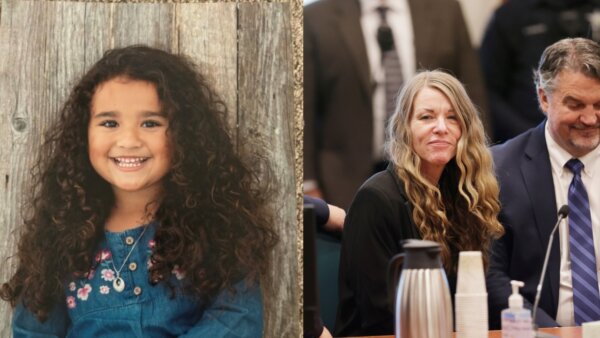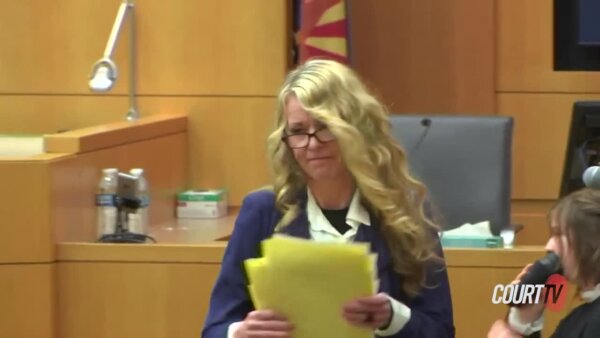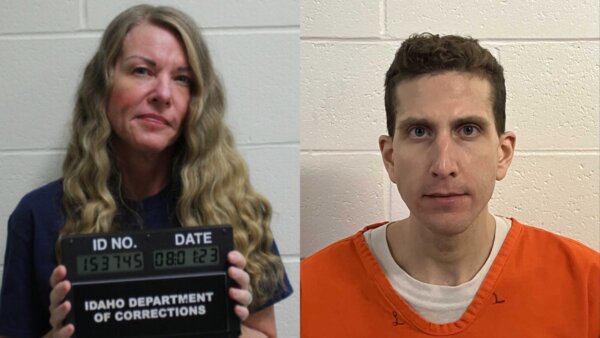

BOISE, Idaho (Court TV) — Idaho prosecutors are urging the state Supreme Court to uphold Lori Vallow Daybell‘s life sentence for murdering her two children and conspiring to kill her husband’s former wife, systematically rejecting each of the five constitutional claims raised in her appeal.
Lori Vallow Daybell stands and listens as the jury’s verdict is read at the Ada County Courthouse in Boise, Idaho on Friday May 12, 2023. The Idaho jury convicted Daybell of murder in the deaths of her two youngest children and a romantic rival, a verdict that marks the end of a three-year investigation that included bizarre claims of zombie children, apocalyptic prophesies and illicit affairs. (AP Photo/Kyle Green)
In a 59-page brief filed Tuesday with the Idaho Supreme Court, Deputy Attorney General Jeff Nye argues that the trial court properly handled every issue Vallow Daybell raised, from the disqualification of her chosen attorney to the admission of evidence about prior deaths in Arizona.
Vallow Daybell was convicted in May 2023 of murdering her children, 7-year-old Joshua “J.J.” Vallow and 16-year-old Tylee Ryan, as well as conspiring to kill Tammy Daybell, the first wife of Vallow Daybell’s husband Chad Daybell. The children’s remains were discovered buried on Chad Daybell’s property in June 2020, months after they were last seen. She was sentenced to serve three life sentences without the possibility of parole.
Court TV’s Legendary Trials: ID v. Lori Vallow Daybell (2023)
Her appellate attorney, Craig Durham, filed an opening brief in May arguing Vallow Daybell deserves a new trial based on five constitutional violations:
- Sixth Amendment violation: The trial court improperly disqualified her retained attorney, Mark Means, depriving her of her right to counsel of choice
- Sixth Amendment violation: She was denied the assistance of counsel during pretrial hearings when the court refused to allow Means to participate in hearings about his own disqualification in Chad Daybell’s separate case
- Due process violation: The trial court held pretrial hearings that affected her substantial rights while she was absent and incompetent to stand trial
- Evidentiary error: The trial court improperly allowed evidence of uncharged bad acts from Arizona under Rule 404(b) of the Idaho Rules of Evidence
- Speedy trial violation: The nearly two-year delay between indictment and trial violated her statutory and constitutional rights to a speedy trial
The state’s response, filed this week, addresses each claim in detail.
Attorney conflict of interest
The most significant issue in the appeal centers on the trial court’s decision to disqualify Vallow Daybell’s attorney, Mark Means, whom she had retained to represent her. Prosecutors argue Means had an irreconcilable conflict of interest because he simultaneously represented both Vallow Daybell and her co-conspirator husband during the alleged conspiracy.

Chad Daybell sits at the defense table after the jury’s verdict in his murder trial was read at the Ada County Courthouse in Boise, Idaho, on Thursday, May 30, 2024. Daybell was convicted of killing his wife and his new girlfriend’s two youngest kids in a strange triple murder case that included claims of apocalyptic prophesies, zombie children and illicit affairs. ( AP Photo/Kyle Green, Pool)
The state’s brief reveals that Chad Daybell arranged and paid for Means to represent his wife. In April 2020, Means publicly announced on Twitter that he represented Chad Daybell, posting: “Please not [sic] that this office (notice being provided by other means as well) represents Mr. Chad Daybell. If any agency, investigative authority, etc., wishes to contact my client please contact my office directly.”
On the same day, in a jail communication with Vallow Daybell, Chad Daybell stated, “Mark [Means] is my attorney,” and “alluded he had shared confidential information with Mr. Means that [Daybell] believed would be covered by attorney/client privilege,” according to the brief.
“Because Daybell and Vallow are named co-conspirators, necessarily, they have interests adverse to one another,” prosecutors wrote.
The conflict became more serious after both defendants were charged with capital offenses. The trial court initially allowed Vallow Daybell to waive the conflict when she faced lesser charges, but noted it would not allow such a waiver “if the charges carried maximum penalties of life imprisonment and/or the death penalty.”
Prosecutors also note that Vallow Daybell was deemed incompetent to stand trial at the time the disqualification decision was made, meaning she could not knowingly and voluntarily waive her right to conflict-free counsel.
“If Vallow ‘lack[ed] the capacity to understand the proceedings against [her] or to assist in [her] own defense,’ she could not possibly waive a fundamental constitutional right knowingly, voluntarily, and intelligently,” the brief states.
Competency proceedings
The state also addressed Vallow Daybell’s claim that her constitutional rights were violated when the trial court held hearings in Chad Daybell’s separate criminal case while she was incompetent. Prosecutors argue those hearings were part of a different criminal proceeding and did not violate her rights.
The brief reveals Vallow Daybell was found incompetent twice during the proceedings, resulting in stays totaling 353 days. The first stay lasted from May 27, 2021, to April 11, 2022. The second occurred from October 6, 2022, to November 9, 2022.
“The district court properly suspended the proceedings in Vallow’s case,” prosecutors wrote, noting the court went out of its way to clarify that hearings about the attorney conflict were being held in Chad Daybell’s case, not Vallow Daybell’s.
Arizona evidence
Prosecutors also defended the admission of evidence about prior alleged crimes in Arizona, including the July 2019 shooting death of Vallow Daybell’s former husband, Charles Vallow, and an attempted shooting of Brandon Boudreaux in October 2019.
The state argued this evidence showed a pattern of how Vallow Daybell and Chad Daybell operated: Chad Daybell would pronounce someone had a “dark spirit” and inform followers that the person’s body “was possessed by a dark entity/spirit which would then require their body to be destroyed/killed.” The targeted individual would then be killed or attacked, with the couple standing to benefit financially.
AZ v. Lori Daybell: Cult Mom Conspiracy Trial (Charles Vallow)
“A self-proclaimed religious leader with a small but committed following who targets individuals by labeling them as dark spirits before utilizing his love interest’s assigned ‘protector’ to kill his targets in the hope of obtaining a financial benefit is about as unique of a calling card as one can have,” prosecutors wrote.

(Left to Right) JJ Vallow, Tylee Ryan & Alex Cox (FBI)
According to the brief, Vallow Daybell’s brother Alex Cox was designated as her “protector” and “would do whatever Daybell asked him to do,” according to witness statements. Cox died in December 2019.
Prior to Charles Vallow’s death, Chad Daybell had pronounced Charles was “dark,” and both Vallow Daybell and Chad Daybell were telling people that Charles’s spirit was no longer in his body. On July 11, 2019, Cox shot and killed Charles, claiming self-defense. However, prosecutors note evidence showed one bullet was fired after Charles was on the floor, Cox claimed he performed CPR, though there was no indication he had, and he waited 43 minutes to call 911.
MORE | Who’s who in the world of Chad Daybell and Lori Vallow Daybell
Similarly, before the attempted shooting of Brandon Boudreaux, Chad Daybell “had determined that Brandon was a dark spirit/entity” and requested that Cox kill him, according to the brief.
The same pattern applied to the victims in Idaho: Chad Daybell pronounced Tammy Daybell, J.J., and Tylee all had dark spirits, and all three were subsequently killed under suspicious circumstances, with Vallow Daybell and Chad Daybell benefiting financially from their deaths.
Speedy trial claim
On Vallow Daybell’s claim that her right to a speedy trial was violated, prosecutors note that while nearly two years passed between her indictment in May 2021 and trial in April 2023, most delays were attributable to her own requests.

Lori Vallow Daybell sits between her attorneys and looks at notes during her sentencing hearing at the Fremont County Courthouse in St. Anthony, Idaho, Monday, July 31, 2023. (Tony Blakeslee/EastIdahoNews.com via AP, Pool)
The 353 days the case was stayed for competency evaluations were either attributable to the defense or “at the very least, not attributable to the State,” prosecutors argue. Additional delays resulted from Vallow Daybell’s successful motion to change venue from Fremont County to Ada County.
“The transfer required complex, multi-faceted planning and case administration,” including “security, staffing of personnel, jury commissioner preparations and designation of physical accommodations for a large jury pool and courtroom,” the brief states.
Prosecutors also emphasized the complexity of the case, noting it involved “voluminous discovery” and multiple defendants and victims in a capital case.
“On balance, all Vallow has going for her on this claim is the length of delay, which runs face-first into the indisputably complex nature of this case and the fact that she contributed to most of the delay,” prosecutors wrote.
What’s next
The Idaho Supreme Court has not yet set a hearing date for oral arguments in the appeal. Vallow Daybell’s appellate attorney may file a reply brief responding to the state’s arguments.
Chad Daybell was convicted in May 2024 of the same murders and sentenced to death. His appeal is pending separately.
This story was generated with the assistance of AI using information gathered and verified by a human journalist. Our editorial team verifies all reporting on all platforms for fairness and accuracy before publication.