
JACKSON, Miss. (Court TV) — Mississippi’s highest court has agreed to hear an appeal from a teenager convicted of killing her mother and shooting her stepfather.

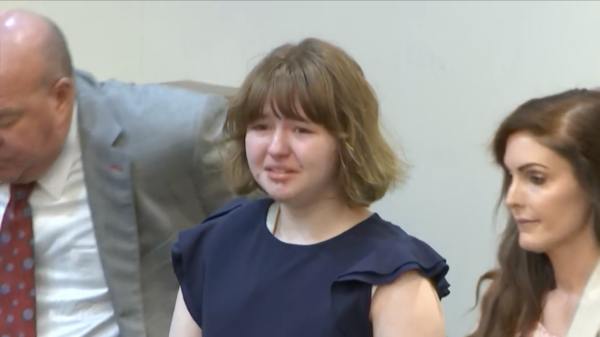
Carly Gregg cried as the verdict was read in court on Sept. 20, 2024. (Court TV)
Carly Gregg, now 16 years old, was 14 when she was convicted of murder, attempted murder and tampering with evidence after shooting her mother and stepfather and inviting a friend to see their bodies. At trial, Gregg pleaded not guilty by reason of insanity and argued she had suffered from mental illness at the time of the shooting.
Gregg filed her appeal with the Mississippi Supreme Court in September, arguing multiple failures at her trial that she believes merit her conviction being tossed and a new trial ordered. On Thursday, the state’s highest court agreed to hear the appeal and scheduled oral arguments for May 27.
In a reply brief filed earlier this year, Gregg maintains that she was compelled to sit for psychiatric examinations by state experts before her team had formally announced their intention to pursue an insanity defense. Gregg’s defense argued the exams she was forced to undergo violated her Fifth and Sixth Amendment rights. “Accelerating evaluations and discovery to preserve a trial date undermines due process and fundamental fairness,” the brief states.
Gregg’s defense has emphasized the accelerated pace at which they felt they were forced to move to comply with a trial court that refused to waver on the set trial date. “The trial judge did not say that continuances are disfavored, discouraged, or rarely granted; he stated without qualification that this Court ‘does not continue cases,’ and did so while announcing a firm September trial setting and admonishing counsel to proceed accordingly,” Gregg’s appellate attorney wrote.
Issues of timing were a focus pretrial, as Judge Dewey K. Arthur weighed sanctions after the defense missed several discovery deadlines.
Gregg’s appeal also focuses on what it calls inadmissible testimony from the state’s expert, Rebecca Kirk. Gregg objects not to the substance of Kirk’s analysis, but rather to the fact that while she was on the stand, Kirk gave a summary of the novel Crime and Punishment, which was mentioned in Gregg’s treatment notes. “The detailed narration of the novel’s plot added no clinical, therapeutic, or diagnostic value,” Gregg’s attorneys argue. “The state did not contend, and the record does not reflect, that Carly identified with the protagonist, discussed the book’s moral philosophy, or connected its themes to her own conduct. Instead, the State selected one of the most infamous novels in Western literature about murder and justification of violence and placed its storyline before the jury. This was not contextual clarification; it was narrative substitution designed to shape the jury’s perception of Carly’s mental state through association with a fictional character.”
The appeal also notes perceived errors in Gregg’s sentencing; her attorneys feel the jury was given incorrect instructions and should have been told that, for juveniles, parole eligibility is the default, rather than life without parole.
Several letters have been submitted to the court as amicus briefs, arguing on Gregg’s behalf on various issues, including one from “a concerned citizen from Poland, currently residing in Ireland.”
Each side will have 30 minutes to present oral arguments when they appear before the Court in May.