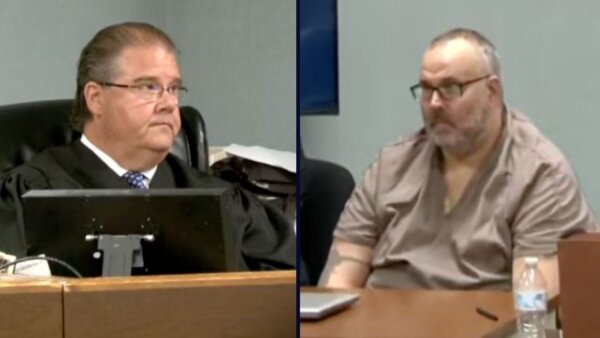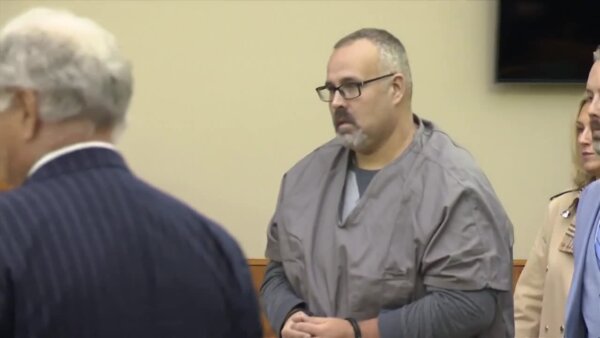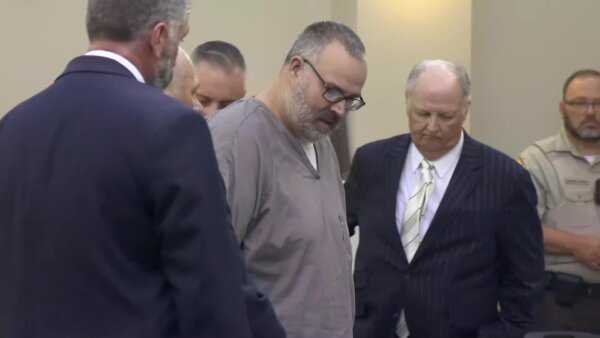

LETCHER COUNTY, Ky. (Court TV) — Attorneys representing a former sheriff accused of killing a judge in chambers say they plan to use a mental health defense — but don’t want prosecutors to send another doctor to interview him.
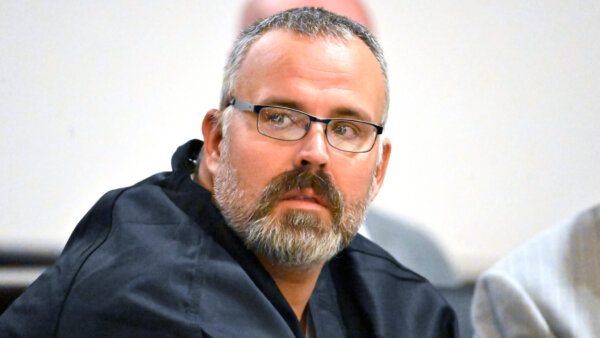
Former Letcher County, Ky., Sheriff Shawn “Mickey” Stines looks over at the prosecutors during his arraignment on Oct. 1, 2024. (AP Photo/Timothy D. Easley)
Shawn “Mickey” Stines, 44, was the sheriff of Letcher County on Sept. 19, 2024, when he allegedly walked into District Judge Kevin Mullins’ office and killed him. Surveillance video from inside the judge’s chambers appears to show the shooting, with Mullins scrambling to hide under his desk.
Stines’ defense filed a notice in February 2025 signaling that they planned to use a mental health defense. That filing opened the door for prosecutors to have an expert examine the defendant. The Commonwealth appointed Dr. Tim Allen of the Kentucky Correctional Psychiatric Center (KCPC) to examine Stines, who, his attorney said, submitted to the exam as ordered.
Allen’s report was sealed, and Judge Christopher Cohron has denied multiple defense requests to unseal it.
Prosecutors filed a motion to conduct a second examination with a different doctor, which Cohron allowed, but the defense wants to block it. “In its request for an additional evaluation, the Commonwealth did not identify any methodologic testing error, incomplete testing, or other deficiency in the KCPC examination, yet seeks to examine Mr. Stines a second time through Dr. George Parker of Indiana,” Stines’ attorneys wrote in a petition for a writ of prohibition. “There is no evidence, or even a suggestion, that there was anything deficient in the first examination methods, testing or any technical issues. The Commonwealth is simply dissatisfied with the opinion its chosen examiner produced. … Simply disagreeing with your own expert is not sufficient grounds to order further invasion of Stines’ Fifth Amendment rights.”
Under the law, defendants’ Fifth Amendment rights are protected during these exams because prosecutors are not allowed to introduce any statements made to the doctors until the defense introduces the issue of mental health at trial. But Stines’ attorneys wrote in their filing that the restriction doesn’t eliminate the risk of “the exposure of defense strategy and the intrusion of the examination itself.”
The defense has limited Stines’ mental health claims to the shooting; his attorneys said he is competent to stand trial. “It is important to note that we are now over two years from the date of the alleged shooting and [Stines] has not asserted incompetency to stand trial,” the petition read. “His notice concerns mental health condition evidence bearing upon criminal responsibility, guilt and punishment.”
Body camera video from officers who responded to the courthouse after the shooting shows Stines behaving erratically and repeatedly telling people around him that he doesn’t feel safe; Stines refused to walk onto an elevator and said he was scared to walk into a stairwell. At times, he appeared responsive to the officers who were talking to him, but as soon as anyone mentioned the shooting, Stines would stop speaking and reacting.
Stines’ attorneys have asked Cohron to vacate his order requiring the second evaluation, which is currently scheduled for Oct. 14.