
PLYMOUTH, Mass. (Court TV) — In a blow to Lindsay Clancy‘s defense, a judge ruled that lay witnesses will not be allowed to testify about their own experience with postpartum psychosis and postpartum depression at the accused murderer’s upcoming trial.
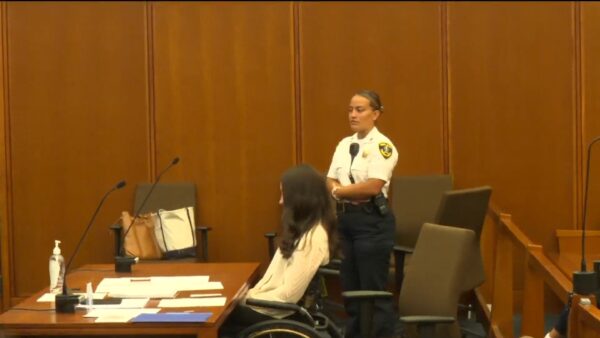
Lindsay Clancy appears in court on July 13, 2026. (Court TV)
Clancy, 35, has conceded, through her attorney, that she killed her three young children. She has pleaded not guilty to charges of murder in the deaths of Cora, 5, Dawson, 3, and Callan, 7 months, claiming that she was in the throes of a mental health crisis when she strangled the victims with exercise bands in her home’s basement, cut herself with knives and then jumped out of a second-story window.
In a last-minute motion filed just one week before jury selection is scheduled to begin, Clancy’s defense attorney had asked a judge to allow him to call witnesses who would testify to their own experiences with postpartum issues. Prosecutors immediately objected, saying that the motion violated the rules of discovery by referring to the proposed witnesses only by initials and failing to include any witness statements or other information about their proposed testimony.
Judge William Sullivan denied the defense’s request. “It doesn’t seem like there’s a question of whether postpartum depression or psychosis is real,” he said, adding that experts agree it is real and that the lay witnesses would have no real evidence to offer that relates to Clancy’s trial.
Sullivan also denied Clancy’s request to have the jury sequestered. Clancy’s attorney, Kevin Reddington, had cited extensive pretrial publicity first in his request to move the trial from Plymouth to Boston — which was denied — and again in his motion to sequester jurors after they were impaneled. Sullivan said he planned to ask the jurors what exposure they had to the case before seating them as well as giving them standard admonishments during the trial: “I’m going to ask them every day whether or not they’ve seen anything and instruct them not to view any articles or social media in regard to this.”
MORE | Prosecution wins battle over expert witnesses as Lindsay Clancy’s trial begins
When jury selection starts on Monday, Sullivan said he plans to impanel 18 jurors — above the usual 12 needed to decide the case. Both the defense and prosecution have asked Sullivan to consider giving them additional challenges to potential jurors; Reddington said on Monday that he was concerned not only with issues regarding publicity, but also with the emotional toll the trial will take on those in the courtroom. “This is probably, in my decades of trying cases, probably the most emotionally disturbing and challenging,” Reddington said.
Reddington also asked Sullivan to consider adding to the judge’s typical instruction on the law before defense openings to specify that lack of criminal responsibility is key to the case. “It’s not the defendant’s burden to prove that she was lacking criminal responsibility, but in fact upon presentation of evidence, it’s the government’s burden to prove beyond a reasonable doubt that she was not acting as a result of mental disease or defect,” Reddington said. Prosecutors objected, saying that it would be inappropriate to mention any affirmative defense regarding insanity or criminal culpability before either expert testimony or the defendant herself formally makes the claim to the jury.
Jury selection is scheduled to begin on the morning of Monday, July 20; prospective jurors will be given a questionnaire to answer, as well as a witness list containing approximately 200 names, before proceeding to the next stage of voir dire.