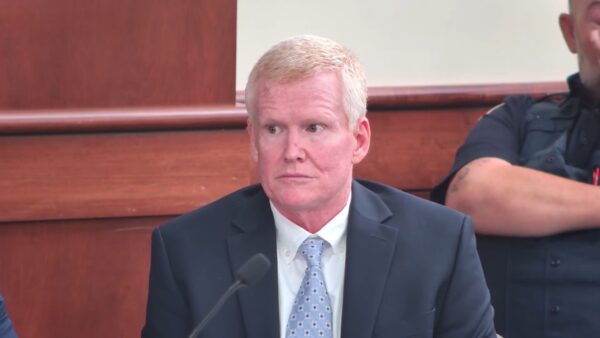

SUMTER, S.C. (Court TV) — Attorneys representing Alex Murdaugh are asking a judge to intervene, saying prosecutors withheld evidence that a police chief removed the weapons used to kill the defendant’s wife and son from the crime scene.

Alex Murdaugh appears in court on Aug. 14, 2026. (Tracy Glantz/The State, Henry Taylor/The Post and Courier/POOL)
Alex Murdaugh was convicted in 2023 on charges that he murdered his wife, Maggie Murdaugh, and their son, Paul Murdaugh, at their Moselle property in 2021; that verdict was overturned by the South Carolina Supreme Court after the justices found that the clerk of court made inappropriate comments to the jury.
At the defendant’s first trial, prosecutors argued that Alex Murdaugh was alone when he killed Paul Murdaugh with a shotgun and Maggie Murdaugh with a .300 Blackout rifle. Those weapons were never found; prosecutors told the jury that the defendant drove to Almeda after shooting the victims and either disposed of the weapons there or on the way.
MORE | ‘This isn’t a sound bite’: Judge scolds attorneys at Alex Murdaugh pretrial hearing
After two local outlets reported that a grand jury had been convened to investigate whether two officers with the Yemassee Police Department had concealed or moved clothing or weapons linked to the case, Alex Murdaugh’s attorneys filed a motion asking prosecutors to disclose what they know about the investigation. Attached to the motion is a subpoena issued to Yemassee Police Department Chief Greg Alexander, a close friend of the defendant’s, ordering him to appear before the grand jury.
Alex Murdaugh’s motion alleges prosecutors convened the grand jury after a tip to the South Carolina Law Enforcement Division (SLED) that Alexander “spoke of arriving early to the murder scene and talked about providing a change of clothes” to the defendant. The tipster added that the guns and clothing were brought to the Yemassee police station and stored there temporarily. The motion claims the tip, which local media credited to a “Lowcountry official,” came from Judge Sheryl McKinney.
Court TV’s Legendary Trials | SC v. Alex Murdaugh (Murdaugh Family Murders)
McKinney was suspended from her judicial duties in 2011 for accepting payments from a police department whose cases she heard. SLED agents found that she had been given checks drawn from the police department’s Victim Assistance Fund, “approved by the chief of police who wanted to supplement the respondent’s salary.” McKinney told investigators she did not know the money came from a victim’s fund or that receiving the payments was improper. Alex Murdaugh — who was a prominent attorney before his arrest on murder charges — represented McKinney during the proceedings.
Alex Murdaugh’s defense motion argued that a second person removed the weapons and clothing from the property, which “impeaches the State’s reconstruction of the night, which admitted of no other participant, and the witnesses who presented it. It bears on the integrity of the scene itself, which Chief Alexander is reported to have reached before it was secured, and therefore on every item of physical evidence recovered from it. And it supports the defense that more than one person was involved in these murders — a defense the State’s own investigation now appears to credit.”
While grand jury proceedings are typically secret, Alex Murdaugh’s defense argued that prosecutors are required to share any witness testimony about the weapons or movements around the Moselle property on the night of the killings. “The State cannot have it both ways. It cannot present evidence to a grand jury that others handled the weapons while withholding that same evidence from the defendant it intends to try for the murders on the theory that he handled them alone,” the motion said. “If the State intends to change its theory at retrial, the defense is entitled to know it and prepare for it. If the State does not, the evidence is exculpatory and the defense is entitled to use it. Either way, the evidence must be produced.”
The defendant’s next pretrial hearing is scheduled for Oct. 16.