PUBLIC NOTICE RE: ELECTRONIC TRANSCRIPT COPY CERTIFIABILITY
WARNING: This electronic transmission of the official transcript of proceedings is deemed certifiable only to the extent that the reader of this message is viewing a first-generation authorized transmission. All subsequent transmissions of this first-generation electronic copy and all copies printed therefrom are unauthorized and non-certifiable, and the Official Reporter assumes no responsibility for consequences stemming from the use of such unauthorized non-certifiable copy. Responsibility for such consequences is that of the person or organization whose use of a non-certifiable unauthorized transmission or printed copy creates those consequences, including civil liability arising therefrom. No portion of this file may be redistributed or resold without permission, pursuant to California Government Code Section 69954(d). Authorized certifiable transcript copies are protected by digital signature. If you would like to purchase an official transcript of the proceedings, contact NetCourt, 1316 Harding Place, Charlotte, North Carolina, 28204 or click here.


           SUPERIOR COURT OF THE STATE OF CALIFORNIA
                 FOR THE COUNTY OF LOS ANGELES
     DEPARTMENT NO. WEQ        HON. HIROSHI FUJISAKI, JUDGE


     SHARON RUFO, ET AL.,                     )
                                              )
                                 PLAINTIFFS,  )
                                              )
               VS.                            )NO. SC031947
                                              )
     ORENTHAL JAMES SIMPSON, ET AL.,          )
                                              )
                                 DEFENDANTS.  )
     _________________________________________)


                  REPORTER'S DAILY TRANSCRIPT

                        JANUARY 15, 1997

                            VOLUME 43


                  REGINA D. CHAVEZ, CSR #8446
                       OFFICIAL REPORTER


     APPEARANCES:


     FOR THE PLAINTIFFS: DANIEL M. PETROCELLI ESQ.,
                         THOMAS LAMBERT, ESQ.,
                         PETER GELBLUM, ESQ., and
                         EDWARD MEDVENE, ESQ.
                         Firm:  MITCHELL SILBERBERG & KNUPP
                                11377 West Olympic Blvd.
                                Los Angeles, CA 90064-1663
                         For: Plaintiff Goldman


                         JOHN QUINLAN KELLY, ESQ.
                                330 Madison Ave.
                                New York, NY 10017-5090.
                         For: Plaintiff the Estate of
                              Nicole Brown Simpson


                         MICHAEL A. BREWER, ESQ.
                         Firm:  HORNBERGER & CRISWELL
                                444 South Flower St.
                                Los Angeles, CA 90071.
                         For:  Plaintiff Rufo


                        PAUL F. CALLAN, ESQ.
                        Firm:  CALLAN, REGENSTREICH,
                                KOSTER & BRADY
                                One Whitehall St.
                                New York, NY 10004
                        For:  Plaintiff Estate of.
                              Ronald L.  Goldman


     FOR THE DEFENDANTS: ROBERT C. BAKER, ESQ.,
                         MELISSA BLUESTEIN, ESQ., and
                         PHILIP BAKER, ESQ.
                         Firm: BAKER, SILBERBERG & KEENER
                               2650 Ocean Park Blvd., #300
                               Santa Monica, CA 90405-2936.

                                       -and-

                         DANIEL LEONARD, ESQ. and
                         ROBERT D.  BLASIER, ESQ.
                         Firm:  BAILEY, FISHMAN & LEONARD.
                                6355 Riverside Blvd.
                                Suite 2-F
                                Sacramento, CA 95831

                    CHRONOLOGICAL INDEX OF WITNESSES

     PLAINTIFFS' WITNESSES:                           PAGE

     RICHARDS, GERALD
            DIRECT (G)                                    6
            CROSS(L)                                     21
            DIRECT (G)                                   52
            RECROSS (L)                                  63

     MATHESON, GREGORY
            DIRECT (TL)                                  71
            CROSS(PB)                                    95
            REDIRECT (TL)                               116
            RECROSS (PB)                                120

     FUNG, DENNIS
            DIRECT (TL)                                 126
            CROSS (B)                                   131
            REDIRECT(L)                                 151
            RECROSS(B)                                  152

     FOX, RICHARD
            DIRECT(M)                                   157
            CROSS (B)                                   196
            REDIRECT (M)                                216
            RECROSS (B)                                 218

     Legend:  (B) = Mr. Robert B. Baker
             (BL) = Mr. Blasier
             (BR) = Mr. Brewer
              (C) = Mr. Callan
              (G) = Mr. Gelblum
              (K) = Mr. Kelly
              (L) = Mr. Leonard
              (M) = Mr. Medvene
             (MB) = Ms. Bluestein
              (P) = Mr. Petrocelli
             (PB) = Mr. Philip Baker
             (TL) = Mr. Lambert


               INDEX OF EXHIBITS MARKED FOR I.D.


     PLAINTIFFS'
        NO.                  DESCRIPTION               PAGE

      2369        Photograph of O.J. Simpsonin the        6
                  end zone

      2369        Enlarged Board showing Mr. Simpson     68

      2371        Enlargement of a photographof a        17
                  glove

      2371        Enlarged Photo                         68

      2372        Enlargement of a photographof a        17
                  glove

      2372        Enlarged Photo                         68

      2373        Enlargement of a photographof a        18
                  glove showing a label

      2373        Enlarged Photo                         68

      2370        Chart with list of Groden issues       68

      2375        Photograph                             76

      2375        Copy of 2374 marked by Mr. Matheson   122

      2376        Photograph                             77

      2376        Photo of vehicle interior             123

      2377        Photograph                             78

      2377        Copy of 2376 marked by Matheson       123

      2378        Photograph                             79

      2378        Photo of Vehicle interior             123

      2379        Photograph                             80

      2379        Copy of 2378 marked by Matheson       123

      2380        Photograph                             80

      2380        Photo of interior showing floor       123

      2381        Photograph                             81

      2382        Photograph                             82

               INDEX OF EXHIBITS MARKED FOR I.D.


     PLAINTIFFS'
        NO.                  DESCRIPTION               PAGE
      2382        Photo of console                      124

      2309        Photograph of glove                    88

      2310        Photograph of glove                    88

      2384        Photograph of glove                    88

      2384        Photo of glove                        124

      2385        Photograph of glove                    89

      2385        Photo of glove                        124

      2386        Photograph of glove                    89

      2386        Photo of glove                        124

      2387        Photograph of glove                    89

      2387        Photo of glove                        124

      2388        Photograph of glove                    89

      2388        Photo of glove                        125

      2389        Photograph of glove                    90

      2389        Photo of glove                        125

      2374        Photo of interior of vehicle          122

      2375         Copy of 2380 marked by Matheson      123

      2383        Copy of 2382 marked by Matheson       124

      2392        Plastic bag and paper bag             128
                  collectively

       716        10 page document with one             168
                  photograph per page

      2393        Photograph of page 1 of               168
                  plaintiff's exhibit 716

      2394        Photograph of page 2 of               170
                  plaintiff's exhibit 716

      2395        Photograph of page 3 of               173
                  plaintiff's exhibit 716

               INDEX OF EXHIBITS MARKED FOR I.D.


     PLAINTIFFS'
        NO.                  DESCRIPTION               PAGE
      2396        Photograph of page 4 of               178
                  plaintiff's exhibit 716

      2397        Photograph of page 5 of               179
                  plaintiff's exhibit 716

      2398        Photograph of page 6 of               179
                  plaintiff's exhibit 716

      2399        Photograph of page 7 of               184
                  plaintiff's exhibit 716

      2400        Photograph of mockup 3                188

      2401        Photograph of mockup 3                190

      2402        Photograph of page 10 of              190
                  plaintiff's exhibit 716


     DEFENDANTS'
        NO.                DESCRIPTION               PAGE

      1925        Contact sheet                        40

      2390                                            109

      2390        Photo                               125

      2391                                            109

      2391        Photo                               125


                  INDEX OF EXHIBITS RECEIVED IN EVIDENCE

     PLAINTIFFS'
        NO.                DESCRIPTION                PAGE

      2357                                               66

      2358                                               66

      2359                                               66

      2360                                               67

      2361                                               67

      2362                                               67

      2363                                               67

      2364                                               67

      2365                                               67

      2366                                               67

      2367                                               68

      2368                                               68

      2369                                               68

      2370                                               68

      2371                                               68

      2372                                               68

      2373                                               68

      2374                                              122

      2375                                              122

      2376                                              123

      2377                                              123

      2378                                              123

      2379                                              123

      2380                                              123

      2381                                              123


                  INDEX OF EXHIBITS RECEIVED IN EVIDENCE

     PLAINTIFFS'
        NO.                DESCRIPTION                PAGE
      2382                                              124

      2383                                              124

      2384                                              124

      2385                                              124

      2386                                              124

      2387                                              124

      2388                                              125

      2389                                              125

      2393                                              223

      2394                                              223

      2395                                              223

      2396                                              223

      2397                                              223

      2398                                              223

      2399                                              223

      2400                                              223

      2401                                              223

      2402                                              223

       716                                              224


     DEFENDANTS'
        NO.                DESCRIPTION                PAGE

      2390                                             125

      2391                                             125


     SANTA MONICA, CALIFORNIA; WEDNESDAY, JANUARY 15, 1997

                        9:00 AM

     DEPARTMENT NO. WEQ    HON. HIROSHI FUJISAKI, JUDGE


     APPEARANCES:

                  (PER COVER PAGE)

                  (REGINA D. CHAVEZ, OFFICIAL REPORTER)


                         (The following proceedings were

                         held in open court outside the

                         presence of the jury.)


            MR. LEONARD:  Morning, Your Honor.

                  I have just one brief procedural matter.

                  I spoke to brother counsel this morning,

     and I would like the opportunity to reserve

     cross-examination until Mr. Richards is returned

     tomorrow, pending the Court of Appeals' decision, if

     we get one today.  We filed a writ this morning, and

     the tact that I take on cross-examination, strategy

     and so forth, will depend on whether or not he's

     allowed to testify as to the Flammer photographs.

                  There's also another area that I think

     they want to get into which involves the analysis of a

     totally different photograph, the Bundy glove, and I

     would object to any testimony about that.

            MR. PETROCELLI:  Morning, Your Honor.

                  I don't think he has a right to reserve

     his cross-examination until tomorrow for tactical

     reasons.  They insisted on bifurcating, so it was at

     their insistence that the Court ordered that

     Mr. Richards' examination be split up.

                  We're doing the Groden rebuttal and they

     need to do the cross-examination on that.

                  Tomorrow we're coming back to do the

     Flammer issue, and then they can do the

     cross-examination on that.

                  For tactical reasons, they can't break it

     up -- they can't make us break up our direct, and yet

     they can do a single integrated cross-examination for

     purely tactical reasons, as he just said.  I don't

     think there's any basis for that.

            MR. LEONARD:  Your Honor, my cross-examination

     is going to be brief, 45 minutes.

            THE COURT:  That's brief?

            MR. LEONARD:  Well, what's a three-hour

     examination?

            MR. PETROCELLI:  It's not the length of time.

            MR. LEONARD:  There is no breaking up.

            MR. PETROCELLI:  You made us break it up.

            THE COURT:  What did the other --

            MR. PETROCELLI:  The other photo, Your Honor,

     this -- this photo -- Mr. Richards will testify that

     this is not a hole; this is debris lying on the top of

     the glove.  We let him testify about this at his

     deposition after court yesterday, so they've examined

     him on this.

                  I will point out that, in

     interrogatories, we asked for all facts and evidence

     that they had in support of a planting theory.  They

     told us nothing about this Bundy glove being planted,

     in regard to a hole and debris.  This is all brand

     new, Your Honor.

                  We had no opportunity at all to prepare

     for this new claim, which to this day, I do not

     understand.  But apparently, they want to make it, as

     you heard Mr. Leonard so boisterously argue earlier in

     the week.

                  We asked Mr. Richards to take a look at

     these photos just the other day.  He did and he

     testified about them yesterday.  We would like him to

     testify about that as well, since this is a new claim

     that they have put into the case after -- after orders

     of preclusion, as well, that they weren't able to get

     into any matters outside of what was in the

     interrogatories.  And they did.

                  This is brand new.  We had no time,

     opportunity or ability to prepare.  They never made

     this claim.  Despite a year of hotly contested

     discovery, we learned about it last week.  So we would

     like an opportunity to address it so the jury is not

     in any way, shape or form misled.

            MR. BAKER:  Comes ill from the mouth of the

     plaintiffs to say that it was sprung on them, when

     they sprang 30 photos on us, and then have their

     experts fly to Buffalo, and we have no opportunity to

     review the photos at all; to come in here and say it

     was sprung on us, and now we should have an

     opportunity to have an expert testify to that.

                  2034, specifically, code sections (k) and

     (l), require them -- what they have to do if they want

     to amend and enlarge the designation of their expert.

                  They have never done that on either the

     30 photos, or this photo, or anything else.  We think

     they ought to be precluded.

            THE COURT:  When was this photograph, this one

     with the glove, discovered?

            MR. BAKER:  Well, they've had it as long as

     we've had it.  Since June 14.  It was taken on -- on,

     I think, June 14, 1994.

                  So they've had it since the inception of

     the case.

            MR. PETROCELLI:  The glove photos have been

     around.

                  But we've asked them for every fact known

     to mankind on which they intend to assert planting of

     evidence, in voluminous discovery.  We had to go to

     court three or four times to get orders.

                  In fact, we got the last order from this

     court on what they could argue and not argue in

     opening statement.

                  At no time did they tell us that they

     were going to contend that the Bundy glove was

     planted.  At no time did they say that one glove had a

     hole in it and the other doesn't.  They didn't say any

     of that, Your Honor.  They talked about the Rockingham

     glove.

                  This is brand new.  We learned about this

     claim when Mr. Leonard stood up in court the other day

     and said now we have proof.

                  That's what we're.

            MR. LEONARD:  Submitted.

            THE COURT:  Okay.  You may do that.

            MR. PETROCELLI:  Thank you.

            THE COURT:  Bring the jury in.

            MR. LEONARD:  Your Honor, with regard to the

     reservation of cross-examination?

            THE COURT:  You can cross-examine on what he's

     said so far.


                         (Jurors resume their respective

                         seats.)


            THE COURT:  Morning.

            JURORS:  Morning, Your Honor.

            THE COURT:  You may proceed.


                         (Chart displayed on easel.)


                       DIRECT EXAMINATION

     BY MR. GELBLUM: (continued)

            Q.    Morning, Mr. Richards?

            A.    Good morning.

            Q.    When we left off yesterday, we were

     talking about the point that Mr. Groden made about the

     photograph of Mr. Simpson in the end zone.

                  On the list that we have up on the easel,

     the next point had to do with the shoes, the right

     shoe in particular, where Mr. Groden said that there

     was -- the red reflection that appears on the sole of

     the right shoe should be white rather than red.

                  Do you agree with that?

            A.    No, I do not.

            Q.    Okay.

                  Let me show you a photograph.

            MR. GELBLUM:  Can we mark that next in order.

            THE CLERK:  2369.

            MR. GELBLUM:  2369.


                         (The instrument herein referred to

                         as a photograph of O.J. Simpson in

                         the end zone was marked for

                         identification as Plaintiffs'

                         Exhibit No. 2369.)


            Q.    (BY MR. GELBLUM)  Does 2369 show the

     reflection on the sole of the right shoe, sir?

            A.    Yes, it does.

            Q.    And what color is it?

            A.    It has a red tint to it.

            Q.    And do you agree that -- or do you think

     that red is the color it should be?

            A.    Yes, sir, I do.

            Q.    Can you explain, please.

            A.    Yes.  If I may show this to the jury?

                  Basically, the right foot is slightly

     angled up and over the red area of the field itself.

     This pretty well is exemplified by the placement of

     the heel and the shadow directly under it, it hasn't

     quite crossed that small blue line there into the

     white area.

                    The light shining down onto the field

     is going to reflect back whatever area or color it is.

     If the foot was over the white area, it would reflect

     back white.  If it's over the red area, it's going to

     reflect back red.

                  This is a diffused light.  In other

     words, the light will be fairly soft but diffused in

     all directions up under -- up under the foot itself.

                  You would expect that that would be

     natural, that any color that's being -- the light

     shining on it will reflect that same color.

                  The general position of the foot is

     pretty evident even though there is some

     foreshortening because of the long lens.  It's pretty

     well evident that it's back far enough that the

     majority of the shoe is over the red area as opposed

     to the white.

            Q.    Can you explain that foreshortening?

            A.    Yes.

                  When photographs are taken, depending on

     where the photographer is with his camera, the

     position, it will create anomalies that we call in

     some cases, foreshortening, or wide angle distortion.

                  They really aren't distortions; they are

     a function of where the observer is or the camera is

     in comparison to other objects out in front.

                  If the object -- all of the objects are

     far away and they're fairly close together by

     themselves, the farther away they get, you will have a

     foreshortening effect which will make them appear to

     shorten -- to become shorter than they are.

                  Inversely, if you use a very wide-angle

     lens, or you see things in a very wide-angle state,

     things will tend to elongate.

                  Some of you may have seen wide-angle

     pictures that are taken very closely to people's faces

     which makes their nose look three times bigger than

     their head, and their ears six inches behind the back

     of their head.  That's the inverse of foreshortening.

                  In this case, there was a long lens used

     so the foot and the shoe would be somewhat

     foreshortened.

            Q.    Mr. Groden also opined that there may

     not -- it may -- that there shouldn't be any

     reflection at all on the sole of that shoe.

                  Do you agree with that?

            A.    No, not necessarily.  There -- you may

     not be able to detect in a photograph a reflection,

     there may not be enough light.  But if the bottom of

     the shoe has enough sheen or reflection to it, it very

     well may record as the -- actually, the sole pattern

     records on the bottom of there.

            Q.    Do you consider the reflection on the

     bottom of the sole of the right shoe evidence of

     alteration of this photograph?

            A.    No, I do not.

            Q.    Next point Mr. Groden made on the list,

     we discussed what he called, I think, sort of a halo

     effect on both the left and the right shoe.

                  Do you know what he's talking about

     there?

            A.    On both the left and right shoe?

            Q.    I believe so, yes.

                  Do you see what he's referring to on the

     soles?

            A.    Yes.

            Q.    Is it this picture?

            A.    Yes.

            Q.    Showing you Exhibit 2287.

            MR. GELBLUM:  Can the jurors see that?

                  Can he come down to the jury?

                  You want to come down to the jury because

     we're talking about small parts on the shoes there.

            THE COURT:  Go ahead.

            MR. GELBLUM:  If that's okay, Your Honor?

            Q.    (BY MR. GELBLUM)  First, sir, if you can

     point out the area where this halo effect is.

            A.    Basically, there's actually a halo effect

     which appears around most of the image.  I think the

     one in question, though, is around the edges -- the

     edges of the shoes, on the bottom, by the soles, by

     the tip of the right shoe, and then the back here,

     it's very, very -- it's difficult to see, but right at

     the sole level of the left shoe, back by the heel

     again.

            MR. GELBLUM:  For the record, we're looking at

     Exhibit 2287.

            Q.    (BY MR. GELBLUM)  Do you have an opinion

     as to the cause of that halo effect?

            A.    Yes.  It's quite common and can actually

     be seen in a number of other portions of this picture

     and in other pictures also.

                  Any time you have something that is

     backlit -- slightly backlit, and this picture is

     backlit, meaning that the light -- the main body of

     the light is coming a little bit in back and to the

     right of Mr. Simpson.

            Q.    How can you tell that?

            A.    I can tell by the highlights on the

     pants, the shoulders, the forehead, the back lighting

     on the hand, on the right hand, and the way the

     shadows are falling here.

                  In this particular case, that

     highlighting effect leaves a very light area anyplace

     there is a distinct edge.  This is a fraction of the

     light actually around the edge slightly, and it takes

     on the color of whatever the background or the closest

     edge to it is.  It can take on the color.  Our eyes

     kind of -- kind of force us into seeing that color.

                  As a matter of fact, that can be seen,

     the same halo effect that goes up the side of the leg

     here, as it transverses from red to white, the little

     halo effect along the side of the pants, you'll see

     red to white, red to white, red to white, as it goes

     up the side of the pants.

            Q.    What would that be from?

            A.    Again, it's just a transition of the

     light from the dark area to the light area of the

     background of the field, and just where the light is,

     right at the edge from -- it's being backlit, that

     very bright spot is taking on the color of whatever is

     nearest to it.

            Q.    You said you could see that on other

     photographs?

            A.    Yes.

            Q.    Let me take a look at the photograph of

     Mr. Simpson with Keith Byars.  I think he's been

     identified as -- that's Exhibit 2289.

                  Do you see that effect in that

     photograph?

            A.    Actually, the effect can probably be

     shown a little bit better in this photograph because

     the left arm -- see this white line along the left

     arm; this is the halo effect we were talking about.

                  That's also on the shoes, but since the

     shoes are so small, it's a little indistinction to it.

     We can see that it picks up a grayish bluish effect as

     it goes up or grayish bluish.  Then it picks up a

     yellow tint when it met the background.

                  Again, it's a common phenomenon when

     something is backlit.  It will have a very slight halo

     effect to it when it's backlit, and that halo effect

     will take on a color of the background or sometimes

     the color of the object, depending on what the color

     is.  But it is basically a natural phenomenon.

            Q.    Do you consider that halo effect on the

     shoes that Mr. Groden described as evidence of

     alteration of this photograph?

            A.    No, I do not.

            Q.    Mr. Groden also said that he had some

     kind of problem, although he -- I think he said it was

     conjecture about the two photographs adjoining the

     photograph of Mr. Simpson walking through the end zone

     on the contact sheet, being different exposures than

     the rest of the roll.

                  First of all, do you agree they are

     different exposures?

            A.    They're slightly overexposed, maybe a

     stop, stop and a half, something like that.

            Q.    And do you see any problem with that in

     terms of the authenticity of the photo of Mr. Simpson

     walking through the end zone?

            A.    No, not particularly.  This is not a

     fully automatic camera like the new modern cameras of

     today; it's a semi-automatic camera.  So you have to

     set one of the controls one way or another and

     physically adjust the other control.  It's very common

     to be a stop or two off as you're moving from subject

     to subject.

                  And here he was moving from a fairly dark

     scene -- Mr. Simpson -- where we have dark red -- dark

     pants, dark jacket, to a fairly bright scene, and he

     just may have miscompensated a stop for it.

                  To be very candid, the entire roll is

     very well exposed, for the most part.

            Q.    Is the photograph of Mr. Simpson walking

     through the end zone properly exposed?

            A.    It appears to be, yes.

            Q.    Do you consider the exposure evidence --

     an indication of -- evidence of an alteration?

            A.    No, I do not.

            Q.    The next point that Mr. Groden made had

     to do with it wasn't an analysis of the photos.

                  You didn't see any evidence of moisture

     in this photograph?

                  Do you see any evidence of moisture in

     the photograph?

            A.    No.

            Q.    Have you seen any evidence of moisture on

     any of the other frames or on any -- either of the

     contact sheets Mr. Scull shot?

            A.    No, I did not.

            Q.    Okay.

                  You consider the lack of evidence of

     moisture in the photograph evidence of alteration?

            A.    No, I do not.

            Q.    And the last point Mr. Groden made was

     that the photograph of Mr. Simpson is the first frame

     on the roll.

                  In your opinion, and in your experience,

     does that have anything whatsoever to do with

     alteration of a photograph?

            A.    No, not any, not to any technique that

     I'm aware of would the first frame make any difference

     whatsoever.  It could have been any frame in a roll,

     if it was to be altered, the first one has no

     significance whatsoever.

            Q.    So then, do you consider any of the

     points that Mr. Groden made regarding the photograph

     of Mr. Simpson wearing Bruno Magli shoes walking to

     the end zone to be evidence of alteration of that

     photograph, whatsoever?

            A.    No, I do not.

            Q.    And did you, in your own examination,

     determine any evidence of alteration in that

     photograph?

            A.    I could find no characteristics in those

     photographs, whatsoever, that led me to the conclusion

     that any alteration had been made on the photograph

     or, in particular, the shoe or pants area.

            Q.    Okay.

                  Now, I'd like to turn to another issue

     entirely, sir.

                  Have you had an opportunity to look at

     the photographs of the -- a glove --

            A.    Yes, sir, I have.

            Q.    -- at issue in this case?

                  Let me show you --

            MR. LEONARD:  For the record, objection.

            THE COURT:  Overruled.

            Q.    (BY MR. GELBLUM)  We place before you,

     sir --

            MR. GELBLUM:  Can I mark the chart we were

     talking about for identification next in order.

            THE CLERK:  That would be 2370.

            MR. GELBLUM:  That's the chart with the list of

     Groden's issues.

                         (The instrument herein referred to

                         as a chart listing Mr. Groden's

                         points was marked for

                         identification as Plaintiffs'

                         Exhibit No. 2370.)


            MR. GELBLUM:  I ask Mr. Foster to put on the

     Elmo what was previously marked as 2309.

            MR. FOSTER:  2311.

            MR. GELBLUM:  2311, sorry.


                         (Exhibit 2311 displayed.)


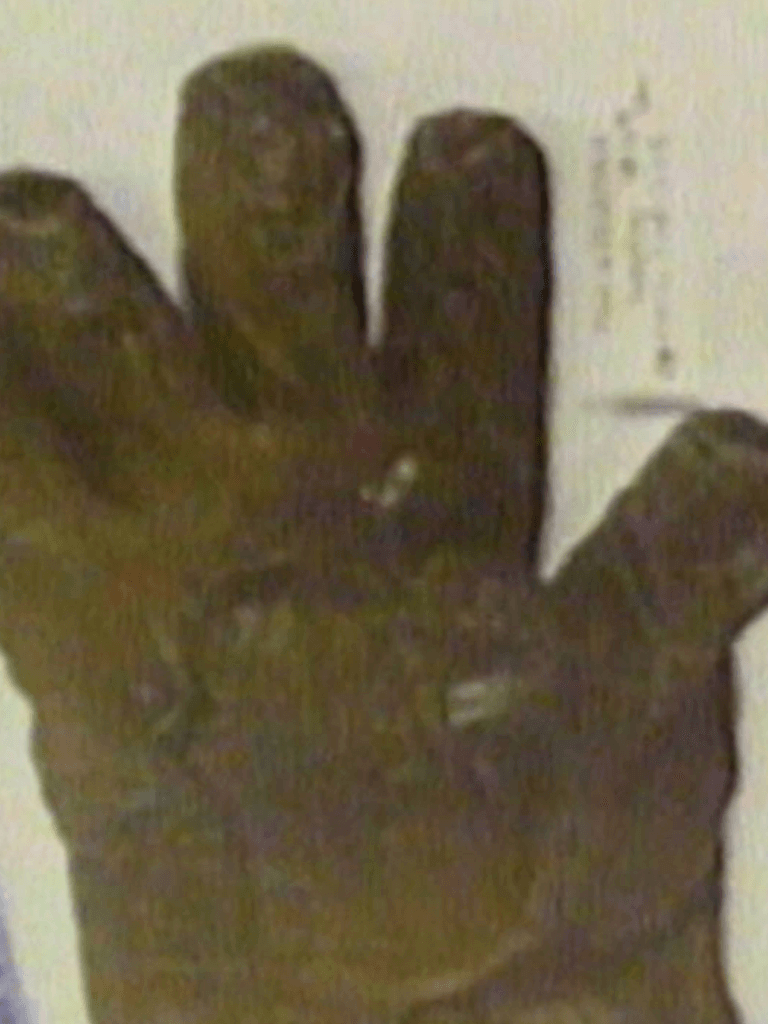
            Q.    (BY MR. GELBLUM)  This has been

     represented to be the glove that was found at the

     crime scene at Bundy.

                  Did you have an opportunity to look at

     this photograph, sir?

            A.    Yes, I did.

            Q.    And did you look at an enlargement of the

     photograph?

            A.    Yes, I did.

            Q.    Is what I'm handing you the enlargement

     that you looked at?

            A.    This appears to be the same enlargement

     that I originally looked at, and this also appears to

     be a slightly reduced enlargement of the -- of the

     glove.

            Q.    Did you look at that as well?

            A.    It appears to be the same one, yes.

            Q.    And did you also look at another

     photograph that I'm handing you -- I'll mark these in

     a minute -- showing the label on the glove.

            A.    Yes, I did.

            MR. GELBLUM:  Okay.  I'd like to mark this

     enlargement, the closest enlargement, as next in

     order.

            THE CLERK:  2371.


                         (The instrument herein referred to

                         as anenlargementt of a photograph

                         of a glove was marked for

                         identification as Plaintiffs'

                         Exhibit No. 2371.)


            MR. GELBLUM:  And one slightly more distant as

     2372.


                         (The instrument herein referred to

                         as an enlargement of a photograph

                         of a glove was marked for

                         identification as Plaintiffs'

                         Exhibit No. 2372.)


            MR. GELBLUM:  And the small one showing a label

     as 2373.

                         (The instrument herein referred to

                         as an enlargement of a photograph

                         of a glove showing a label was

                         marked for identification as

                         Plaintiffs' Exhibit No. 2373.)


            Q.    (BY MR. GELBLUM)  How did you examine

     those photographs, sir?

            A.    Basically, I examined it using a head

     loupe, the same head loupe that I used here yesterday

     in court, in addition to a small second eye loupe that

     is a little more powerful than that particular device.

            MR. GELBLUM:  Steve, can you focus -- zoom in

     on the white spot.


                         (Elmo adjusted.)


            Q.    (BY MR. GELBLUM)  Could you come to a

     conclusion, sir, about what that white spot is?

            A.    I was asked to examine that particular

     white spot to see if I could determine what it was and

     how it was orientated to the glove.  In this

     particular case, it was my determination that that was

     a piece of debris sitting on top of the glove itself.

                  However, the exact material that it was,

     I was not able to determine from the photographic

     examination.

            Q.    And what was the basis for your

     conclusion that it is a piece of debris sitting on top

     of the glove?

            A.    Well, basically, the positioning, the

     material that it's composed of in the back -- back

     portion -- if I might, Your Honor, might I step down?

            THE COURT:  (Nods affirmative.)

            A.    It's debris back in the -- for the sake

     of this particular image, on the upper portion of it,

     there appears to be dirt or soil similar to the dirt

     and soil up in this particular area.

                  And also, on the smaller reduction --

     reduced portion of the photograph, there's dirt and

     debris very similar to that soil.  It could also be

     seen on the left side of the -- the white piece of

     debris.

                  And in further examining it, it appears

     there are like little hair-like fibers in the debris

     itself.  Those hair-like fibers can be seen dipping

     down under in the base -- on the right-hand side into

     the shadow area.  If we look very closely into the

     shadow area, you can just see the weave or the texture

     of the glove going into the shadow area.

                  In addition to that, in examining the

     shadow itself, it was totally consistent with the

     shadow of the rest of the debris as to the direction

     and angle, making it consistent with the flash that

     took this picture producing a shadow in the lower half

     of that portion, which indicates that it is above the

     surface of the glove itself.

            Q.    Can you explain that -- why the fact --

     why there's a shadow indicating there is debris above

     the surface of the glove?

            A.    Well, in this particular case, if a light

     source which is coming from the upper left-hand corner

     here is shining down in this direction on all of the

     other material, and you can see it here on the back,

     how the shadow falls in this direction, if this in

     fact -- let's say it was a hole, this portion would be

     lit and the top portion would be in shadow, and it's

     the inverse of that, indicating that the material's on

     top of the surface, producing a shadow directly

     underneath.

            Q.    Okay.

                  Did you make a determination whether that

     white material could be the lining of the glove?

            A.    Well, I asked to look at Plaintiffs'

     Exhibit Number 2373 --

            MR. GELBLUM:  Let me put that on the Elmo.

            A.    -- to determine what the lining of the

     glove is to see, if perhaps, it was a piece of lining

     itself that had got lodged or possibly come from the

     inside of the glove onto the surface of it.

                  However, the lining of the glove appears

     to be a brown color as opposed to a white and doesn't

     have the same texture around the top and -- or

     textured material around the top and left edge, which,

     as I said, appears to be a soil of some sort.

            Q.    Well --

            MR. GELBLUM:  Your Honor, for the jury's

     benefit, may I pass around 2371, this enlargement that

     we had made?

            THE COURT:  You may.


                         (Jurors examine Exhibit 2371.)


            MR. GELBLUM:  I have no further questions for

     the witness, Your Honor.

            MR. LEONARD:  Put that back up, if you will,

     please.

                  Thank you.

                  Actually, the exhibit before.

            MR. FOSTER:  2311.


                        (Exhibit 2311 is displayed.)


                       CROSS-EXAMINATION

     BY MR. LEONARD:

            Q.    Morning, Mr. Richards.

            A.    Morning, sir.

            Q.    Let me ask you something before we get

     started on some background questions and so forth.

                  Let's get right to this issue -- to this

     issue of the glove.

                  You've made a determination that there's

     a piece of debris on the top of the glove, correct?

            A.    That's my opinion, yes, sir.

            Q.    You're aware of the fact, are you not,

     that Mr. Fung testified before this jury that there

     was a cut underneath the piece of debris?

                  Are you aware of that?

            MR. GELBLUM:  Object, Your Honor, no

     foundation, misstates the testimony.

            MR. LEONARD:  Exactly what he testified.

            MR. GELBLUM:  Not what he testified.

            MR. BAKER:  Page 63, January 8, bottom of 62,

     top of 63.

            Q.    (BY MR. LEONARD)  Are you aware of the

     fact --

            THE COURT:  Just a minute.

            MR. PETROCELLI:  It's also argumentative.

            MR. GELBLUM:  It's not what it says at all.

            THE COURT:  Approach the bench with the

     reporter.


                         (The following proceedings were

                         held at the bench with the

                         reporter.)


            MR. GELBLUM:  They're saying top of -- bottom

     of 62 to 63.


                        (Court reviews transcript.)


            THE COURT:  I'll sustain the objection.

                  But Mr. Leonard could read that portion

     to the witness.

            MR. LEONARD:  Thank you.


                         (The following proceedings were

                         held in open court in the presence

                         of the jury.)


            Q.    (BY MR. LEONARD)  Reading from page 62,

     line -- page 62, line 16.

                  (Reading:)

                         And you're telling me that's not

                  a cut, Mr. --

                  Question by Mr. Baker.

                         -- Mr. Fung?

                         Well, there's an area of damage

                  on there; I don't know if it's a cut or

                  if it was caused by a rip.

                         Q.     Now, are you telling this

                  jury that there was a rock in that exact

                  area and you have a recollection of that

                  when you collected the Bundy glove on

                  June 13, 1994?

                         Yes.

                         Q.     And you didn't see the

                  damaged area because a rock was on it;

                  is that what you're telling this jury?

                         I'm telling you that damaged area

                  was where a rock was.

                         Q.     And you couldn't see the

                  damaged area because there was a rock on

                  top of it; is that your testimony, sir?

                         A.     I'm saying it was embedded

                  in that damaged area.

                         Q.     So it was embedded in the

                  damaged area?

                         A.     Yes.

                  Now, you were -- sir, let me put this

     question to you:

                  You have no idea from your examination of

     this photograph whether there's a damaged area

     underneath that piece of debris, do you?

            A.    No, I do not.

            Q.    Do you have any reason to doubt

     Mr. Fung's testimony that he saw a damaged area?

            MR. GELBLUM:  Objection, argumentative, Your

     Honor.

            THE COURT:  Overruled.

            A.    No, I do not.

            Q.    (BY MR. LEONARD)  Now, let's talk a

     little bit about you.

                  Mr. Gelblum spent some considerable

     amount of time going through your qualifications.  He

     asked you a lot of questions about your experience in

     questioned documents -- examination of questioned

     documents and photographic examination.

                    Do you remember that?

            A.    Yes, sir.

            Q.    Now, when you were testifying about your

     experience, were you trying to leave the impression

     with the jury that you spent a great majority of your

     time examining questioned photographs?

                  Were you trying to leave that impression,

     sir?

            MR. GELBLUM:  Argumentative, Your Honor.

            THE COURT:  Sustained.

                  You may ask him how much time he did it.

            Q.    (BY MR. LEONARD)  You have testified in

     how many cases, total, sir, in your career?

            A.    Over 100.

            Q.    Would you say 200?

            A.    Over 100.  I don't -- I don't keep track

     of how many cases I testified to, but I would

     definitely -- I would be certain it would be over a

     hundred.

            Q.    Now, is it fair to say, sir, that in less

     than ten of those cases were you called upon to render

     an opinion about whether or not a photograph was faked

     or not?

                  Is that fair to say?

            A.    That's fair to say.

            Q.    In fact, it would be less than five?

            A.    That's fair to say.

            Q.    Would it be less than three, sir?

            A.    Yes, sir.

            Q.    Is this the first case you've ever

     testified in which there was an issue of whether or

     not there was a photograph faked or not?

            A.    I have testified in a deposition

     regarding a faked photograph but not in a trial court.

            Q.    You've never testified before a jury on

     that issue, have you, sir?

            A.    No, sir.

            Q.    And in your career at the FBI, sir, you

     spent the vast majority of your time when you were

     examining photographs doing analysis of the photograph

     to determine what images were on the photograph,

     correct?

            A.    Yes, sir.

            Q.    For instance, to determine the height of

     a bank robber from a surveillance video, correct?

            A.    Correct.

            Q.    You spent very little time at all

     examining photographs to determine whether or not they

     were real or fake; isn't that right, sir?

            A.    I spent just exactly the amount of time

     that was necessary on each case.

            Q.    You spent, sir -- the percent of your

     cases that involved the question of whether or not a

     photograph was faked was very small, wasn't it?

            A.    Yes, sir.

            Q.    Less than one percent, wouldn't you say,

     sir?

            A.    Probably.

            Q.    Did you tell that to Mr. Gelblum when he

     was interviewing you before your testimony?

            MR. GELBLUM:  Objection, argumentative,

     irrelevant.

            THE COURT:  Sustained.

            Q.    (BY MR. LEONARD)  Did you ever work in

     the field of creating composite negatives, sir?

            A.    In the field itself?

            Q.    Yeah.  Did you ever work making composite

     negatives?

            A.    Yes, sir.

            Q.    You didn't do that for a living at any

     time, did you, sir?

            A.    Well, it was part of my duties as what I

     was doing, yes.

            Q.    By the way, when is the last time that

     you testified with regard to the allegation that a

     photograph was faked?

            A.    As I mentioned, I only testified in a

     deposition.  That was about two years ago -- or,

     excuse me -- it was two and a half years ago.

            Q.    Now, the examination of a photograph to

     determine whether or not it's altered, that's not an

     exact science, is it?

            A.    No, sir.

            Q.    In fact, it involves a lot of subjective

     determinations on the part of the examiner, doesn't

     it?

            A.    Yes, sir, based on experience and

     education.

            Q.    Can you answer my question yes or no?

     You can explain all you want.

            MR. GELBLUM:  He did.  I object to the comment.

            THE COURT:  Question may remain.

            Q.    (BY MR. LEONARD)  There are no standards,

     are there, with regard to the examination of

     questioned photographs?

            A.    Would you define for me what you mean by

     standards.

            Q.    Yeah.

                  Are there any guidelines you can look to,

     standards that say you should look for X, Y and Z if

     you see any indicia of a fake that allows you to call

     a photograph a fake?  Is there anything like that that

     you rely on?

            A.    No, sir.

            Q.    It's up to each individual examiner to

     make a subjective decision about whether or not the

     photograph is a fake, correct?

            A.    Yes, sir.

            Q.    When you make a judgment as to whether or

     not a particular phenomenon or indication on a

     photograph is innocent, that is it doesn't lead to a

     conclusion of fakery, as opposed to culpatory, leading

     to a conclusion that a photograph is a fake, you take

     into account all of your past experience, correct?

            A.    Yes, sir.

            Q.    Any biases that you may bring into the

     case, right?

            A.    I take into account any of my biases.

            Q.    You would agree if there is any bias you

     have, that could very well influence you?

                  Do you agree with that, sir?

            A.    Yes.

            Q.    Okay.

                  And you would also agree that in order to

     make the ultimate determination of whether or not a

     photograph is fake, you have to take into account not

     just what you see within the four corners of the

     photograph but all of the facts and circumstances

     surrounding the photograph, the conditions under which

     it was taken and the history of the negative and so

     forth?

                  Would you agree with that, sir?

            A.    Not necessarily.

            Q.    Not necessarily?

            A.    Not necessarily.

            Q.    Sir, you were -- you were an FBI

     investigator, Mr. -- you were actually a specialist,

     you were a special agent, you were actually a field

     investigator for some period of time, correct?

            A.    Yes, sir.

            Q.    And is it your testimony before this

     jury, if you were going to make a determination

     whether or not a photograph is a fake or not, that you

     could disregard these other external factors, that is

     factors that you don't see within the four corners of

     the photograph?

            A.    One, what are the factors that we're

     talking about?

            Q.    Whether or not there was a motivation on

     the part of a photographer or his agent, for instance,

     to fake the photograph, do you think that's something

     that should be taken into account, sir?

            MR. GELBLUM:  Objection, assumes facts not in

     evidence, any such motivation in this case.

            THE COURT:  You may answer.

            A.    No, sir.

            Q.    (BY MR. LEONARD)  That's not something

     that should be taken into account?

            A.    Not by me.

            Q.    Do you think it should be taken into

     account by the jury or someone who should be --

            MR. GELBLUM:  That's really improper; ask that

     it be stricken.

            THE COURT:  Sustained.

            Q.    (BY MR. LEONARD)  Your job was to look at

     these photographs with tunnel vision, looking at just

     the four corners of the photographs, the negatives and

     the contact sheets, to see whether you could see any

     indicia of fakery, correct?

            MR. GELBLUM:  Objection, argumentative.

            Q.    (BY MR. LEONARD)  Was that your job?

            THE COURT:  He may answer.

            A.    As stated, no.

            Q.    (BY MR. LEONARD)  When you were told --

     were you told by the plaintiffs to disregard anything

     other than what you saw in the actual photographs,

     negatives and contact sheet?

            A.    No.

            Q.    Did you disregard that?

            A.    What do you mean by disregard?

            Q.    Any other information you received other

     than what you saw through the microscope, through the

     loupe, and measured.

            A.    Not anything that had significance to my

     exam, no.

            Q.    Did it have significance to your exam,

     sir, that this photograph was to be sold?  Did that

     have -- that it was sold?

                  Did that have any significance, sir?

            A.    No.

            Q.    Did it have significance to you, sir,

     that the photograph got into the hands of a fellow

     named McElroy, as testified by Mr. Scull, was flown to

     London and came back on the Concord?

                  Did that have any significance to you?

            A.    No, sir.

            Q.    Have you ever talked to McElroy?

            A.    Yes, sir.

            Q.    Did you ask him about the history of the

     photograph?

            A.    No, sir.

            Q.    Did you ask him why he had the negative

     flown to London?

                  Did you ask him that, sir?

            A.    No, sir.

            Q.    Didn't think that was important?

            A.    I didn't know it was flown to London.

            Q.    You didn't?

            A.    No, sir.

            Q.    Did you read Harry Scull's deposition?

            A.    I finally read Harry Scull's deposition

     yesterday.

            Q.    Well, that's in there, isn't it?

            A.    Yes, sir.

            Q.    You just told the jury you didn't know

     that?

            A.    I didn't know when I talked to

     Mr. McElroy.

            Q.    Oh, I see.

                  Did you think that was important when you

     read it in Scull's deposition?

            A.    No.

            Q.    Did you wonder why McElroy had the

     photograph flown to London and back on the Concord?

            MR. GELBLUM:  Objection, relevance.

            THE COURT:  Sustained.

            Q.    (BY MR. LEONARD)  Do you know how much

     Scull got for the photograph?

            A.    No, sir.

            Q.    That wasn't important to you?

            MR. GELBLUM:  Objection, relevance, Your Honor.

            THE COURT:  Sustained.

            MR. LEONARD:  Your Honor, goes to motive.

            MR. GELBLUM:  Not this witness.

            THE COURT:  This is not his expertise.

            MR. GELBLUM:  It's argument.

            Q.    (BY MR. LEONARD)  Now, is it true, sir,

     that you can't always tell whether a photograph is

     fake?

                  Is that true?

            A.    That I can't always tell?

            Q.    Yeah.

            A.    Yes, sir.

            Q.    In fact, the technology and techniques

     that exist today can be fairly sophisticated and very

     good, can't they?

            A.    They can be, yes, sir.

            Q.    To the extent to where even a seasoned

     examiner like you can't see any indicia of a fake?

            A.    Under some circumstances, yes.

            Q.    And by the way, you're not telling this

     jury that you're 100 percent certain that this

     photograph isn't a fake, are you, sir?

            A.    In my mind?

            Q.    Yes.

            A.    Yes, I am.

            Q.    You're saying 100 percent?

            A.    I'm saying that around the area that is

     in question, the feet and shoes and leg areas, my

     opinion is 100 percent certain it is not a fake.

            Q.    Despite the fact, sir, that you testified

     in your deposition, did you not, that there are

     techniques out there and technology available that

     could make it literally impossible under certain

     circumstances -- in fact, in many cases, for

     photographs to be faked with no indicia of fakery,

     right?

            A.    Yes, sir.

            Q.    Now, what you do when you look to see if

     there's any fakery in a photograph is you basically

     look to see if there are any clues left behind,

     correct?

            A.    Correct.

            Q.    Clues that the photograph has been faked,

     correct.

                  And would you agree with me, sir, that

     the areas that Mr. Gelblum had up on that board, in

     general terms, would be areas of clues or indicators

     that a photograph would be fake?

                  Would you agree with that?

            A.    I would say the great majority would not

     be.

            Q.    But there were some up there that were,

     weren't there, sir?

            A.    Yes, sir.

            Q.    In fact, you would agree with me that the

     existence of an edge that shouldn't be there is an

     indicator of a faked photograph, right, that can be?

            A.    An edge that shouldn't be there?

            Q.    Yeah.

            A.    Be where?

            Q.    An edge along the side of a negative that

     shouldn't be there, that -- wouldn't that be an

     indication that there's been a cutout, sir?

            A.    In the picture area or outside of the

     picture area?

            Q.    Outside the picture area, sir.

            A.    Probably not.

            Q.    It could be, though, isn't that right,

     sir?

            MR. GELBLUM:  Objection, relevance, Your Honor.

            THE COURT:  Overruled.

            A.    It could be.

            Q.    (BY MR. LEONARD)  Now, one -- one of the

     areas, also, that Mr. Groden testified to was whether

     or not there was an edge along the bottom of the first

     photograph, the subject photograph, that shouldn't be

     there.

                  Do you remember that?

            A.    Yes, sir, I do.

            Q.    And you had taken the position with this

     jury that that is actually some kind of an image of a

     football field; is that correct?

            A.    That's correct.

            MR. LEONARD:  Can we put that up.

                  Hold on, I got it right here.

                  Would you mind stepping down, holding

     this up for the jury.

            THE COURT REPORTER:  What number is that,

     please?

            MR. LEONARD:  That's 2368.


                        (Exhibit 2368 is displayed for

                        jury.)


            MR. LEONARD:  Can everyone see that?


                        (Jury panel nods affirmatively.)


            Q.    (BY MR. LEONARD)  Now, is it your

     testimony, sir, that that -- that these lines

     represent the lines of the football field?

            A.    That's correct, sir.

            Q.    And you testified yesterday that the

     camera was facing down when that photograph was --

     when that image was taken.

                  Do you remember that, sir?

            A.    Facing slightly down, yes, sir.

            Q.    Do you remember saying yesterday that it

     was facing down?

                  Do you remember that?

            A.    Facing in a down direction, relative to

     the other image that I was showing on frame 12, yes,

     sir.

            Q.    With the lens down, correct?

            A.    Not down.  Slightly down, as I said

     yesterday, pointing in a slightly down direction.

            Q.    Is it your testimony, sir, that you're

     opining that that photograph was taken from the end

     zone; is that right?

            A.    Yes, sir.

            Q.    And would you agree with me, sir, that if

     the photograph is taken from the end zone, that the

     person taking the photograph had to be about 60 or 70

     feet off the ground?

                  Would you agree with me about that, sir?

            A.    No, I would not.

            MR. LEONARD:  Show that to the jury again,

     please.

            THE COURT:  You want him to still stand there?

            MR. LEONARD:  No, he can resume.

            THE WITNESS:  Thank you.


                        (Witness resumes witness stand.)


                        (Jurors pass around Exhibit 2368

                        among themselves.)


            Q.    (BY MR. LEONARD)  Sir, did you compare

     that photograph with any of the other images -- any of

     the other images -- that image which you say is a --

     is a partial photograph of the football field, with

     any of the other images on the contact sheet?

            A.    Yes, I believe I used my frame 12 here as

     an illustration to compare it with that.  We passed it

     around to the jury yesterday.

            Q.    Did you see, sir, that when -- when a

     photograph was taken with the lines of the football

     field, that the lines, as -- as they -- as they move

     away from the position of the photographer, they got

     closer and closer together?

                  Did you see that, sir?

            A.    Yes, sir, I did.

            Q.    Did you see that they got -- at the end,

     the last couple lines were virtually right next to

     each other?

                  Did you see that, sir?

            A.    Yes, sir.

            Q.    You don't see that in this photograph, do

     you?

            A.    And you wouldn't, either.  Yes, sir.

            Q.    In fact, the last two lines are almost

     equal distance from each other -- the last three

     lines, isn't that right, sir?

            A.    That's correct.

            Q.    Now, we also talked about the issue of

     the reflection on the bottom of the shoe purported to

     be worn by Mr. Simpson in that photograph.

                  Do you remember that?

            A.    Yes, sir.

            Q.    And you told this jury that there you'd

     expect reflection no matter what the surface was,

     whether -- what the color, whether it was red, white

     or green for that matter, correct?

            A.    I would expect that color to be reflected

     onto whatever surface is directly above it, yes.

            Q.    Including green --

            A.    Yes, sir.

            Q.    -- right?

                  Did you have an opportunity to look at

     any of the other -- there were other images there

     where the foot is slightly raised, other images where

     the foot of the individual in the photograph is

     slightly raised.

                  Did you see that?

            A.    Yes, sir.

            Q.    Did you have a chance to look at those,

     sir?

            A.    Yes, sir, I did.

            Q.    Did you notice that you can't see any

     detail on the sole -- underside of the soles of any of

     those photographs?

                  Did you notice that, sir?

            A.    Yes, sir.

            Q.    Did you think that was a little strange?

            A.    No, sir.

            Q.    Did you notice that there's no reflection

     underneath the soles on any of those photographs, sir?

            A.    Yes, sir.

            Q.    And some of those were over green and

     some of those are over other colors, aren't they?

            A.    Yes, sir.

            Q.    No reflection?

            A.    None that I could see, no, sir.

            MR. LEONARD:  I'll put up some photographs.

                  Start with contact sheet 2 at frame 17

            MR. P. BAKER:  This is 1833.

                         (The instrument herein referred to

                         as contact sheet was marked for

                         identification as Defendants'

                         Exhibit No. 1925.)


                         (Exhibit 1925 displayed on Elmo

                         screen.)


            Q.    (BY MR. LEONARD)  You're looking at frame

     17, which is a photograph of --

            MR. P. BAKER:  I'm sorry; it's 1925.

            MR. LEONARD:  If you could zoom in -- there you

     go.

            Q.    (BY MR. LEONARD)  That's a photograph of

     Marv Levi, correct?

                  Do you know who that is, by the way?

            A.    Do I?

            Q.    Yeah.

            A.    I believe he's the Buffalo Bills coach.

            Q.    Fine.

                  Take a look at the underside of the sole,

     there.

            A.    Yes, sir.

            Q.    You can't see any -- you can't see any

     detail on the bottom of that sole, can you?

            A.    No, sir.

            Q.    And you can't see any reflection of any

     green, can you, sir?

            A.    No, I cannot.

            MR. LEONARD:  The next photograph would be

     C2F -- frame 15, contact sheet 2, frame 15.

                  Can you zoom in on the feet?

            MR. P. BAKER:  That's as far as that goes.

            Q.    (BY MR. LEONARD)  You examined that?

            A.    Yes, from --

            MR. P. BAKER:  I'm going to -- the pro has told

     me how to work this thing.

            MR. PETROCELLI:  Well, I'm glad you learned by

     the end of the trial.

            Q.    (BY MR. LEONARD)  Couldn't see any detail

     whatsoever on the underside of the sole?

            A.    That's correct.

            Q.    No reflection, correct?

            A.    That's correct.

            MR. LEONARD:  Can we go to contact sheet 1,

     frame 26.

            Q.    (BY MR. LEONARD)  Now, that's coach Don

     Schula, correct?

            A.    Correct.

            Q.    Same question, sir:  Do you see any

     detail on the bottom of the sole?

            A.    Yes.  In that particular picture, you can

     see detail.

            Q.    Do you see any reflection, sir?

            A.    No, sir.

            Q.    Show the jury where the detail is.

            A.    Could -- would you enlarge that to the

     maximum capability?

            Q.    That's it.

            A.    Well, it isn't evident.  But on -- I'll

     explain it from here.

                  That's the left shoe.  On the right-hand

     side of the shoe, you can see the serration of the

     sole itself.  In other words, the design is somewhat

     of a serrated design, and you can see the detail of it

     on the right-hand portion of it when you look at it

     under magnification.

            Q.    Sir, would you agree with me that the

     amount of detail that you can see in that sole is

     nowhere near the amount of detail you can see in the

     sole of the shoe depicted in the subject photograph?

                  You agree with that, wouldn't you, sir?

            A.    Yes, sir.

            Q.    Okay.

                  You'd also agree there's no reflection

     there, wouldn't you?

            A.    Yes, sir.

            Q.    There's no halo effect around that shoe,

     is there, sir?

            A.    Not that I recall.

            Q.    Well, look at it, if you don't recall.

                  There's no halo on that, is there, sir?

            A.    Well, from that particular image, I would

     not be able to determine.  I would have to go back and

     look.

            Q.    Your best recollection is, there was

     none?

            A.    Not --

            MR. PETROCELLI:  He was in the middle of an

     answer, Your Honor, and he interrupted him.

            MR. LEONARD:  Excuse me.

            THE COURT:  You may proceed.

            MR. LEONARD:  Thank you.

            THE CLERK:  For the record, this is Exhibit

     1924.

            Q.    Now, you also testified, I believe --

            MR. LEONARD:  Can we put the photograph that

     has the close-up.

                  Yeah.

            MR. P. BAKER:  This is 1830 going on the

     screen.

                         (Exhibit 1830 displayed on the

                         Elmo screen.)


            MR. LEONARD:  If you go down to the area of the

     foot, particularly the right foot, and focus as best

     you can.

            Q.    (BY MR. LEONARD)  You testified just now

     on direct examination, that the majority of that shoe

     was over the red.

                  Do you remember saying that on direct

     examination, sir?

            A.    Yes, sir.

            Q.    Some of it's over the white.  Would you

     agree with that, sir?

            A.    No, sir.

            Q.    Would you agree with me, sir, that there

     should be some white reflection, if that is a valid

     photograph, on the very tip of that shoe?

            A.    No, sir.

            MR. LEONARD:  Now, let's move -- let's pull

     back on this particular image.

                  Do we have a number on this --

            MR. P. BAKER:  1830.

            MR. LEONARD:  -- so the record is clear?

                  And if you could, try to focus on the

     scratch along the right-hand side.

            MR. P. BAKER:  (Adjusts Elmo.)

            MR. LEONARD:  Not that close.  Pull back a

     little.

            MR. P. BAKER:  (Adjusts Elmo.)

            MR. LEONARD:  And up a little bit, please.

            MR. P. BAKER:  (Adjusts Elmo.)

            MR. LEONARD:  There we go.

            Q.    (BY MR. LEONARD)  Now, you spent a lot of

     time on your direct examination talking about this --

     what you described as a scratch made by the camera.

            A.    Yes, sir.

            Q.    Never got a chance to examine the camera,

     correct?

            A.    I didn't hear.

            Q.    You never got a chance to examine Scull's

     camera, correct?

            A.    No, sir, I did not.

            Q.    Scull told you that it had been stolen,

     right?

            A.    Yes, sir.

            Q.    Now, before we get into the specifics

     here, would you agree that if you were going to fake a

     photograph, and that you wanted to do a thorough job

     of covering your tracks, that you would attempt to

     create a duplicate negative and fit it back into the

     original roll that you were claiming the photograph

     was taken on?

                  Would you agree with that?

            A.    No, sir.

            Q.    Never heard of that happening; is that

     right?

            A.    Not in that -- not that technique as

     you've just described it.

            Q.    Would you agree with me, sir, that if you

     were going to do that, that you would try to use the

     same camera to recreate the fake roll of film?

            MR. GELBLUM:  Objection, Your Honor.  He just

     said he never heard of anybody doing that.

            Q.    (BY MR. LEONARD)  If you were going to

     use that technique that you haven't heard of?


                        (Laughter.)


            MR. GELBLUM:  Objection.

            MR. PETROCELLI:  Now we're in Never Never Land,

     Your Honor.

            MR. LEONARD:  No, we're not.

            MR. PETROCELLI:  Well, we've been there.

            MR. BAKER:  Your Honor, I object.

            THE COURT:  Well, it calls for speculation.

                  It's close, so I'll allow it.

            A.    No, sir.


                        (Laughter.)

            Q.    (BY MR. LEONARD)  Now, when you -- I take

     it you examined this rather closely, right?

            A.    Yes, sir.

            Q.    And one of the things you were looking

     for was to see if there was a continuous scratch,

     correct?

            A.    Yes, sir.

            Q.    Okay.

                  And, first of all, this -- this

     illustrates quite nicely how the first slide is out of

     line with the second.  Would you agree with that?

            A.    (No verbal response.)

            Q.    Do you follow that scratch up there, sir?

            A.    Yes, sir.

            Q.    Okay.

                  And, of course, your explanation for that

     is an innocent one; that it has something to do with

     the movement of the camera, correct?

            A.    Yes, sir.

            Q.    It can also be that that was inserted

     into -- that was a fake negative inserted into this

     film, correct?

            A.    No, sir.

            Q.    When you see a fake negative inserted

     into a -- into a strip, if you don't insert it exactly

     correct, it can be out of line, correct?

            A.    I would never -- I've never heard of, nor

     would I understand, any reason to do it in that

     manner.

            Q.    Now, if -- You are telling the jury

     that -- that this scratch was caused by the camera,

     correct?

            A.    Correct.

            Q.    And you're saying that the scratch occurs

     as the film is pulled through the camera, correct?

            A.    Correct.

            Q.    Is it your testimony, sir, that if the

     film was moving, you wouldn't see any change in that

     scratch whatsoever?

                  Is that what you're saying?

            A.    You're going to have to wind the film.

     If the film was moving, you wouldn't see any change --

     that kind of change.

            Q.    You said that the fact that this negative

     is out of alignment has something to do with the fact

     that the film was moving in the camera, correct?

            A.    Correct.

            Q.    Wouldn't you expect to see some change in

     that scratch, sir, that the scratch would move?

            A.    Yes, sir.

            Q.    You don't see any between these frames,

     do you, sir?

            A.    I wouldn't expect to, necessarily.

            Q.    You don't see any, do you?

            A.    No, sir, I do not.

            MR. LEONARD:  Can you put up -- yeah, put that

     photograph up again.

                  The one that's on the Elmo, just pull it

     back.

                  Focus on that right foot again, please.


                        (Mr. P. Baker adjusts Elmo.)


            Q.    (BY MR. LEONARD)  I want you to take a

     look carefully, sir, at the positioning of that foot

     on the ground, and in particular, at the position of

     the heel.

                  You see that?

            A.    Yes, sir.

            Q.    That heel is flat on the ground, is it

     not, sir?

            A.    From that photograph, I cannot tell.

            MR. LEONARD:  Now what are we putting up?

            MR. P. BAKER:  This is a zoomed 1931.


                         (Exhibit 1931 displayed on the

                         Elmo screen.)


            MR. LEONARD:  Just zoom back first.

            Q.    (BY MR. LEONARD)  Let me ask you a couple

     foundational questions.

                  You testified in your deposition that --

     that the shoe was in the position where the toe is up

     and it's cocked to the left, correct?

            A.    I said to the left.  It should be -- it

     should have been to the left.

            Q.    Cocked to the right?

            A.    Yes.

            Q.    Now, I want to you take a look at that

     heel.

                  Is that heel not flat on the ground, sir?

            A.    No, sir.

            Q.    With no portion above the surface?

            A.    No, sir.

            Q.    How much is above the surface, sir?

            A.    A small portion in the front of the heel.

            Q.    Extremely small portion, right?

            MR. LEONARD:  Zoom in.

            MR. P. BAKER:  (Adjusts Elmo.)

            A.    It depends on how you define "extremely."

     I say a small portion of it is above the ground.

            Q.    (BY MR. LEONARD)  Measure it.

                  Can you measure it?

                  Did you attempt to measure it?

            A.    No, sir.

            Q.    Now, you've discussed in your direct

     testimony a lot of experiments.  You did

     demonstrations; you put those in front of the jury.

                  Let me ask you something.  Did you ever

     try to replicate this photograph?

                  In other words, did you ever attempt to

     try to take a similar photograph, sir, with -- with

     someone walking in the manner that Mr. Simpson is,

     with the same stride pattern?

                  Did you ever try to do that?

            A.    No, sir.  That would be extremely

     difficult.

            Q.    You didn't do that, right?

            A.    No, sir, I did not.

            MR. LEONARD:  I don't have any further

     questions.

            THE COURT:  Ten-minute recess, ladies and

     gentlemen.

            MR. LEONARD:  Maybe I do.  Hold on.

            MR. BAKER:  We can take a ten-minute recess.

            THE COURT:  Don't talk about the case.  Don't

     form or express any opinions.


                        (Recess.)


                         (Jurors resume their respective

                         seats.)


            THE COURT:  Okay.  You may proceed.

            MR. GELBLUM:  Thank you, Your Honor.

                       DIRECT EXAMINATION

     BY MR. GELBLUM: (continued)

            Q.    You said this is the first time -- I

     think the first time you testified in court on the

     subject of an altered photographed; is that correct?

            A.    Yes, sir, that's true.

            Q.    How many cases have you worked on

     involving alteration of photographs?

            A.    Probably somewhere between 50 and 60.

            Q.    In all the professional organizations

     that you belong to and the agencies you've worked

     with, do you know anybody in the country who has

     worked on more cases involving altered photographs

     than you?

            A.    Not that I'm aware of no, sir.

            Q.    On those 50 or 60 cases, do you know why

     those didn't come to court?

            MR. LEONARD:  Objection, irrelevant.

            THE COURT:  You may explain.

            A.    I'm sorry.  I didn't hear.

            Q.    (BY MR. GELBLUM)  Go ahead.

            A.    In about half of them, they were not

     criminal matters, they were cases involving

     alterations made such as in MIA cases, prisoner of war

     cases, where photographs had been put forth as being

     individuals who were in the military being held by

     Vietnamese; those type of examinations.

                  The other half, approximately, were

     criminal matters.  However, most of them just did not

     go to trial.  I was called a number of times for

     testimony, but the cases settled before that

     particular time.

            Q.    I think you testified over 100 times in

     court?

            A.    Somewhere between 100 and 200, yes, sir.

            Q.    And some of those involved forensic

     photography issues?

            A.    Yes, sir, a great many of them.

            Q.    Do you use the same, or some of the same,

     skills examining a photo for alteration as you do in

     examining a photo for comparison purposes?

            A.    First of all, you have to have a good

     understanding of the photographic process, from the

     camera, to the film, to the processing techniques,

     pretty well across the board.

                  You to have a basic knowledge through

     training, education, and also just pure experience

     looking at a lot of -- lot of film, lot of negatives,

     lot of prints, over the years, to understand the many

     characteristics in photography that you may run across

     in doing an examination.

                  And all of these relate one way or

     another, eventually, to doing an examination of

     alterations.

            Q.    Okay.

                  Does the FBI, when you were working with

     the FBI, get many alteration cases?

            A.    The FBI itself will accept cases from all

     56 of the field divisions and 11,000 police

     departments throughout the United States and the unit

     was the special photographic unit, we would get

     somewhere between three or possibly four a year of

     this type of case.

            Q.    Did you work on those?

            A.    I worked on the grand majority of them.

     Other agents there also worked on them, but not as

     many as normally I would.

            Q.    So you just don't see many claims about

     photographs that have been altered?

            A.    You just don't see many claims, yes.

            Q.    Mr. Leonard asked you when determining

     whether a photograph had been altered is an exact

     science.  You said it is not, sir?

            A.    It is not.

            Q.    What do you mean by that?

            A.    An exact science.  I don't think any

     science is exact.  Even in mathematics there's

     idiosyncrasies that don't make it exact, like pi; you

     can't get an exact number for pi.

                  But most sciences are not exact, most

     sciences require a -- a methodology and an analysis,

     evaluations, and a conclusion, as a rule, and this

     science follows just like most others.

                  Some sciences, you have to use more

     experience than others, and this is one of them.

            Q.    In this field, training and experience is

     important?

            A.    Very important.

            Q.    Mr. Leonard asked you questions about

     bias.

                  Do you have any bias in this case?

            A.    I feel I do not.

            Q.    Have you ever had a case where you were

     hired to determine some issue with respect to a

     photograph and you gave your employer an answer they

     didn't want?

            MR. LEONARD:  Objection, beyond the scope.

            THE COURT:  Overruled.

            MR. LEONARD:  Irrelevant.

            THE COURT:  You may answer.

            A.    Yes.  Particularly since I have been in

     private practice, I would say probably one-third of

     cases I receive, I provide the answer to my client,

     and they would rather not talk to me again after that.

                  When I was in the FBI, I would also, even

     though those were all criminal cases, and mostly all

     prosecution cases that were coming in, many times I

     would issue a report that was contrary to the -- to

     the beliefs of the prosecution, and henceforth, the

     case may or may not go to court.

            Q.    (BY MR. GELBLUM)  Now, Mr. Leonard also

     asked you if you had looked at anything outside the

     four corners of this particular photograph in reaching

     your conclusion that it has not been altered.

                  Did you look at any other photographs?

            A.    Yes, I did.

            Q.    What photographs did you look at?

            MR. LEONARD:  Objection.

            MR. GELBLUM:  He opened the door.

            MR. LEONARD:  Based on your prior ruling --

            MR. GELBLUM:  He opened the door, Your Honor.

            THE COURT:  Approach the bench and tell me

     which door he opened.


                         (Laughter.)


                         (The following proceedings were

                         held at the bench with the

                         reporter:)


            MR. GELBLUM:  Mr. Leonard asked did he look at

     anything else.

                  In fact, he looked at the Flammer

     photographs.  And those re-enforce his opinion --

     supports his conclusion about the authenticity of the

     Scull photographs and these other photographs showing

     the same shoes -- just not going to go into detail of

     authenticity itself or anything else.

                  He did ask him whether he looked at

     anything else and the fact is he did.

            MR. LEONARD:  That was specifically in the

     context of questions about motive and such things as

     that.  I did not intend to, nor did I communicate to

     this jury anything that would open the door to the

     Flammer photos.  That's a subject of a writ at this

     point and this --

            THE COURT:  All right.  Save it for tomorrow.

            MR. LEONARD:  Thank you.

            MR. GELBLUM:  Thank you.


                         (The following proceedings were

                         held in open court in the presence

                         of the jury.)


            MR. GELBLUM:  We may try to talk about that

     later.

            Q.    (BY MR. GELBLUM)  Mr. Leonard asked you

     whether a -- if you could see a false edge outside the

     image, whether that could be evidence of alterations.

                  Is there any doubt in your mind about

     this false edge issue in this case?

            A.    There's absolutely no doubt in my mind

     about the false edge issue in this case.  There's no

     doubt in my mind that it is the frame previous to it

     that's underexposed that's taken during the initial

     loading of the camera.

            Q.    Is there a false edge in this case?

            A.    No, sir.

            Q.    Mr. Leonard asked you whether the

     photographer would have to be 60 or 70 feet above

     ground to get this image, and you said no?

            A.    No, sir, it would not.

            Q.    Would you explain?

            THE WITNESS:  Your Honor, may I?

            THE COURT:  (Nods affirmatively.)

            THE WITNESS:  Thank you.

            A.    I'll go through the process of loading

     the camera.  Let's assume this is the end zone of the

     football field, and the football field is -- looking

     down here, all the lines are parallel to my particular

     camera.  Where I'm standing, I'm just looking down the

     football field, and loading the camera.

                  Normally, the position would be to hold

     it -- pick it up, as I'm doing here, take the film out

     of my, possibly, bag, and place it into the camera,

     and once I get it into the camera, close the back --

     close the back, look at where No. 1 is on the top of

     my camera here, and click off two or three shots.

                  Now, if I were to hold the camera exactly

     at 90 degrees to the ground, pointing straightforward,

     we would see -- and if we have the photographs here --

     we would see the horizon line.  And the horizon line

     being the image in back of here, we would see the

     ground portion as we see them in Exhibit -- I mean in

     frame No. 12, 13, 14, the great majority of these.


                         (Indicating to Exhibit 2366.)


            A.    As we tip the camera down, even a few

     degrees, this much -- let's say 15 degrees down, the

     top of the camera is no longer going to see the end of

     the field, it's going to see what's in front of me to

     this point on, out to a certain distance, depending on

     what the tilt is.

                  If I were to hold it directly down, it

     would see none of the field, of course.

                  But somewhere between 90 degrees and

     looking straight down, the camera would pick up the

     first few lines, and they would tend to diminish, as

     they did, until it was out of the field of view any

     longer.

            Q.    Is that the normal position for loading a

     camera?

            A.    Yes, sir.

            Q.    And do the lines in frame 0 diminish as

     you would expect them to diminish?

            A.    Yes, I would.

            Q.    I think you told Mr. Leonard that you

     would not expect to see the last couple of lines in

     frame 0 right next to each other?

            A.    No, because basically, we're not seeing

     far enough down the field.  If we were seeing farther

     down the field, they would continue to get closer and

     closer until either we ran out of lines or eventually

     they would appear all to be touching as one big line

     at the end of the field, very similar to when I showed

     the image of the railroad ties yesterday; we could see

     the first couple ties in front of us very plainly, but

     as they continued on down the track, they were no

     longer distinct, they all kind of merged into one.

            Q.    Can you hold up the exhibit in front of

     you.

                  What's the number on the back?

            A.    Yes, Exhibit 2365.

            Q.    And that shows the lines there?

            A.    Yes.  This would be the closest line to

     the camera.  There very well may be a line closer than

     that we can't see, it's out of the frame, and then

     continuing up at least six lines here until we no

     longer see them, but the lines will continue on down

     the field to the end zone.

            Q.    If you say you see more lines, they would

     in fact get closer and closer together?

            A.    Yes.  If we tipped the camera up to the

     horizon, we would see images very, very similar to

     what we see in the other frames.

                  However, when you're loading the camera,

     as I said, you're pointing the camera slightly down,

     you're not intending to take a picture.  And if you

     remember the example I used yesterday, many times when

     amateurs take pictures, they get pictures of their

     feet or the kitchen tiles or what have you, because

     they're pointing the camera basically down.

            Q.    Now, Mr. Leonard showed you some

     photographs of some other shoes on the field, some

     other people's shoes, and the soles of those shoes,

     and you said, I think, you saw less detail in the

     soles of those shoes than you do in the photograph of

     Mr. Simpson walking across the end zone.

            MR. LEONARD:  Objection.  That misstates his

     testimony.  He said he didn't see any detail except

     for one.  When he says soles --

            THE COURT:  Overruled.

            Q.    (BY MR. GELBLUM)  He talked about the

     detail and the soles.

                  Do you recall that?

            A.    Yes, sir.

            Q.    And why would you -- do you have an

     opinion as to why you don't see the detail in those

     shoes, or as much detail as the one in the

     photographs?

            A.    Well, there may be numerous reasons:  One

     of them is the different types of shoes, different

     types of materials on the bottom.  Different lighting

     conditions very well may cause it.  And when we

     actually look at the shoe of -- Mr. Simpson's shoe,

     here at the bottom we can see -- we only see a very

     small portion of the sole where the light is

     reflecting off of it on the far right-hand side.  All

     the rest of it is black and has no detail, just like

     the other shoes in the other photographs.

            Q.    Okay.

                  Mr. Leonard also showed you some of the

     other shoes, and I think you said there was no

     reflection visible, at least in the ones he showed you

     on the other soles?

            A.    Yes.

            Q.    What could the reason for that be?

            A.    Well, again, because the material may not

     reflect very well, the lighting may not -- there may

     not be enough light to reflect that green back on up

     to -- up to the black sole.  There's a number of

     reasons.  I can't explain why it wouldn't be there

     because of the numerous reasons or possibilities of

     it.

                  In this one particular case, we do have

     just enough light at just the right angle, and it is

     backlit where it is reflecting up, to show just a

     portion of the sole, just the edge of the sole.

            Q.    Okay.

                  And finally, Mr. Leonard asked you some

     questions about the position of Mr. Simpson's foot,

     his right foot, in the photograph.

                  In your 25 years of work in forensic

     photography, is one of the things you do when you're

     comparing photographs, when you're determining whether

     a photograph has been altered, to look at the position

     of different body parts?

            A.    Well, I always look to see if they're

     unusual.  Obviously, if the body part isn't in correct

     anatomical position, in other words, if the foot isn't

     facing forward, it would concern me greatly.  But in

     most cases, it is a natural part of viewing the

     picture.  I look at the body parts to make sure that

     they are not completely out of sync.

                  Perhaps, if a person is falling, they may

     be in a very contorted position which would be natural

     for a person falling.

                  But in a contorted position, if they are

     normally walking, there would have to be some other

     explanation for it.

            Q.    And did you look at the photograph of

     Mr. Simpson walking across the end zone to determine

     whether his feet seemed to be in a natural and proper

     position?

            A.    Yes.  It appears to me they are.

            MR. GELBLUM:  Nothing further, Your Honor.


                      RECROSS-EXAMINATION

     BY MR. LEONARD:

            Q.    When you made this determination about

     the natural and appropriate position of Mr. Simpson's

     feet, did you actually try to walk like that and see

     if your heel would be flat on the ground, sir, and

     your foot was up like that?

                  Did you try to do that?

            A.    No, sir.

            MR. GELBLUM:  Objection, misstates the evidence

     about flat on the ground.  This witness said it

     wasn't.

            THE COURT:  Overruled.

            Q.    (BY MR. LEONARD)  Now, you went through

     this demonstration here about how Harry Scull loaded

     the film that day, where he was pointing the camera.

                  You have no idea where he loaded the film

     or how he was pointing the camera, do you, sir?

            A.    Based on my analysis of the photograph,

     yes.

            Q.    Did you -- you actually interviewed Harry

     Scull?  You talked to him, didn't you?

            A.    I did not interview him.  I talked to

     him, yes.

            Q.    You never asked him that, did you?

            A.    No, I did not.

            Q.    Now, you know, sir, don't you, that

     there's an issue in this case regarding some

     footprints that were left behind at the Bundy crime

     scene?

                  Do you know that, sir?

            MR. GELBLUM:  Objection, beyond the scope.

            MR. LEONARD:  I'll make it up.

            MR. PETROCELLI:  No.  I want to know now.

            MR. LEONARD:  Okay.  Let's go.

            MR. GELBLUM:  I want an offer of proof.

            MR. LEONARD:  Let's go.

            MR. PETROCELLI:  I guess we're going, Your

     Honor.

            MR. LEONARD:  Well, you want to know.

            MR. KELLY:  So we'll go.


                         (The following proceedings were

                         held at the bench with the

                         reporter:)


            MR. LEONARD:  I guess it's my turn.

                  I just want to ask him if he knows that

     that's an issue in this case with regard to the

     footprints, and the fact that it just so happens

     there's a portion of the -- of the sole that's visible

     on the shoe that's not visible on the other shoes.

                  That's all I want to ask him.

            THE COURT:  I'll sustain the objection to that.


                         (Laughter.)


                         (The following proceedings were

                         held in open court in the presence

                         of the jury.)


            MR. LEONARD:  No further questions.

            MR. GELBLUM:  Nothing further.

            MR. LEONARD:  Your Honor, at this point I have

     no further questions.

            THE COURT:  Thank you.

            MR. GELBLUM:  Nothing further until tomorrow,

     if that comes to pass.

            THE COURT:  You may step down.

            THE WITNESS:  Thank you.

            MR. GELBLUM:  I'd like to move in various

     exhibits, if I can find my list.  2369 through 2373,

     is the list I have.  That's from today.

            MR. FOSTER:  Yesterday, starting at 2357

     through 23 --

            MR. GELBLUM:  It's 2357 through 2373.

            THE REPORTER:  Those are all consecutive,

     right?

            MR. GELBLUM:  Yes.

            THE COURT:  Received.


                         (The instrument previously marked

                         as Plaintiffs' Exhibit 2357 was

                         received in evidence.)


                         (The instrument previously marked

                         as Plaintiffs' Exhibit 2358 was

                         received in evidence.)


                         (The instrument previously marked

                         as Plaintiffs' Exhibit 2359 was

                         received in evidence.)


                         (The instrument previously marked

                         as Plaintiffs' Exhibit 2360 was

                         received in evidence.)


                         (The instrument previously marked

                         as Plaintiffs' Exhibit 2361 was

                         received in evidence.)


                         (The instrument previously marked

                         as Plaintiffs' Exhibit 2362 was

                         received in evidence.)


                         (The instrument previously marked

                         as Plaintiffs' Exhibit 2363 was

                         received in evidence.)


                         (The instrument previously marked

                         as Plaintiffs' Exhibit 2364 was

                         received in evidence.)


                         (The instrument previously marked

                         as Plaintiffs' Exhibit 2365 was

                         received in evidence.)


                         (The instrument previously marked

                         as Plaintiffs' Exhibit 2366 was

                         received in evidence.)


                         (The instrument previously marked

                         as Plaintiffs' Exhibit 2367 was

                         received in evidence.)


                         (The instrument previously marked

                         as Plaintiffs' Exhibit 2368 was

                         received in evidence.)


                         (The instrument previously marked

                         as Plaintiffs' Exhibit 2369 was

                         received in evidence.)


                         (The instrument previously marked

                         as Plaintiffs' Exhibit 2370 was

                         received in evidence.)

                         (The instrument previously marked

                         as Plaintiffs' Exhibit 2371 was

                         received in evidence.)


                         (The instrument previously marked

                         as Plaintiffs' Exhibit 2372 was

                         received in evidence.)


                         (The instrument previously marked

                         as Plaintiffs' Exhibit 2373 was

                         received in evidence.)


            MR. GELBLUM:  I'm just going to take these away

     from the stand.


                         (Indicating to exhibits.)


            MR. LAMBERT:  Plaintiffs' call Gregory

     Matheson, Your Honor.

            THE BAILIFF:  You can retake the stand.


            THE CLERK:  You've been sworn previously and

     you are still under oath.

                  Would you please state your name again

     for the record.

            THE WITNESS:  Gregory Matheson.

            MR. P. BAKER:  Your Honor, I'd like to go to

     sidebar real quickly on this issue.

                         (The following proceedings were

                         held at the bench with the

                         reporter:)


            MR. P. BAKER:  I want to object.

                  I'm sorry.  You here?

                  I want to object to this.  I asked what

     Mr. Matheson was going to testify to, and he was going

     to testify about the glove.  Now, they're bringing out

     a Bronco board.

            MR. PETROCELLI:  No, no, no, no.  I said many,

     many times to him, and on the record here when you

     asked me to lay out the witnesses, that Matheson and

     the photographers were talking about the second Bronco

     collection and the gloves.  I never --

            MR. P. BAKER:  That was -- you never said that.

                  I want an offer of proof.

            MR. PETROCELLI:  I'm not capable of making that

     mistake.

                  Go ahead.

            MR. LAMBERT:  They've done -- Your Honor,

     they've shown the jury a photograph that was taken on

     August the 10th that they claim -- this photograph is

     in evidence, which they claim shows there's no blood

     in the Bronco on August the 10.

                  We're going to have Matheson point out

     the blood that he collected, that he can see in this

     photograph, and four other photographs also taken on

     August the 10th.

            MR. P. BAKER:  What date did he collect them?

            MR. LAMBERT:  September the 1st.

            MR. P. BAKER:  That's not relevant.

            MR. LAMBERT:  They put the photograph in.

            THE COURT:  Overruled.

            MR. PETROCELLI:  We'll be dismissing the three

     photographers that were on the list; Carmaney, Taggert

     and Wilson.  We've stipulated as to the photos.

            THE COURT:  Okay.

            MR. PETROCELLI:  So we only have a couple of

     witnesses after today.  I don't think we're going to

     be here very long.

            THE COURT:  Good.


                         (The following proceedings were

                         held in open court in the presence

                         of the jury.)


                       DIRECT EXAMINATION

     BY MR. LAMBERT:

            Q.    (BY MR. LAMBERT)  Morning, Mr. Matheson.

            A.    Morning.

            Q.    Would you please tell the jury once again

     what your occupation is, sir?

            A.    I'm assistant director of the Los Angeles

     Police Department Crime Laboratory.

            Q.    Up in front of you here, or off to the

     side, is Exhibit 211 which is the Bronco evidence

     collection board.

                  You've testified briefly about this when

     you were here last time.

                  You personally did some collection of

     evidence from the Bronco, sir?

            A.    Well, not from the Bronco itself, from

     parts of the Bronco that were brought into the

     laboratory.

            Q.    When was that done?

            A.    September 1, 1994.

            Q.    And which parts of the Bronco were

     brought into the laboratory?

            MR. P. BAKER:  Your Honor, I'm going to object.

     There's no foundation as to the offer of proof.

            THE COURT:  Overruled.

            A.    The left door of the driver's door, both

     front seats, the center console of the vehicle, and

     the steering wheel, plus there was a couple of little

     trim pieces.

            MR. LAMBERT:  Let's put the next exhibit in

     order up on the Elmo.


                         (Exhibit 2374 displayed on Elmo.)


            Q.    (BY MR. LAMBERT)  Could you identify for

     the jury what it is a photograph of, sir?

            A.    What this photograph shows is the

     driver's door, the interior of the driver's door.

     This is a photograph that was taken in the laboratory.

     I believe at this point, the door is actually laying

     on the ground.  That's one reason why the mirror is

     turned flat.

                  You'll see in the picture three numbers,

     I believe, 296, 297, 298 and 299.  Those numbers are

     placed as evidence item numbers next to blood items

     that I collected, along with scales, to show the size

     of it.

            THE CLERK:  That's Exhibit 2374.

            MR. LAMBERT:  283 --

            THE CLERK:  2374.

            MR. LAMBERT:  2374.

            Q.    (BY MR. LAMBERT)  These were items that

     you collected on September the 1st; is that what

     you're saying?

            A.    That's correct.

            Q.    Would you please compare for the jury the

     items that you collected from the door on September

     the 1st to the items collected by Dennis Fung,

     depicted in this photograph on June 14, from the door.

            MR. LAMBERT:  Indicating to Exhibit 211.

            Q.    Starting with the lowest number, No. 296,

     in the photograph on the TV screen.

            A.    That would be stain Item 223, on the

     other exhibit from the original evidence collection,

     (indicating to Exhibit 211), taken from the Bronco.

                  Item No. 298 on the television (2374),

     corresponds with what is No. 22, which is kind of a

     swipe or a light smear-type of blood-stain area above

     the armrest (indicating to Exhibit 211).

            Q.    And number 299 on the TV screen here

     (indicating to Exhibit 2374) refers to a stain that's

     up on the trim area.  This does not -- the number is

     not depicted but it corresponds with the stain that is

     kind of above the 22 -- number 22 stain, up kind of

     towards the front of the car a little bit up on this

     trim (indicating to Exhibit 211.)

            Q.    So those three items that you collected

     on September the 1st were re-collections of items that

     Dennis Fung had already done on June 14?

            MR. P. BAKER:  Leading, no foundation.

            THE COURT:  Overruled.

            A.    Yes, that's correct.

            Q.    (BY MR. LAMBERT)  And when you were here

     last time, Mr. Matheson, you also mentioned that of

     the items that you collected off the console on

     September the 1st, that some of those were items that

     Mr. Fung had collected on the earlier occasion, too.

                  Which items are those?

            A.    Can I step down?  (Indicating to Exhibit

     211.)

                  Referring to this display here, the lower

     right-hand photograph is a photograph of the console

     that's actually taken in the laboratory.  The numbers

     that appear on it are numbers that I placed there

     during my collection on that day.

                  To compare it to a collection that was

     done by Mr. Fung earlier, there's a kind of a

     continuous stain here that is actually item number 303

     on the console which would correspond with item number

     30 from the original collection, and item number 304

     from my collection corresponds with the right rear of

     the console, item number 31.

            Q.    And when you collected items 303 and 304,

     were you able to determine if they had previously been

     the subject of a collection effort by Mr. Fung?

            MR. P. BAKER:  No foundation.

            THE COURT:  Overruled.

            A.    You could tell there had already been

     some blood removed from that area.

            Q.    (BY MR. LAMBERT)  Now, sir, I'd like to

     show you some photographs taken on August the 10th by

     two different LAPD photographers.

                  And what I'd like you to do is to examine

     each of the photographs in the order in which I give

     them to you, and on this copy of the photographs, I'd

     like you to mark whether you see any of the blood that

     you collected on September the 1st in these

     photographs.

            MR. LAMBERT:  The first one, Your Honor, is

     Exhibit 1420, already in evidence.

            Q.    (BY MR. LAMBERT)  And if you could --

     we've put the same photograph up on the Elmo here.

                  If you could point out to the jury any of

     the blood evidence that you see in Exhibit 1420?

            A.    Okay.

                  In this particular exhibit, looking at

     the photograph that's in front of me, I can make

     out -- doesn't show up quite as clearly on the screen,

     but in the recessed area of the driver's door handle,

     there is a -- a dark stain area that would coincide

     with a stain that was collected both by Mr. Fung and

     by myself.  In this exhibit that's the only, you know,

     clear stain that I could make out.

                  There are some kind of hazy areas that,

     you know, may or may not be blood.  I know where

     they're at so it makes it maybe a little easier to see

     it so -- I'm not totally sure it's obvious in the

     picture that's what they are.  That one stain is clear

     down in the recess, and when you look with a

     magnifying glass --

            Q.    Would you take this copy of that exhibit

     and mark the blood area that you can see in the

     photograph?

            A.    It's not as clear in this copy as it is

     on the original photograph.

                  But I'm circling an area down in the

     recess of the driver's door handle.

            MR. LAMBERT:  And, Your Honor, could we mark

     this as the next in order.

                  Which would be what?

            MR. FOSTER:  2375.

            MR. LAMBERT:  2375.

                         (The instrument herein described

                         as a photograph was marked for

                         identification as Plaintiffs'

                         Exhibit No. 2375.)


            Q.    (BY MR. LAMBERT)  Now, I'll show you the

     exhibit -- next exhibit --

            MR. LAMBERT:  Which will be 2376.

            Q.    (BY MR. LAMBERT)  This is another

     photograph taken on August the 10th.

            MR. LAMBERT:  Steve, if you could put that up.


                         (The instrument herein described

                         as a photograph was marked for

                         identification as Plaintiffs'

                         Exhibit No. 2376.)


            Q.    (BY MR. LAMBERT)  Would you point out to

     the -- on the television screen, to the jury, where

     you see any of the blood evidence that you collected

     on September 1 in this August 10 photograph?

            A.    Okay.

                  The most apparent stain in this

     photograph is the one that was collected above the arm

     rest on the driver's door.  In this area right here,

     you can make out, you know, on the video screen, a

     little bit of a darkened area that corresponds to

     where that red stain was collected.

            Q.    Okay.

                  Thank you.

                  And on Exhibit 2377, would you please

     mark where it is you could see the blood on that

     particular photograph?

            A.    Okay.

                  I'm circling on 2377 the stained area

     that corresponds with blood that I collected at a

     later date.


                         (The instrument herein described

                         as a photograph was marked for

                         identification as Plaintiffs'

                         Exhibit No. 2377.)


            Q.    Thank you.

                  Now, I'll show you the next photograph --

            MR. LAMBERT:  Which will be 23 --

            THE COURT:  What is on the Elmo?

            MR. LAMBERT:  Pardon me?

            THE COURT:  What do you have on the video

     screen?

            MR. LAMBERT:  That's the next one.  He beat me

     to the punch.

            THE COURT:  Let's not confuse the jury.

            MR. P. BAKER:  I'm confused, if you can imagine

     that.

            THE COURT:  I can't imagine.

                  Would you take that off.

            MR. LAMBERT:  Don't beat me to the punch,

     Steve.

                  The next one now is going to be 23 -- 23

     what?  2378.  Which is another photograph taken on

     September 1.  And could you please put that up now,

     Steve.


                         (The instrument herein described

                         as a photograph was marked for

                         identification as Plaintiffs'

                         Exhibit No. 2378.)


            MR. GELBLUM:  Which one?  Steve doesn't know

     which one.

            MR. LAMBERT:  Put it up and I'll tell you if

     it's the right one.  No.  The one you had up before.

            MR. FOSTER:  Okay.

            MR. LAMBERT:  Okay.  Put it up a little higher.

     There you go.

            Q.    (BY MR. LAMBERT)  Now, would you point

     out to the jury where you see blood that was collected

     by you on September the 1st in this August 10

     photograph?

            A.    Okay.

                  The area that I'm concerned with here

     that shows a stained area is on that right rear area

     of the console, would be right down in this area here

     (indicating).  You can see the darkened area.  That

     corresponds with the stains that were collected by

     Mr. Fung and by myself on that upper corner.

            Q.    Would you on 23 --

            MR. LAMBERT:  What's the number on that?  78.

            Q.    (BY MR. LAMBERT)  2379, would you mark

     the area that you're describing to the jury.


                         (The instrument herein described

                         as a photograph was marked for

                         identification as Plaintiffs'

                         Exhibit No. 2379.)


            A.    On 2379 I'm circling with a red pen the

     right rear corner of the console showing the stained

     area.

            Q.    (BY MR. LAMBERT)  Okay.

                  Now, on the next exhibit --

            MR. LAMBERT:  Which will be 2380.


                         (The instrument herein described

                         as a photograph was marked for

                         identification as Plaintiffs'

                         Exhibit No. 2380.)


            MR. LAMBERT:  Okay, Steve, the one with the

     three numbers, 2380.

            Q.    (BY MR. LAMBERT)  Would you please take a

     look at that one and tell the jury if you can see any

     of the blood that you collected on September the 1st

     in that photograph?

            A.    This photograph actually shows two faint

     areas of staining that was later collected.  One that

     was depicted earlier in a previous photograph, the

     smear or swipe stained area that's above the left arm

     rest on the side.  And there also is another area

     which is on the inner side of -- of this console,

     appears right where I'm pointing to the picture, right

     there.

            Q.    Now, I also would ask you whether this

     appears to be one of the stains that you collected in

     that photograph as well?

            A.    Yes, that's correct, that's a third area

     that we talked about previously up on the trim piece

     up here (indicating).

            Q.    Can you please mark those, then, on the

     next one -- exhibit in order -- which is 2381?


                         (The instrument herein described

                         as a photograph was marked for

                         identification as Plaintiffs'

                         Exhibit No. 2381.)


            A.    Okay.

                  On 2381, I am circling with the red pen

     the stained area above the arm rest, the stained area

     on that control module edge, and the stained area on

     the trim piece.

            Q.    And finally, on Exhibit 2382, the final

     photograph we have taken on August 10, could you point

     out if you see any of the blood you collected on

     September 1 in that photograph and then point it out

     to the jury?


                         (The instrument herein described

                         as a photograph was marked for

                         identification as Plaintiffs'

                         Exhibit No. 2382.)


            A.    Okay.

                  This photograph -- actually the

     photograph shows it better than up on the video

     screen.  But it's very evident.  The red staining on

     the right rear of the console back in this area right

     here which is a lower part of it.  Little bit of

     staining on the upper right corner where the blood was

     collected from.  And it does show a little bit of

     staining that's on the lower right side of the

     console, obviously -- or previously collected in

     the -- and collected by myself at a later time.

            Q.    Would you, on Exhibit 2383, please mark

     the spots that you just pointed out to the jury where

     you see blood evidence?

            A.    Okay.

                  I'm going to put one red circle around

     the combined stains on the right rear of the console

     area and one red circle around the stain that appears

     farther forward on the right-hand side of the console.

            Q.    Thank you.

            MR. LAMBERT:  Now, Your Honor, with your

     permission, I'd ask that I pass these photographs with

     the magnifying glass to the jury so they have an

     opportunity to look at them themselves close up.

            THE COURT:  Okay.


                         (Photographs and magnifying glass

                         passed around among jurors.).


            THE COURT:  Turn the light on.


                        (Bailiff complies.)


            MR. P. BAKER:  Your Honor, for one minute I'm

     going to run back for an exhibit.  Are you taking a

     quick -- are you --

            MR. LAMBERT:  I'll wait.

            MR. LEONARD:  Are you waiting?

            MR. LAMBERT:  (Nods affirmatively.)


                        (Pause.)


            MR. PETROCELLI:  May I approach without the

     reporter with Mr. Baker?


                         (A bench conference was held which

                         was not reported.)


                         (Counsel resume their seats.)


            MR. BAKER:  Why don't we go back up there.


                         (A bench conference was held which

                         was not reported.)


                         (The following proceedings were

                         held in open court in the presence

                         of the jury.)


            Q.    (BY MR. LAMBERT)  Mr. Matheson, the

     photographs from August 10 showing the blood that you

     collected on September the 1st that we just passed

     around, those were taken outdoors at Viertel's.

                  Have you ever been to the indoor

     Viertel's facility where cars are stored?

            A.    Yes, I have.

            Q.    Have you ever attempted to do a search of

     any of the vehicles indoors at Viertel's?

            A.    Yes, I've been sent over to do a few car

     searches in my career.

            Q.    Are you able to do a search for something

     like these blood traces that we've been looking at in

     a car indoors at Viertel's without special lighting

     equipment?

            MR. BAKER:  Objection, outside the scope, Your

     Honor.  This is not rebuttal.

            THE COURT:  Sustained.

            MR. LAMBERT:  Your Honor, may I approach on

     that?

            THE COURT:  Oh, no.

            MR. PETROCELLI:  Mr. Blasini, they put --

            MR. P. BAKER:  No speaking --

            MR. PETROCELLI:  It's directly rebuttal to

     Mr. Blasini's testimony.

            THE COURT:  You may have him testify to what he

     did.

            Q.    (BY MR. LAMBERT)  When you did car

     searches at Viertel's inside the lot, did you use a

     flashlight?

            MR. P. BAKER:  Irrelevant, Your Honor, it

     doesn't have to do with this case.

            THE COURT:  Overruled.

            A.    Yes, I use flashlights.

            Q.    (BY MR. LAMBERT)  And would you have been

     able to see the evidence without a flashlight?

            MR. P. BAKER:  Lack of foundation.

            THE COURT:  Overruled.

            A.    It would be very difficult.

            Q.    (BY MR. LAMBERT)  Now let's turn to

     another subject.

                  Before you is exhibit number -- what is

     this exhibit number -- 2312, the Bundy glove.

                  Do you recognize that glove, sir?

            A.    Yes, I do.

            Q.    The glove has some writing on it.

                  Would you please tell the jury what that

     writing is?

            A.    Yes.

                  Appearing on the lower palm area of the

     glove are my initials, GBM, along with the letter A

     and an arrow pointing to an area I sampled for

     testing, a D and a line pointing to an area that was

     sampled for testing.  On the back of the palm is a

     white B with an arrow pointing to an area where I -- I

     did some testing.  There should also be a C which may

     appear under the -- under the tag.

            Q.    And the marks that are on there, were

     those put by you on that glove?

            A.    Yes, they were.

            Q.    And you tested this glove in what

     fashion, Mr. Matheson?

            A.    I removed portions of the stains on there

     to do serological or blood typing, type of testing.

            Q.    And was that conventional serology?

            A.    That's correct.

            Q.    And what were the results that you got

     from that conventional serology test?

            MR. P. BAKER:  Objection, outside -- that's not

     rebuttal.

            THE COURT:  Overruled.

            A.    The results that I obtained from all four

     of the stained areas that I tested off of this glove

     was in an enzyme system called PGM subtyping.  The

     results were a 2 plus 1 plus.

            Q.    And is that result consistent with any of

     Mr. Simpson, Nicole Brown or Ronald Goldman?

            A.    Yes.

            MR. P. BAKER:  Irrelevant, Your Honor.

            THE COURT:  Overruled.

            MR. P. BAKER:  This is not rebuttal.

            THE COURT:  Go ahead.

            A.    Yes, it is.

            Q.    (BY MR. LAMBERT)  Who is it consistent

     with?

            A.    Of the three, that type is consistent

     with Ron Goldman.

            Q.    After obtaining those conventional

     serology tests, was any further testing done with

     regard -- in regard to this glove?

            A.    Not as far as serology goes, no.

            Q.    Why is that?

            A.    Well, the indication of who's blood it

     was was Mr. Goldman, the glove was found at the scene

     in proximity to Mr. Goldman's body, did not seem

     necessary at that point to do any further testing on

     this item.

            Q.    Is that glove that's in front of you the

     same glove that you did that testing on?

            A.    Yes, it is.

            Q.    Now, I'd like to show you some

     photographs of the glove, the first one of which is

     Exhibit 40, which is from the crime scene, and then in

     addition, I'd like to show you Exhibits 2309 -- put

     the number on the back.

            THE COURT REPORTER:  Have those been previously

     marked?

            MR. LAMBERT:  They've been previously marked.

     Yeah.  2309, 2310.


                         (The instrument herein described

                         as photograph of glove was marked

                         for identification as Plaintiffs'

                         Exhibit No. 2309.)


                         (The instrument herein described

                         as photograph of glove was marked

                         for identification as Plaintiffs'

                         Exhibit No. 2310.)


            MR. LAMBERT:  I have six new -- what's the next

     number?

            MR. FOSTER:  2384.

            THE CLERK:  Correct.

            MR. LAMBERT:  Which will be 2384.


                         (The instrument herein described

                         as photograph of glove was marked

                         for identification as Plaintiffs'

                         Exhibit No. 2384.)


            MR. LAMBERT:  2385.


                         (The instrument herein described

                         as photograph of glove was marked

                         for identification as Plaintiffs'

                         Exhibit No. 2385.)


            MR. LAMBERT:  2386.


                         (The instrument herein described

                         as photograph of glove was marked

                         for identification as Plaintiffs'

                         Exhibit No. 2386.)


            MR. LAMBERT:  2387.


                         (The instrument herein described

                         as photograph of glove was marked

                         for identification as Plaintiffs'

                         Exhibit No. 2387.)


            MR. LAMBERT:  2388.


                         (The instrument herein described

                         as photograph of glove was marked

                         for identification as Plaintiffs'

                         Exhibit No. 2388.)


            MR. LAMBERT:  And 2389.


                         (The instrument herein described

                         as photograph of glove was marked

                         for identification as Plaintiffs'

                         Exhibit No. 2389.)


            Q.    (BY MR. LAMBERT)  I would ask you,

     Mr. Matheson, if you could compare first the glove to

     the crime scene photograph, Exhibit 40, and tell me if

     the glove depicted in the crime scene is the same as

     the glove in front of you?

            MR. P. BAKER:  Lack of foundation.

            THE COURT:  Overruled.


                         (Witness examines glove and photo

                         with magnifying glass.)


            A.    Yes it is.

            Q.    And could you point out to the jury --

            MR. LAMBERT:  Do we have this up on the screen,

     please, Steve, Exhibit Number 40.

            Q.    (BY MR. LAMBERT)  Could you point out to

     the jury on the Elmo up here, the stains on the crime

     scene photograph that appear on the glove here in

     court?

            A.    Again, some of it is a little more

     difficult to see up on the video screen, but I was

     making the comparison, just both a general appearance

     of the glove, but in particular there are a number

     of -- of stained areas or stains on the glove that

     appear in the photograph.  There's two in this

     vicinity, and then along kind of drooling kind of

     stain on this side along with a larger pooled area of

     blood along this area of the glove and a stain up

     towards the kind of palm area.

                  From looking at the location of those

     stains, and looking at the glove itself, even though

     you no longer have the chips of blood or the chunks of

     blood that are visible in this picture, on the glove,

     you can make out stained areas that are the same in

     appearance.  There's -- in the lower portion of the

     glove itself, as a matter of fact, one of the stains

     sampled for testing is D.  There's the -- two kind of

     roundish stains that appear here and here.  There's

     the elongated kind of what I call a drooling type of

     stain that appears across here.  An area of staining

     here near this notch in