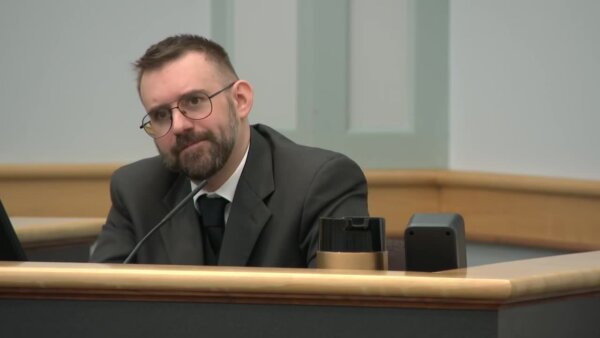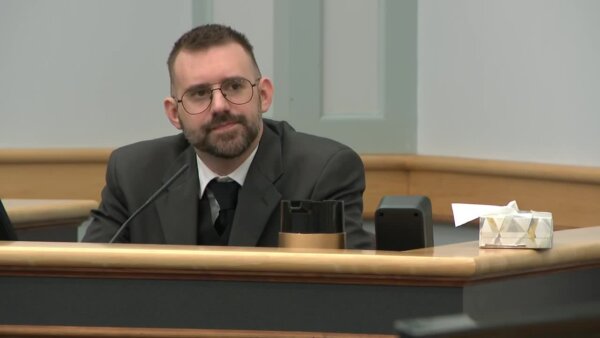

MANCHESTER, N.H. (Court TV) — A New Hampshire Marine veteran continued his testimony Monday, providing graphic details about the moments leading up to the fatal shooting of his children’s mother, describing his actions as muscle memory from his military training.
Dustin Duren, 38, returned to the witness stand to continue his testimony as he stands trial for the Feb. 29, 2024, shooting death of Caitlyn Naffziger, 31. Duren faces murder charges in Naffziger’s death and first took the stand on Friday.
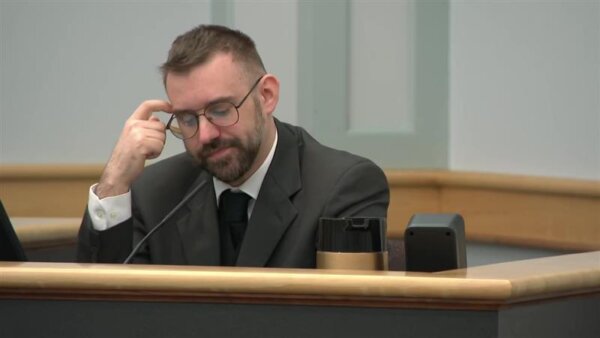
Dustin Duren testifies at his murder trial on Oct. 27, 2025. (Court TV)
On Monday, Duren testified that after returning from the library on Feb. 29, Naffziger began ignoring his questions about transportation plans while playing with their daughters. He said he became increasingly frustrated when she wouldn’t respond to his repeated inquiries about whether her Aunt Brenda was picking her up.
Duren told the court he didn’t know what was happening, comparing the situation to a previous incident when Naffziger took their daughter, Vaelyn, to Nevada without permission.
Duren testified that when he told Naffziger she needed to leave and attempted to put their daughters in the car, she grabbed 4-year-old Elowyn and refused to let go. He said Naffziger told him she wasn’t leaving and pulled Elowyn away when he tried to retrieve his daughter.
MORE | NH v. Dustin Duren: Amber Alert Murder Trial
According to Duren’s testimony, Naffziger then began making financial demands and threatening that he would never see his children again if he didn’t comply. He said she was holding Elowyn hostage with one arm around the child’s chest.
Duren described his mental state using what he called the Marine Corps color code system, explaining that he went from his normal yellow alert status to orange when he perceived a potential threat, and finally to red when he believed there was immediate danger to his daughter.
Duren testified that his response was like muscle memory from his military training, saying he didn’t have to think about what was happening because he was trained for such situations. He said the entire incident lasted no more than three to five seconds.
Duren said that he grabbed his gun from a desk next to the couch, chambered a round, pulled Elowyn forward to create distance between her and Naffziger, then fired. He said Elowyn was still in Naffziger’s arms when he shot, but Naffziger released the child immediately after. Duren then ran outside to his car with Elowyn.
After the shooting, Duren testified that he checked Elowyn for injuries, finding none except that she complained about the loud noise. He said he then gathered both daughters and essential items from the house before driving away. Duren told the court he realized he had shot Naffziger, someone important to him, rather than a random person, and felt horrible about what happened. He became emotional while testifying about not understanding how the situation had occurred.
Duren described driving through the night with his daughters, eventually stopping at a gas station in New York where they slept in the car. The next morning, he decided to return to New Hampshire and turn himself in to the police.
He was arrested at an Applebee’s parking lot in Keene after police spotted his vehicle. Duren testified that he immediately told officers about the loaded gun in his car door and that there were children in the vehicle.
MORE | Dustin Duren gets 45 years to life for girlfriend’s murder
During his police interview, approximately 15 hours after the shooting, Duren said he was clearly in shock and struggling with personal guilt. He testified that he wasn’t thinking about legal justification but rather about having killed Naffziger, the mother of his children, rather than a random person.
On Friday, Duren had testified about his military background, including deployments to Iraq and Afghanistan, and his subsequent diagnosis of service-connected PTSD. He described struggling with the condition after leaving the Marines and detailed escalating custody disputes with Naffziger.
The defense has argued that Duren acted in self-defense, claiming he believed Naffziger was attempting to kidnap their children. Prosecutors have portrayed the case as one involving anger and control, arguing that Duren deliberately shot Naffziger after she refused to leave his apartment.
Police found Naffziger’s body with a single gunshot wound to the head at Duren’s Berlin apartment. An Amber Alert was issued the following day for the couple’s two young daughters, who were found unharmed with Duren.
This story was reported by a journalist and has been converted to this platform with the assistance of AI. Our editorial team verifies all reporting on all platforms for fairness and accuracy.