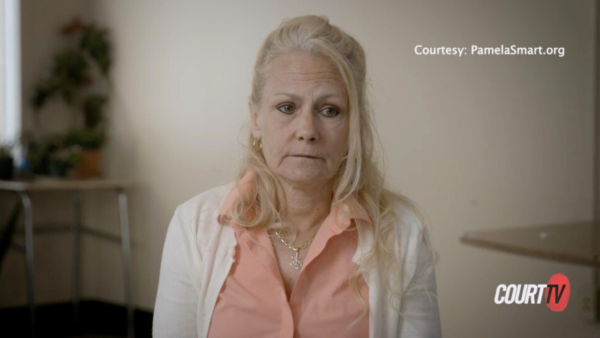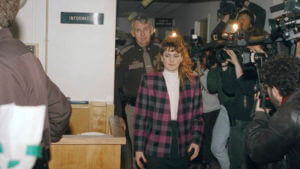

MERRIMACK, N.H. (Court TV) — Thirty-five years after she was convicted of conspiring with her teenage lover to kill her husband, Pamela Smart appeared in a New Hampshire courtroom in a bid for a new trial.
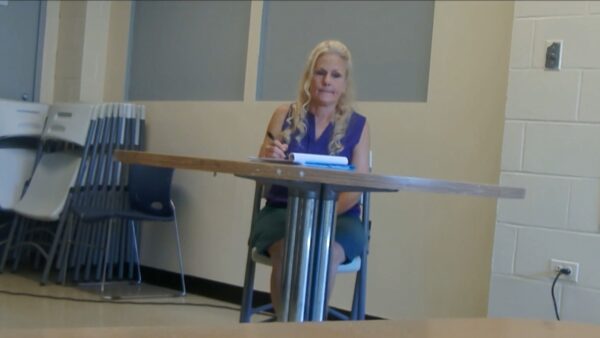
Pamela Smart appears virtually at a hearing on July 20, 2026. (Court WebEX)
Pamela Smart, 58, was sentenced to life without the possibility of parole after a jury found her guilty of witness tampering, conspiracy to commit murder and accomplice to first-degree murder in the death of her husband, Gregory Smart. Gregory Smart was shot to death in the couple’s home on May 1, 1990; his killer was a 15-year-old named William Flynn.
Court TV Archives | NH v. Pamela Smart
Pamela Smart, a director of media services for the school district where Flynn was a student, was 22 when she began having sexual contact with the teenager. Prosecutors said that she told Flynn that in order for them to continue their relationship, they would have to kill her husband. Flynn confessed to his role in the killing and said that he had worked alongside another teenager and Pamela Smart, who guided him to the house and told him to stage the scene like a burglary.
After the murder, Pamela Smart admitted her role in the killing to another student; that teenager went to the police and then surreptitiously recorded a conversation in which Pamela Smart further discussed her role in her husband’s death and the plan to make it appear like a burglary.
Pamela Smart has appealed her conviction multiple times — each time, the trial court and New Hampshire Supreme Court have denied her petitions. Her latest bid is focused on challenging her trial through the civil courts, where she filed a petition for a writ of habeas corpus both in New York and New Hampshire.
The Troubling Transcript
Pamela Smart’s latest legal move focuses on a transcript given to jurors when they listened to the recordings of the conversation in which she allegedly confessed. The defendant’s appellate team has argued that the transcript was rife with errors and did not accurately reflect the conversation that took place.
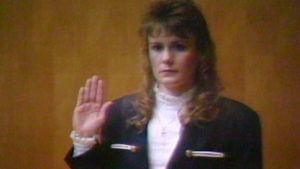
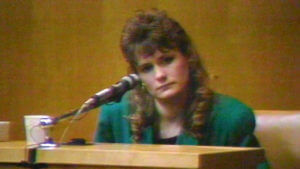
In this image from video, Pamela Smart testifies in her own defense during her 1991 murder trial. Smart’s trial was the first-ever televised murder trial in the country. (Court TV)
Pamela Smart’s team dismissed the transcript as being prepared by a “journalist” and unverified; her lawyers have argued that the recordings are difficult to hear because of distorted audio and that the written transcript inappropriately guided the jurors to see things from the state’s point of view. “These transcripts deceptively directed the jury to hear Ms. Smart making inculpatory statements not actually present in the audio,” her team wrote in their filing. To that end, Pamela Smart’s attorneys referenced a 191-person study that they said determined that without the transcripts, people heard the audio differently.
MORE | Court blocks killer wife Pamela Smart’s attempt at new trial
Attorneys representing the state of New Hampshire argued at a hearing on Monday that any reference to the study should be ignored. “All we have are allegations about the study,” attorney John Brennan argued. Brennan said that his office didn’t know “if it will be published — don’t know where and don’t know when — if it’s in the school newspaper, or a respected scientific journal.” Brennan also argued that the issue is moot because jurors were instructed not to consider the transcripts as evidence, only an “interpretation of evidence,” and that they should only consider what they heard themselves.
The ‘Bathtub Recordings’
Pamela Smart’s attorneys say those transcripts had a profound impact on the way jurors thought about the case, and said they can prove it through what they called “bathtub recordings.”
During Pamela Smart’s trial, one of the jurors started recording her impressions of the evidence and what it meant to her on a series of tapes recorded in her bathroom. The juror, wanting to comply with the judge’s order not to speak about the case to anyone, used the recordings to process and reflect on the testimony she had heard each day without violating the order. Those recordings allegedly reveal the juror saying that “not in this world could [Pamela Smart] have been convicted, if it wasn’t for the tapes,” and also saying the jurors “wouldn’t understand the tapes if it wasn’t for the transcripts,” Pamela Smart’s attorney, Matthew Zerhelt, said in court.
Unfair Sentencing
Pamela Smart’s attorneys are also challenging her sentence, saying that the judge at her trial improperly said that the court was statutorily mandated to impose a sentence of life without the possibility of parole on the charge of accomplice to first-degree murder. Her attorneys argued that because she was never charged with first-degree murder — only accomplice to the crime and conspiracy in planning it — she should not face the same mandatory sentence she would have faced had they charged her with first-degree murder.
“It’s not a matter of how a state charges the crime,” Brennan said, explaining that the mandatory sentence applies to the crime, whether a defendant is a principal actor or an accessory. “It’s just the legal fact in New Hampshire law.”
Jurisdiction
The court is separately considering the issue of jurisdiction in the case. Because this is a civil case challenging her detention, there is a legal argument that Pamela Smart can only challenge her detention in New York state, where she is imprisoned at the Bedford Hills Correctional Facility. Because she is held there as part of a pact with New Hampshire — and the underlying sentence that sent her there is from New Hampshire — her attorneys are arguing the case in both states. New York has previously said that it is not eligible to respond to the habeas petition because the defendant is being held under orders from a different state.
Judge James Kennedy took the arguments under advisement and said he would issue a ruling in the next two months.