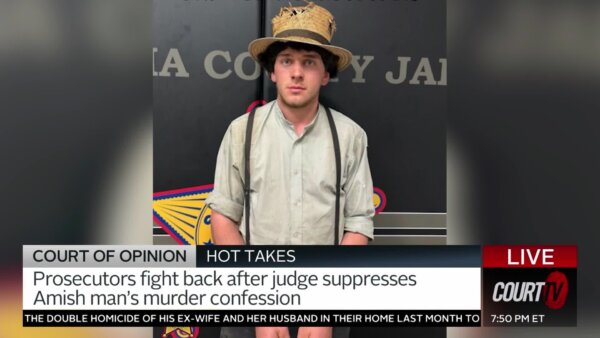
POMEROY, Ohio (Court TV) — Prosecutors are urging an Ohio judge to reconsider her ruling suppressing incriminating statements made by an Amish man about a murder he’s now charged with.

Samuel Hochstetler is led into court for a hearing on May 13, 2025. (Court TV)
Samuel Hochstetler is charged with aggravated murder, rape and kidnapping in the death of Rosanna Kinsinger, who was found dead in her trailer home in March 2025.
In a written decision following a hearing in the fall, Judge Linda R. Warner ruled that statements Hochstetler made to detectives with the Meigs County Sheriff’s Office would be inadmissible at his trial because the defendant didn’t understand his rights.
Hochstetler was taken to the sheriff’s office on May 5, 2025, by deputies who were talking to him both during and after the transport about Kinsinger’s death, his relationship with the victim and his thoughts on what had happened. While Judge Warner ruled that the circumstances did not amount to a custodial interrogation, she said that when the officers decided to read Hochstetler his Miranda rights, they failed to ensure he understood what was going on.
Hochstetler was raised in an Amish community in Kentucky before moving to the Amish community in Meigs County. “In our Amish community, the Amish typically do not watch television, read secular or English materials, have dealings with government officials, the criminal justice system or attorneys/lawyers,” Judge Warner wrote. “This puts this Defendant in a somewhat different position than an average ‘English’ suspect.”
MORE | Amish man to stand trial on charges he killed woman during sex
Hochstetler’s primary language is Pennsylvania Dutch; while Judge Warner found the defendant proficient in English, she said he failed to grasp concepts such as “court of law” and “attorney,” which are critical to understanding Miranda rights. Rather, the officers tried to explain the concepts by telling Hochstetler that the right to have an attorney was akin to “having the church Bishop go forward with him in front of the church and God and to ask for and anticipate receiving forgiveness.” Thus, Judge Warner said, “The defendant’s testimony that he believed confession would lead to judicial forgiveness suggests he fundamentally misunderstood that his statements would be used against him in an adversarial proceeding.”
In a motion urging the judge to reconsider, prosecutor James Stanley argued that because the Court found that Hochstetler was not in custody at the time of the interview, reading the Miranda warnings was unnecessary — Miranda rights apply when a defendant is in police custody.
Hochstetler’s attorney, Kirk McVay, argued in a response to the prosecution’s request to reconsider that, regardless of whether or not the defendant was in custody, he had a right to remain silent and to the assistance of counsel that he did not understand.
A hearing is scheduled for Jan. 26 for prosecutors to argue for the statements to be allowed back in.