
BOZEMAN, Mont. (Court TV) — A Montana man has been found not guilty on charges he killed his neighbor in a shooting that began with a misunderstanding.
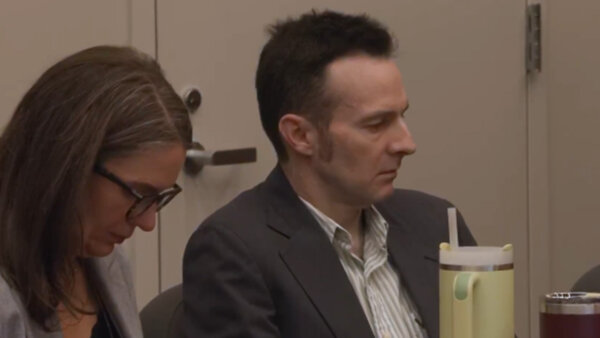
Jordan Palmer appears in court Thursday, July 30, 2025. (Court TV)
Jordan Palmer was acquitted of a single charge of deliberate homicide.
In charging documents reviewed by MTN News, Palmer told Belgrade Police officers that he shot and killed his neighbor after Stephen Campbell attacked him on April 19, 2024. When police arrived, they found Palmer standing over Campbell’s body with a gun in his hand; Palmer allegedly told the officers, “This guy attacked me, I (expletive) shot him.”
Investigators say Palmer had found a piece of mail on the road and was going to the associated address to place it in the correct mailbox when Campbell confronted him and accused him of breaking into vehicles, KULR reported. Palmer denied the accusation and told detectives he opened fire when Campbell threatened him and started trying to hit him.
TRIAL HIGHLIGHTS
DAY 7 – 8/7/25
- Chief Deputy County Attorney Shannon Foley delivered the State’s closing argument.
- Reminded jurors of the emotional testimony from officers regarding finding Campbell alive and attempts to save him.
- Spoke about the chaotic scene when Campbell was found on the ground with a chest wound.
- Reminded jury that video footage weas degraded, highlighting the absence of a clear argument in that footage.
- Grace Brosofsky, Montana Office of the Public Defender, delivered the defense closing argument.
- Argued Palmer acted in self-defense.
Argued Palmer perceived a threat from Campbell, who displayed aggression while intoxicated.
Emphasized Campbell’s emotional state, which she described as upset and unpredictable.
Argued Palmer acted swiftly in a moment of perceived danger and called 911 immediately after.
Stated that the State botched the investigation as well as the evidence preservation processes.
Described Legal Justification for Use of Force: Argument hinged on Montana’s self-defense laws, therefore Palmer’s response was reasonable given the circumstances.
- Argued Palmer acted in self-defense.
- Chief Deputy County Attorney Shannon Foley delivered the State’s Rebuttal.
- Reiterated the lack of justification for Palmer’s use of deadly force, even if he felt threatened; emphasized public policy against gun violence.
Acknowledged shortcomings in the investigation but maintained that they do not constitute justifiable homicide.
- Reiterated the lack of justification for Palmer’s use of deadly force, even if he felt threatened; emphasized public policy against gun violence.
- After a brief deliberation of just under 2.5 hours, the jury unanimously rendered a NOT GUILTY verdict of “Not Guilty” for Palmer on the charge of deliberate homicide of Stephen Campbell.
DAY 6 – 8/6/25
- Lewis Von Kliem, a use-of-force consultant, discussed threat assessment using a framework evaluating opportunity and ability to carry out a threat.
- Explained the relevance of barriers and distance in assessing threats, presenting findings from the 21-foot principle study.
- Stated that, based on his review, the distance between the parties appeared to be within a threatening range.
- Highlighted that low-light conditions disadvantage threat assessments and that clearing hands can indicate imminent aggression.
- Noted that verbal threats, such as expressing intentions to physically harm someone, are significant indicators of potential aggression.
- Affirmed that de-escalation training is essential but requires the other party’s willingness to de-escalate.
- Discussed discretionary time during a confrontation and indicated Mr. Palmer had some discretionary time initially but lost it as Mr. Campbell approached aggressively.
- Confirmed that Mr. Palmer attempted de-escalation in his interaction with Mr. Campbell.
- Stressed that when a threat becomes imminent, individuals have trained responses to counter the threat.
- Indicated that reasonable belief in a threat is essential in assessing use-of-force incidents and that the law does not require perfection in decision-making.
- Addressed the fact that shots fired in an incident cannot be evaluated in isolation, as they represent a response to an ongoing threat.
- Explained that the context of continuous threats affects decision-making during a confrontational encounter.
- Concluded that Mr. Palmer’s reactions aligned with reasonable use of force under the circumstances as observed in the video footage.
- Athena Del Valle, the ex-wife of Mr. Palmer, described her relationship with him and his positive attributes, including financial support and parenting.
- Recalled Mr. Palmer’s kindness and calm demeanor, especially in challenging situations.
- Highlighted Mr. Palmer’s involvement with their son, who has Asperger’s, stressing his nurturing nature despite his smaller stature.
- Testified that Mr. Palmer was not very athletic and focused on providing for his family.
- Clarified that she had no direct knowledge of the events leading to the incident and mentioned the last time she spoke with him.
- Affirmed her observations about his character, particularly his calm temperament, reinforcing his ability to remain composed.
DAY 5 – 8/5/25
- The State rested its case-in-chief Tuesday afternoon after eliciting protracted testimony from firearm examiner Lynette Lancon and chief state medical examiner Walter Kemp, MD, Ph.D. Direct examination of the medical examiner featured a detailing of each gunshot wound sustained by Stephen Campbell and Dr. Kemp’s wound path trajectory opinions regarding the same.
- Lynette Lancon (Montana State Crime Lab Firearm and Toolmark Examiner) examined a Glock Model 19 Gen4 9mm Luger pistol associated with the case
- Identified serial number BFSV482 on the firearm.
- Explained the functioning of safeties on the firearm.
- Provided reasons for conducting microscopic comparisons and general information about semi-automatic firearms.
- Found no modifications on the firearm; it functioned as designed by the manufacturer.
- Received cartridge casings and bullets collected at autopsy but reported no findings initially.
- Arranged cartridge casings and bullets on an ELMO for jury visibility.
- Identified fired bullet 10.1 and another fired bullet 10.2.
- Concluded that the fired cartridge cases were identified as having been fired by the submitted firearm, but the bullets were inconclusive.
- On cross, confirmed she was not provided with gunshot residue (GSR) evidence but could conduct GSR tests normally.
- Clarified that while casings were consistent, she could not conclude that the bullets were fired from the Glock pistol received for testing.
- Noted the impact of clothing color and condition on GSR testing.
- Dr. Walter Kemp (Chief Medical Examiner for the State of Montana) conducted autopsy on Stephen Campbell, noting seven gunshot wounds (GSWs) on the body.
- Described the path and impact of each GSW using photographs.
- Established the cause of death as multiple gunshot wounds, concluding it was a homicide.
- Discussed characteristics of entrance and exit wounds, including a graze wound.
- Explored the trajectory and potential complexities of the bullets recovered from the body.
- Emphasized that the video evidence did not alter his conclusions regarding the wound paths.
- On cross, clarified that cause and manner of death are not legal determinations of murder or manslaughter.
- Discussed the nature of stippling and its implications regarding GSR based on clothing analysis.
- Negated the possibility of determining what was said or whether Mr. Campbell was holding a knife solely from an autopsy.
- Acknowledged that a fist could potentially cause death but noted that beating deaths are less common than gunshot fatalities.
- After 18th District Court Judge John C. Brown denied a defense motion for judgment of acquittal, the trial formally turned to the defense case-in-chief, although the Gallatin County jury had already seen a substantial amount of the defense case by that point due to certain witnesses being called out of order by agreement during the state’s case.
- Lewis Von Kliem, a use-of-force consultant with a background in military and law enforcement, provided testimony focused on the human element of force encounters and the importance of context in evaluating use-of-force claims.
- He emphasized the necessity of investigating the totality of circumstances surrounding a use-of-force incident rather than just whether shots were fired, asserting that autopsy photos alone cannot determine self-defense.
- Von Kliem discussed the implications of aggressive statements, such as threats of violence, suggesting that such words indicate a belief in the ability to inflict harm, thereby affecting perceptions of threat.
- He affirmed that a fist could indeed be a means of inflicting death or serious bodily injury and highlighted the vulnerabilities an individual faces if they get knocked out during a physical confrontation.
- The witness indicated that it is unreasonable to wait for a physical attack to commence before responding defensively, underscoring the importance of acting based on perceived threats and the potential presence of weapons in dangerous situations.
DAY 4 – 8/4/25
- Outside of the jury’s presence, Palmer’s defense pointed out discovery issues as they asked for a mistrial. The state plans to have a formal response to the motion to dismiss before it rests its case-in-chief.
- Belgrade Police Officer John Hughes testified about his response to the deadly altercation, saying he saw Campbell lying on his back, unresponsive, and Palmer face-down on the concrete, maybe six feet away.
- The jury saw Officer Hughes’ body-worn camera footage, which showed his interactions with Palmer on the scene.
- Video from inside a cruiser showed Palmer in the backseat after he was detained at the scene.
- Belgrade Police Officer Bryan Phipps testified to FARO scans of the crime scene that were done, which provide 360-degree photos of the scene.
- Marissa Herron, Campbell’s longtime friend and brief romantic partner, testified to their relationship, which had just been placed on “pause” prior to the deadly altercation.
- Herron said she wanted to pause the relationship, while Campbell wanted to continue. She interpreted his feelings as being stronger than hers.
- Herron said that Campbell would frequently flick cigarettes while smoking, which he was seen doing on video while speaking with Palmer.
- On the evening of the incident, Herron was working but said that Campbell had sent her a number of texts, and described his tone as “escalated.”
- WATCH: Friend Won’t Share Last Texts With Stephen Campbell Moments Before Death
- Gallatin County deputy coroner Brian Monro testified that Campbell’s cause of death was multiple gunshot wounds; his manner of death was homicide.
- Toxicologist Andrew Wade, a defense witness, was called out of order due to scheduling issues.
- Wade testified that Campbell’s blood alcohol level was .301 at the time it was drawn at the hospital. Also found in the victim’s blood were metabolites of clonazepam, generic Cymbalta and ketamine.
- WATCH: Toxicologist: Victim Stephen Campbell’s BAC Was .301, Had Drugs In System
DAY 3 – 8/1/25
- WATCH: Returned Mail Murder Trial: Day 3 Recap
- Before testimony began, jurors were questioned off camera about claims they made about feeling “intimidated” by alleged victim Stephen Campbell’s family.
- Judge Brown considered the defense’s motion for a mistrial based on allegations of “egregious misconduct” on the state’s part for “losing control” of alleged victim Stephen Campbell’s family.
- Judge Brown denied Palmer’s motion for a mistrial based on the jurors’ representations that they could be fair despite concerns some (not all) expressed about being around Stephen Campbell’s family.
- The judge set the following remedies:
- The jurors will park in a different lot from the families and deputies will escort them to the courthouse.
- Family members with “justice for Stephen” decals on their cars will park where prosecutors park.
- The prohibition on wearing “justice for Stephen” shirts in the courtroom stands.
- The victim advocate will convey to the family that they cannot react to testimony in the courtroom.
- Defense forensic video analyst Michael Albin offered dense technical testimony about problems with the home surveillance video that the defense argued make it unreliable.
- Gave a slideshow presentation that included animations and freeze-frames of the shooting. This matters because police and prosecutors cited the video in charging documents as evidence that contradicts Palmer’s self-defense claim, leading them to charge him with deliberate homicide (Montana’s version of murder).
- Testified that police did not properly acquire video evidence.
- Explained why it’s important to play video natively in order to see what the camera recorded, not a compressed version of it.
- Said you can NOT tell from the video where there was movement.
- Said you can NOT look at the video and determine whether or not Campbell swung at Palmer.
- Time between the first trigger pull and the last trigger pull was 1.467 seconds, said this speed IS consistent with an elevated stress level.
- Det. Sgt Benjamin Martin became emotional recalling the “death notification” process with Campbell’s family.
- Photographed bullet holes in neighbor’s home but the pictures they got lost in an evidence software data migration.
- Defended his team and his decisions as THEIR supervisor, saying he did the best he could with the resources he had.
- Just learned last week that Campbell had a knife in his pocket and was not unarmed, an assumption that factored into his charging decision and undermined Palmer’s self-defense claim for him.
- Spoke to Campbell’s girlfriend about them fighting that day but chose not to ask to see her phone or text data because he didn’t think they would be relevant.
DAY 2 – 7/31/25
- Members of the jury told a court representative they are “intimidated” by alleged victim Stephen Campbell’s family, making the judge worry that they can no longer be fair, raising the possibility of a mistrial.
- Both sides agreed to the judge’s proposal to question each juror on Friday morning individually. Each juror will be excused after questioning and told to return at 1:30 p.m. MT/3:30 p.m. ET to prevent them from discussing the case.
- The issue came up after a break today when the jury asked if they could park in a secure parking area. The judge said they had “seen the T-shirts,” referring to “justice for Stephen” shirts the family has worn to court, and “they are uncomfortable parking in front with Mr. Campbell’s family.”
- Belgrade Det. Juan Cervantes recalled that the defendant made a profanity-laden 911 call reporting an attack by Stephen Campbell, claiming Campbell threatened him and then swung at him.
- Initially, the defendant declined to assist Campbell, but later agreed to perform chest compressions after the dispatcher insisted.
- The defendant described Campbell as aggressive in a phone call with his mother from jail, stating, “I wasn’t thinking.”
- Key evidence included:
- A knife found in the victim’s pocket was not taken into evidence as it was closed and deemed not relevant.
- A cigarette butt belonging to Campbell was noted as important to his movements during the incident.
- Bullet holes in Campbell’s shirt were mentioned as relevant for future arguments regarding the shooting’s circumstances.
- Cross-examination highlighted the inadequacies in the Belgrade PD’s investigation, emphasizing Cervantes’ inexperience with homicide cases.
- Cervantes admitted to not reviewing critical evidence, such as the 911 call or Campbell’s clothing, before charging the defendant with deliberate homicide.
- James Shults, Neighbor with Surveillance Camera
- Shults checked his surveillance footage after receiving numerous inquiries about an incident on his street.
- He noticed activity around 12:45 AM, prompting him to review the footage again after hearing gunshots.
- After confirming the footage contained relevant information, Shults contacted the police and provided them with the footage on a USB stick.
- Laureem Mashek, Neighbor/911 Caller
- Mashek discovered what she thought was someone passed out and emotionally called 911 after hearing gunshots.
- She initially mistook the gunshots for someone knocking at her door and described not being able to sleep that night.
- During her 911 call, she reported seeing a person lying in the street and informed dispatch of the situation while ensuring the police were on their way.
- WATCH: Returned Mail Murder Trial: Day 2 Recap
DAY 1 – 7/30/25
- Both sides delivered opening statements, offering conflicting views of what the evidence would say about Jordan Palmer’s self-defense claim.
- Gallatin Deputy Attorney Shannon Foley said no evidence supports Palmer’s claim that alleged victim Stephen Campbell swung at him first. Of Campbell’s high blood alcohol content of .3, Foley said Campbell didn’t deserve to be shot seven times for being intoxicated.
- Public Defender Brigette Carneal said Palmer was a “calm and peaceful” person who had no reason to shoot a man who had not threatened or attacked him first. What little can be gleaned from the low-quality video shows Campbell aggressively confronting Palmer, Carneal said. She said the location of Campbell’s gunshot wounds supported Palmer’s claim that Campbell was “moving forward and swinging” at Palmer before Palmer opened fire.
- Carneal slammed police for not getting raw, high-resolution footage of the encounter from home security provider Vivint — which could have potentially shown more – and for not preserving as evidence the knife that was in Campbell’s pocket, among other allegations of “mistakes” in the investigation.
- One of the first responding Belgrade Police officers, Jacob Aiken (who was on the job for a year when this happened), teared up on the witness stand recalling his efforts to render aid to Stephen Campbell.
- On cross, Aiken said Palmer was compliant, respectful, responded to Aiken’s commands and admitted to shooting Campbell, saying Campbell had “attacked” him.
- The jury saw footage from Aiken’s dash camera and body worn camera. In the latter, Aiken is hearing exclaiming “holy s***” as he exits his vehicle and comes upon Campbell’s body. Palmer is seen on the video with his hands up and dropping to the ground in response to Aiken’s commands, asking him, “is this OK, sir?”
- Det. Juan Cervantes introduced photos of the scene, including photos of a knife in Campbell’s jeans pocket.
- WATCH: Returned Mail Murder Trial: Day 1 Recap