
|
MILWAUKEE (Court TV)
He butchered his victims in
secret for more than three years,
turning his apartment into a
grisly slaughterhouse filled
with human heads and stripped
flesh. He even took photographs
of their corpses so he could
later look back and relive the
experience of murder.
He found teenagers and young
men at bus stops, bars and the
streets. He lured them to his
apartment by promising drinks,
pornographic videos and even
money to some in exchange for
sex.
Once inside his apartment,
he would slip a potent sedative
into their drinks, strangle
them and then dismember their
bodies with an electric saw.
On occasion, he ate some of
their flesh.
But the secret and bizarre
world of this serial killer
would eventually be revealed. On July
22, 1991, two Milwaukee police
officers talked to a man named
Tracy Edwards. There was something
odd about him. Handcuffs were
dangling from one of his wrists.
Edwards told police a strange
tale of a man who held him hostage
and threatened him with a knife.
The man's name was Jeffrey
Dahmer.
The Grisly Discovery
Edwards led the two officers
to Dahmer's one-bedroom apartment
at 924 North 25th Street.
They were met by Dahmer, 31,
who answered the door, and an
overwhelming stench. Edwards
instructed police to look in
the bedroom for a knife. When
an officer went inside the room,
he found photographs of human
remains. The other officer opened
the refrigerator and quickly
slammed the door shut when he
saw a human head inside.
Investigators found seven
skulls, four heads, body parts
and photos of naked and dismembered
victims inside the small apartment.
Human remains were found preserved
in formaldehyde, and heads had
been boiled. Dahmer told police
how he had poured acid over
flesh to dissolve remains. He
had kept strips of flesh in
his freezer for later consumption.
Dahmer was unmasked to the
world as one of America's most
notorious serial killers. He
gave police a 160-page confession
detailing how he lured, murdered
and then dismembered the remains
of his victims. He provided gruesome
details of a killing spree that
began in 1978 in Ohio and stretched
to Wisconsin by 1991.
"It's hard for me to believe
that a human being could have
done what I've done, but I know
that I did," Dahmer said in
his confession.
In all, Dahmer admitted to
killing 17 males.
But was he a manipulative
killer who planned each murder
in detail or simply a madman?
That was the issue facing
a Wisconsin jury, which had to decide whether Dahmer
would spend the rest of his
life in prison or be sent to
a mental hospital.
If Dahmer had been found insane
in connection with the murders
he committed before 1989, he
could have been eligible to
apply for release from a mental
hospital six months after confinement.
On the murders committed after
1989, Dahmer would have been up for
release within a year.
Making a Case for Insanity
Dahmer pleaded not guilty
to two counts of first-degree
murder and 13 counts of first-degree intentional homicide.
He was also charged with being
a habitual criminal due to
his previous conviction for
sexually assaulting a child.
During a pretrial hearing
in 1992, Dahmer disregarded
the advice of his defense lawyer,
Gerald Boyle, and changed his
plea to guilty on all 15 counts,
saying he was insane.
Under Wisconsin law, two trials
are held in insanity cases
one to determine guilt or innocence
and the other to determine whether
the defendant is insane.
Since Dahmer had already pleaded
guilty to the murder and homicide
counts, a jury only had to decide
whether he was insane.
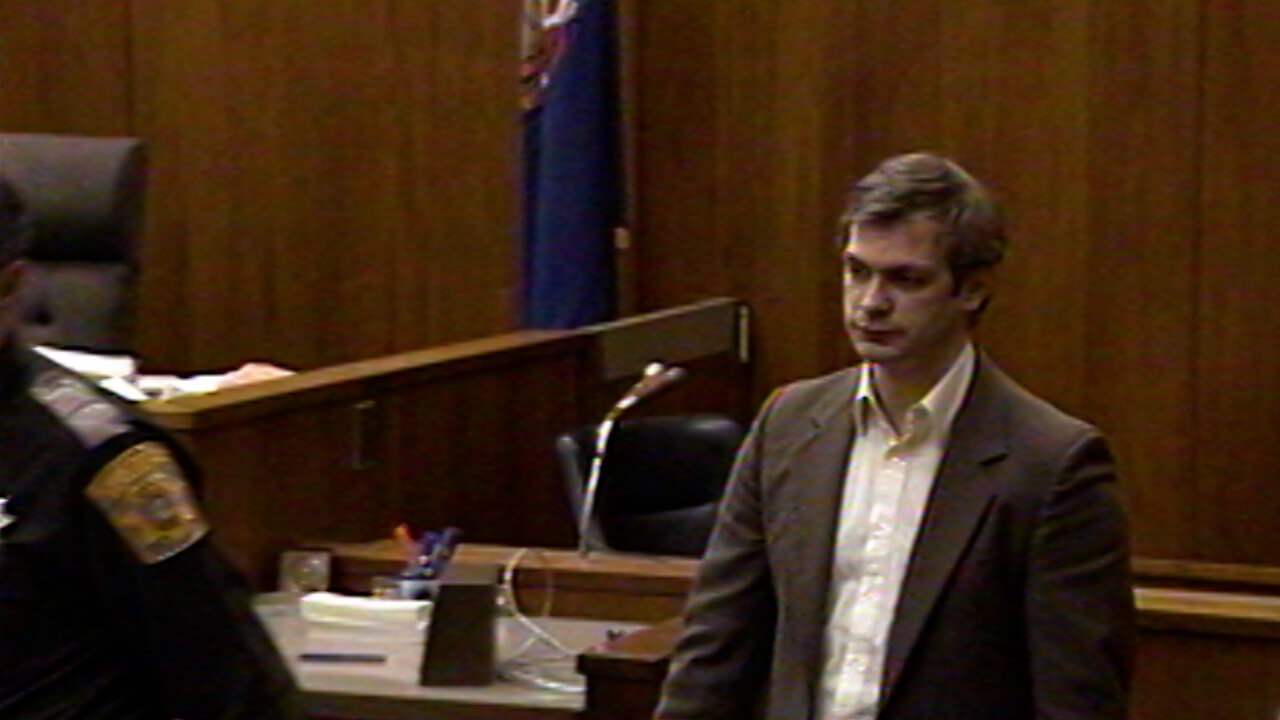
Boyle and District Attorney
Michael McCann were left to
duel in court over whether Dahmer
was insane, or knew exactly
what he was doing in committing
the gruesome murders.
The defense contended that the
gruesome nature of the crimes
proved that the murders were
the handiwork of a madman. Boyle
characterized his client as
a "runaway train on a track
of madness."
But prosecutors maintained that
Dahmer was a manipulator who
planned each murder.
Portrait of a Killer
Dahmer was born in Milwaukee
on May 21, 1960, later moving
with his parents to Iowa and
Ohio. When he was 18, his parents
divorced following a long, unhappy
marriage. Dahmer attended Ohio
State University for one semester
and later joined the army, leaving
in 1985 because of alcohol abuse.
He then moved to West Allis,
a suburb of Milwaukee, to live
with his grandmother. He was
fired from a job there at a
chocolate factory because of
excessive absenteeism.
Dahmer was known to lawmen
before his 1991 arrest. They had visited his apartment after one of his victims temporarily escaped. The incident occurred in May
1991. Dahmer had lured Konerak
Sinthasomphone, 14, who he had
met in front of a local mall,
to his apartment. Once inside,
Dahmer enticed him to pose for
several photographs and then
gave the youth a drink with
a "sleeping potion," the serial
killer later confessed.
After watching videos, Sinthasomphone
passed out. Dahmer later told
police that he had sex with
the child before going out to
buy more beer. As he returned
from the bar, Dahmer told police
that he saw Sinthasomphone staggering
down the street. He went up
to Sinthasomphone, but police
also arrived to investigate.
Dahmer told the police at
the time that the youth was
a "friend" and promised to take
him back to his apartment. Police
escorted Dahmer and Sinthasomphone
back to the apartment, but didn't
investigate further.
Dahmer strangled Sinthasomphone that night,
took photographs of his body,
dismembered him and kept
his skull as a memento.
Before that murder, Dahmer had already
been on five years' probation
for second-degree sexual assault
and enticement of a child for
immoral purposes. The victim
was Sinthasomphone's
13-year-old brother.
Murderer Murdered
The jury found that Dahmer
was sane. He was sentenced to
15 consecutive life terms in
prison or more than 950
years in prison.
But Dahmer never got the chance
to fulfill his sentence. While imprisoned
at Columbia Correctional Institute
in Portage, Wis., an inmate
working with Dahmer on a janitorial
detail bludgeoned him to death
on Nov. 28, 1994.
|