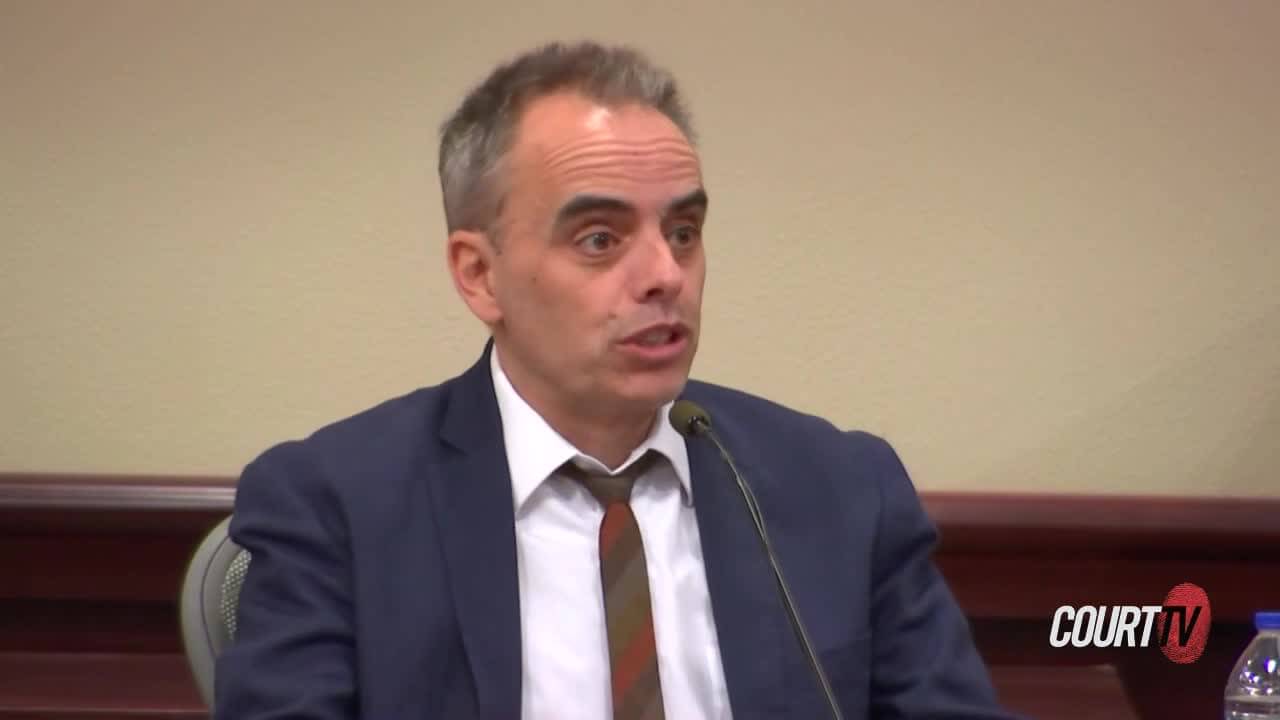
Dr. Henry Lee
  The forensic scientist on his new book, Famous Crimes Revisited
Feb. 2, 2001


Court TV Host: We're very pleased that we're going to be joined by Dr. Henry Lee, medical examiner, forensic scientist, perhaps one of the most well-known forensic scientists in the world. He's just written a book called "Famous Crimes Revisited." Dr. Lee testified during the just concluded trial of Rae Carruth, and has also worked on the O.J. Simpson, JonBenet Ramsey, and Waco cases. And by the way, after you talk to Dr. Lee online here, you can see him on Court TV, where he's going to be interviewed by Alan Dershowitz.

Court TV Host: Dr. Lee is here! Let's get started.

Dr. Henry Lee: Today I was at a computer crime conference, a group of computer crimes investigators gathering in New York City. I was one of the keynote speakers.

ctv_warhorse46 asks: What cases do you cover in your book?

goobersandraisonettes asks: What made you want to go back and look at these famous crimes?

Dr. Henry Lee: The book covers seven cases in total, from Sacco and Vanzetti, which happened in the 1920's to the Lindbergh baby kidnapping which happened in the 1930's, to the Sam Sheppard case which happened in 1954, the Kennedy assassination which happened in 1963, the Vincent Foster case which happened in 1993, the OJ Simpson case, which happened in 1994, and the JonBenet Ramsey case, which happened in 1996. Each case represents the era and the time period. Each of the cases are pretty well-known, not only in the US but all over the world. Each of the cases has been written about and debated, and many of the questions are unanswered. Five of the seven I was directly involved in part of; two cases I was indirectly involved in. And there are so many lessons that can be learned from those cases, from the crime scene, to the recognition of physical evidence, to the collection and preservation of evidence, and the laboratory examination of the evidence, through to the courtroom. We take a critical review of the evidence. The book really doesn't try to cover the minute details of the story because those details have been published, but what we tried to do was to go back and take a look at physical evidence at the crime scene. We're not trying to criticize or point a finger at anyone, or talk about who slept with somebody, or those little details.

shandy9 asks: I don't believe the public has heard all there is to hear about the JonBenet Ramsey case. Do you have an opinion about whether there will ever be an arrest there?

tweety34286 asks: Regarding the JonBenet Ramsey case, as we all know it wasn't investigated properly. Who do you believe could do this to a little girl?

Dr. Henry Lee: It's a good question. Because what's the public perception and the reality are a little apart. The public perception will come from reading the newspaper or watching talk shows. What happened with the JonBenet Ramsey case, what happened in the first six hours, is that the police treated it like a kidnapping case. The crime scene wasn't thoroughly searched. In six hours, things can be changed, physical evidence can be lost or contaminated. That created problems later for the investigators who investigated the case because the body wasn't discovered right away and, later, Mr. Ramsey found the body himself and carried the body from the basement to the upstairs living room. So we generally try to look at the scene and say whether it's an outdoor or indoor scene, and we also want to know whether it's a primary scene or a secondary scene. Primary, meaning that the crime was committed in that particular location. If we can find out where the primary location is, then you can recover more evidence. So in this case, because of the initial six hours lost, investigators subsequently developed some difficulty in looking at the original location. Also, the body was carried by the victim's father, so there was this cross-contamination of trace evidence, which created problems later on. And there were other friends and relatives visiting the scene during those six hours.

Dr. Henry Lee: There are many theories about the suspect of the case. It boils down to two major groups, either a family member or an unknown intruder. I would say that we should keep our minds completely open, let the evidence speak for itself. We cannot come up with a tunnel vision or a hypothesis and then use the evidence to build a case. We should let the evidence itself make the case. Some of this evidence is still being investigated by the Colorado Bureau of Investigations lab and the FBI lab and the Boulder police department.

Court TV Host: You say in the book that the Ramseys' behavior was reportedly suspicious. Can you elaborate? Have people considered whether the Ramseys' son could have done it?

Dr. Henry Lee: As I indicated to you, as scientists we are really not looking at human behavior. There are forensic psychologists who specialize in human behavior. I did not talk to the Ramseys or any other witnesses. I am not in a position to comment on that. I did talk to district attorney Alex Hunter and also the investigator in the Boulder police department. We've had numerous discussions about the case, but as for human behavior, you have to talk to people directly.

why_not_why_not9474 asks: What was it like to work on the "Dream Team" in O.J. Simpson's defense?

Dr. Henry Lee: I didn't know OJ Simpson directly before I worked on the case. I met Bob Shapiro before when he called me and asked me to look at the case. He called me and asked me to work for a very famous football player named OJ Simpson. And I said maybe he's not that famous, I never heard of him before. As for the Dream Team, all the lawyers, both the district attroneys and the defense team were all excellent attorneys. I have excellent relations with both district attorneys and defense attorneys. Sometimes they're under a lot of pressure because they all need instant answers. Sometimes scientists don't have the answer. Sometimes they need a black-and-white answer And sometimes scientists only find gray answers. That's the difference between law and science.

shandy9 asks: With the O.J. Simpson case, the blood on the gate supposedly had EDTA in it...other than from a tube, how would it have EDTA added?

Dr. Henry Lee: EDTA is a preservative, a so-called anti-coagulant, preventing coagulation. It's not going to appear in a human body. It's a chemical additive to a test tube. When you collect a sample, you add it in the test tube to prevent the blood from coagulating. Dr. Reider, one of the well-known toxicologist from Philadelphia, he read the FBI laboratory results, when he reviewed the result of the testing, found EDTA in some of the samples tested, including the very crucial sample found on the back gate, also from a sample found on the socks. If you find EDTA, it could mean that this blood is not found from human circulation, rather from a test tube. Therefore the source of the blood becomes questionable. That's how all the controversy started.

ctv_warhorse46 asks: What is your opinion on the Lindbergh case?

princesss1677 asks: Could you go over the Lindbergh kidnapping briefly...I've always been curious and am not sure of many of the details.

Dr. Henry Lee: The Lindbergh kidnapping happened in 1932. His only child disappeared from their home in New Jersey The baby's room was on the second floor. The investigator discovered a wooden ladder. That's the most crucial piece of physical evidence linked to Bruno Hauptmann, who was a carpenter. The investigator found some wood board in his attic matching the wood grain from the ladder. That's how the linkage of the physical evidence was used in the trial. Hauptmann was convicted and later executed. Many years later, people thought he was not the real suspect because one of the pieces of evidence used during the trial was a ransom note. A handwriting examiner matched that note with Bruno Hauptmann but several years ago handwriting experts reexamined the note, and the conclusion was that it was not written by Hauptmann. In our book, my co-author, Dr. Labriola and myself tried to present both sides of the story -- presenting evidence linking Hauptmann and also presented evidence exonerating Hauptman. The evidence from the other seven cases follow the same format, presenting both the positive and and negative evidence. So this way the reader can be the judge by reading the book, looking at the evidence and being their own judge.

shelbysmama2000 asks: Do you feel Rae Carruth was wrongly convicted based on your evidence that the car was moving?

Dr. Henry Lee: The Carruth case did not prove what the two prosecution witnesses described, that the car was boxed in. As scientists, we usually stay away from innocence or guilt. Our job is to present the facts to the jury and the courtroom. Scientists are not able to say who is innocent or who is guilty because we do not look at the whole picture. They do not give us all the whole picture.

rick77748110 asks: How will DNA evidence effect the future of the justice system?

Dr. Henry Lee: The future of DNA evidence will have tremendous effect on forensic investigation. DNA is primarily used in two areas. One is civil litigation, and the second is in criminal cases. In civil litigation, DNA can be used in paternity cases, and can positively identify the alleged father of the child. Second, DNA can be used for identification of human bodies in mass disasters or accidents such as airline crashes, or major fires, or earthquakes. It can be used for civil liability issues -- for example, who is the driver of in accident? The second major category, is criminal cases. We can link a suspect to a rape or homicide. Equally important, we can exonerate innocent people wrongly accused of a crime. We also have used DNA to identify homicide victims, or body parts to find out the identity of the person. Another powerful application is cases where we have no suspects. Many states have DNA data banks. Let's say a victim was raped and she cannot identify who is the attacker. Through DNA searches in the data bank, we can look at sex offender data banks.

angry_blonde_x asks: Which of the cases that you worked on, is your favorite?

Dr. Henry Lee: I have been assisting the law enforcement community around on about 6 to 7000 cases Each case, for the victim's family, that's the most important case to them. Each case to the defendant, that's the most important case to them. All those cases I've worked on, they all have an interesting twist. Of course, many people think the woodchipper case is the most interesting case because the body was never found. Other people suggest a case we solved in Louisiana. Basically, a whodunit case where the blood pattern shined the light to solve the case. Recently in Connecticut the state and local police working together through the crime scene analysis were able to solve a case of a triple murder in several hours.

heavensentwentz asks: What do you think of the Mark Chamura trial? ... Though there was no semen found in her vagina, is there any other DNA evidence which could be found in penis to vagina contact?

Dr. Henry Lee: Yes, in this particular case, no semen was found, which is indicative of no ejaculation taking place. That no semen was found is only proof of no ejaculation but cannot prove that there was no physical contact. However, if the young lady had received injuries that were due to the insertion, they should do a penile swab to check for her DNA, then you can prove whether or not there was physical contact or insertion. That would have had to have been done as soon as possible, or they can collect his undergarment, that he put on afterwards.

goobersandraisonettes asks: Where do you think forensic science will go in the next 20 years?

Dr. Henry Lee: The next twenty years is going to play an even more important role.

Court TV Host: Dr. Lee, they're telling me you have to run to go to be on TV, so thanks for being our guest today.

Dr. Henry Lee: Thank you

Court TV Host: Sorry folks, but Dr. Lee had to run because he's going to be on Court TV with Alan Dershowitz in just a few moments.


©2001 Courtroom Television Network LLC. All Rights Reserved.
Terms & Privacy Guidelines

Small Court TV Logo


advertisement